
The Legitimacy Framework
From Threat to Order
Peace is not the absence of conflict. It is the presence of justice.
Legitimacy is the condition that makes both possible.
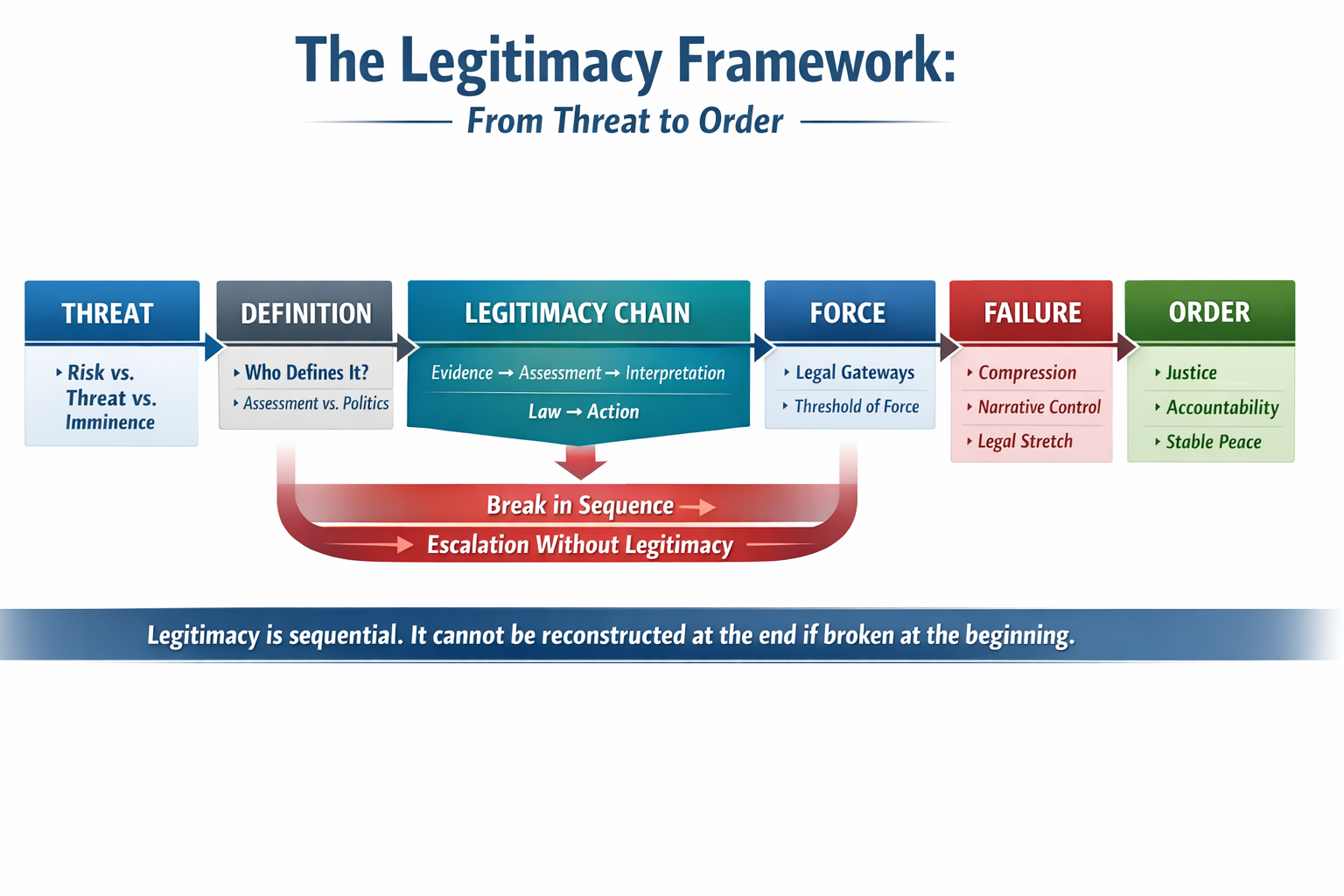
The Geneva Charter Legitimacy Framework explains how conflict legitimacy is formed, tested, broken, and rebuilt. It begins before force is used, at the level of threat definition and evidentiary discipline. It continues through the legal and institutional thresholds governing action. It then examines how legitimacy fails, how systems drift into narrative-driven escalation, how unstable peace can preserve the seeds of future conflict, and how stable order can only emerge where justice, accountability, and institutional trust are restored.
This framework is designed as a coherent sequence, not a set of isolated concepts. Each page builds on the previous one. Together they provide a structured method for examining how facts become judgments, how judgments become action, how action may break down, how broken systems can produce only the appearance of peace, and how durable order depends on legitimacy rather than narrative closure alone.
It is therefore not only a reading path. It is a disciplined analytical model. It moves from the concept of threat, to the authority that defines it, to the chain that protects legitimacy, to the threshold for force, to the mechanisms of breakdown, to the danger of peace without justice, and finally to the conditions under which stable order can be rebuilt. In Geneva Charter terms, these are not separate debates. They are one sequence.
Seven connected pages. One structured method for examining how legitimacy is formed, tested, broken, and rebuilt.
1. Foundation
What Is a Threat?
Distinguishing Risk, Hostility, and Imminence
Distinguishes concern, risk, hostility, threat, imminent threat, and armed attack. This page establishes the conceptual foundation for the whole framework and shows how threshold inflation begins. It clarifies the categories that are most frequently compressed in public debate and demonstrates why conceptual discipline is the first protection against illegitimate escalation.
Read What Is a Threat?2. Authority
Who Defines a Threat?
Intelligence, Power, and the Foundations of Legitimacy
Examines who has the authority to classify danger and how legitimacy begins to fail when political actors overtake independent assessment. It addresses the institutional boundary between evidence and power, and explains why the question of who defines reality is central to any lawful claim of urgency, necessity, or self-defence.
Read Who Defines a Threat?3. Method
The Legitimacy Chain
From Fact to Force
Presents the core Geneva Charter model from verified information to accountable action. This is the signature structural concept of the framework. It defines legitimacy as a sequence rather than a slogan and makes visible the chain by which fact, assessment, interpretation, law, and action must remain connected if order is to remain reviewable and defensible.
Read The Legitimacy Chain4. Action
When Is Force Legitimate?
From Threat Definition to Lawful Action
Applies the framework to the use of force under the UN Charter system, focusing on lawful threshold, necessity, proportionality, and the separation between evidence and action. It explains the narrow gateways for force, the dangers of threshold inflation, and the decisive moment at which disciplined analysis must either constrain action or give way to escalation without legitimacy.
Read When Is Force Legitimate?5. Diagnosis
Failure of Legitimacy
How Systems Break Down
Maps how systems break down through compression, politicisation, narrative dominance, and legal stretch. This is the diagnostic page of the framework. It shows how failure accumulates across evidence, assessment, interpretation, law, decision, and outcome, and why institutions often appear formally intact even after the substance of legitimacy has already been compromised.
Read Failure of Legitimacy6. Distortion
Peace Without Justice
The Seeds of Future Conflict
Examines how settlements that bypass justice, verification, and accountability create only the appearance of peace. These outcomes often stabilise violence temporarily while preserving the underlying conditions for future conflict. It shows how “peace” can become a structural delay of instability rather than its resolution.
Read Peace Without Justice7. Outcome
From Conflict to Stable Order
Peace Is Not the Absence of Conflict. It Is the Presence of Justice.
Shows how peace becomes durable only where justice, verified reality, accountability, and legitimate process are restored. This is the outcome page of the framework. It explains why a bad peace can preserve the conditions for future war, and why stable order depends not on silence alone, but on the restoration of legitimacy across institutions, law, and public trust.
Read From Conflict to Stable OrderWhy this framework matters
International systems do not fail only because rules are broken. They fail when thresholds are blurred, when evidence is displaced by narrative, when force outruns law, when failure is not diagnosed honestly, and when unstable peace is mistaken for restored order. The Legitimacy Framework brings these stages into one sequence so they can be examined together rather than in isolation.
In Geneva Charter terms, legitimacy is not a slogan and not a retrospective claim. It is a process condition. It must be built, preserved, tested, and, where broken, restored. This framework exists to make that sequence visible. It also exists to show that apparent peace can itself become part of the problem where truth, accountability, and structural justice remain absent.
The purpose of this parent page is therefore not simply to list seven articles. It is to provide an entry point into one structured doctrine. Readers may enter through threat, through force, through failure, through distorted peace, or through stable order, but the framework is strongest when read as a whole because each stage explains the limits, burdens, and consequences of the next.
Suggested reading path
Begin with What Is a Threat?, then continue to Who Defines a Threat?, The Legitimacy Chain, When Is Force Legitimate?, Failure of Legitimacy, Peace Without Justice, and From Conflict to Stable Order.
Durable peace is built from legitimacy, not from deception.
