
Charter Framework Components
The Coherence Requirement in the Use of Force
A framework component for assessing whether the use of force remains anchored in law, aligned with political purpose, and capable of producing a legitimate and stable outcome.
The Coherence Requirement
The coherence requirement provides a structured basis for assessing whether force is legally grounded, strategically coherent, and capable of producing an outcome other than escalation, fragmentation, or prolonged instability.
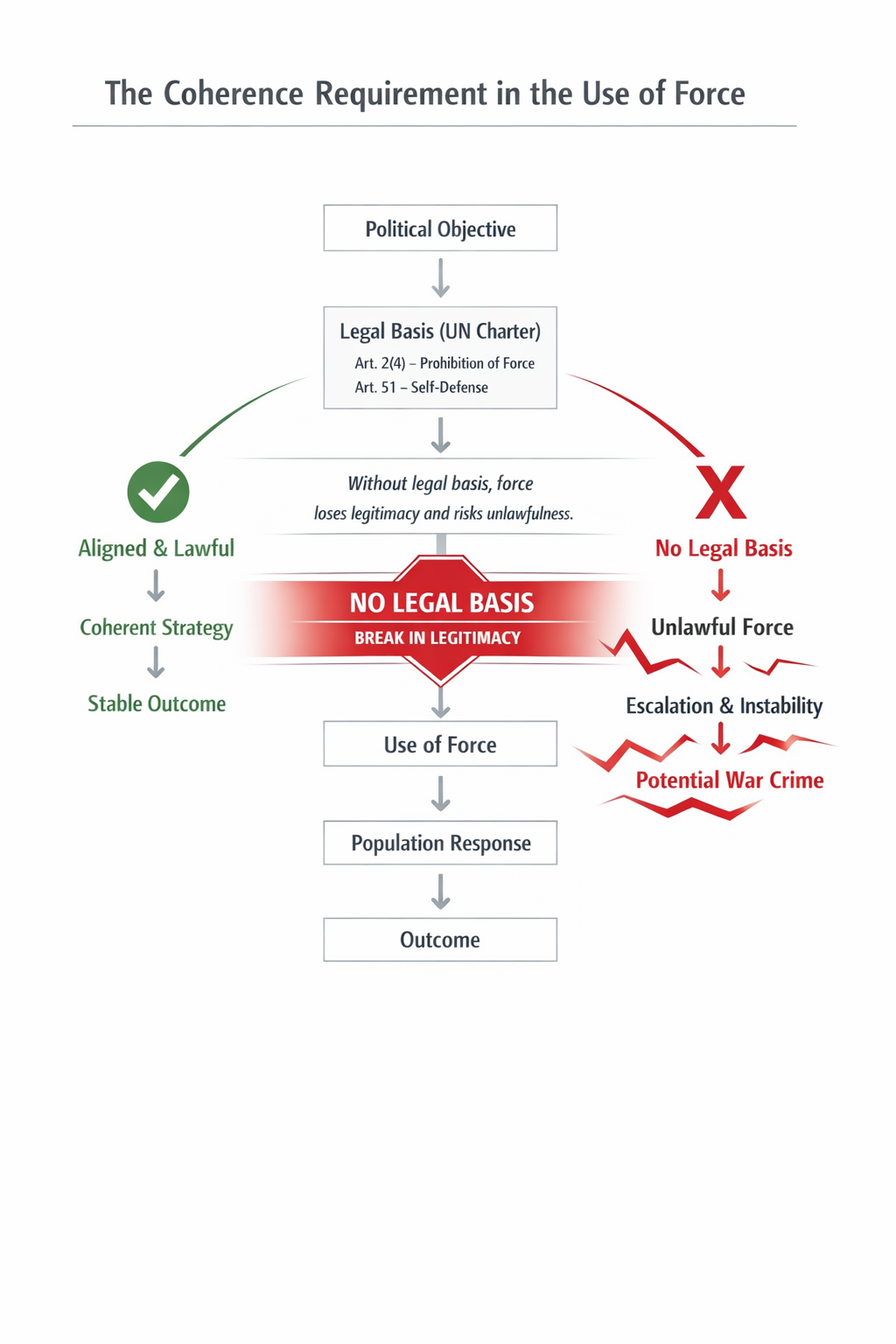
In practical terms, coherence is what connects political objective, legal basis, operational action, population response, and final outcome into a single intelligible chain. Once that chain breaks, force may continue, but legitimacy weakens, strategic clarity deteriorates, and exposure to unlawfulness sharply increases.
The legal breakpoint rests on the UN Charter prohibition on the use of force and the narrow exception of self-defence. Legal basis is not secondary to coherence. It is one of the conditions on which coherence stands or fails.
Why this page matters
The coherence requirement provides a structured basis for assessing the use of force beyond rhetoric, symbolism, or fragmented justification. It asks whether political objective, legal basis, operational means, population effects, and intended outcome remain aligned within a single intelligible framework. Where coherence cannot be demonstrated, legitimacy weakens. Where legal basis under the UN Charter is absent, the issue is no longer merely strategic or rhetorical. It becomes a matter of unlawfulness and possible war crime exposure.
The coherence requirement in practice
These cases are not presented as isolated events. Together, they show how the coherence requirement behaves across different conditions, from baseline interventions to systemic strain and active geopolitical fracture.
Click on a case to see how the coherence requirement applies in practice.
Foundational reference cases
Classic coherence breakdown reference points
These cases establish the baseline doctrine. They are widely recognized, heavily debated, and central to any serious discussion of legality, objective coherence, and long-term political outcome.
Use these to understand baseline arguments on legality, coherence, and outcome.
System stress and breakdown cases
Mandate strain, prolonged conflict, and population effects
These cases deepen the framework by showing how legal ambiguity, expanding aims, and severe population-level consequences place mounting strain on claims of coherent and legitimate force.
These cases show how coherence weakens under expanding aims and prolonged conflict.
Active systemic pressure cases
Current order under direct pressure
These pages show the framework operating against live system fracture, including great-power confrontation, coercive pressure, alliance strain, and the erosion of legal restraint in the present international order.
These cases reflect the framework under live geopolitical pressure and escalation risk.
How to use these cases
Each case applies the same analytical structure: context, legal basis, claimed objective, operational reality, population effects, coherence assessment, and outcome.
This consistency allows comparison across cases and reveals patterns that are harder to see when events are treated in isolation.
1. Core Principle
War cannot be conducted as an expression of impulse, spectacle, narrative improvisation, or fragmented justification. The use of force requires a clearly defined political objective, a valid legal basis, a coherent account of means and ends, and an identifiable path from action to outcome.
Without coherence, force becomes self-defeating. It may still be applied, but it will no longer function as a lawful and intelligible instrument of policy. Instead, it risks becoming a generator of escalation, uncertainty, and structural illegitimacy.
2. Functional Role in the System
Coherence is the mechanism that connects law to legitimacy, strategy to outcome, and force to political purpose. It is what prevents military action from collapsing into isolated tactics, symbolic demonstrations, or reaction-driven escalation.
Where coherence is present, action can be assessed, constrained, justified, and judged against outcome. Where coherence is absent, the system loses intelligibility. Legal claims weaken, strategic direction fragments, and the ability to define success deteriorates.
3. System Positioning
Coherence sits at the point where political intent, legal constraint, operational action, and social consequence must align. This is not a rhetorical matter. It is a systems requirement.
Input
Political Objective
Constraint
International Law
Mechanism
Use of Force
Output
Political Outcome
Coherence is the alignment across all four. If the objective is unclear, if the legal basis is absent or retrofitted, if force operates independently of strategy, or if population response is ignored, the chain no longer holds.
4. The Coherence Failure Pattern
A coherence failure occurs when the system cannot maintain alignment between objective, legal basis, operational means, and desired outcome. In practice, this often appears as multiple contradictory justifications, shifting war aims, unclear legal authority, or public messaging that conflicts with operational reality.
Typical indicators
- Changing war aims
- Undefined or unstable end-state
- Conflicting public justifications
- Retrofitted claims of legality
- Tactical action replacing strategic direction
System effects
- Legitimacy erosion
- Strategic drift
- Reduced predictability
- Escalation without resolution
- Heightened exposure to unlawfulness
5. The Spectacle Substitution Problem
When coherence collapses, systems often substitute spectacle for strategy. Symbolic displays of power, dramatized narratives of dominance, and aestheticized representations of violence can create the illusion of control while masking the absence of a lawful and strategically coherent path forward.
This substitution is not harmless. It can deepen strategic drift, widen the gap between public narrative and operational reality, and accelerate the deterioration of legitimacy.
6. The Strike-as-Strategy Trap
One of the clearest signs of incoherence is the moment tactical action becomes the strategy itself. When political purpose is undefined or unstable, the strike, operation, or demonstration of force can become the substitute for an actual strategic framework.
The result is repeated force without direction, escalation without resolution, and an increasing inability to state what success would concretely mean.
7. Human Reality Disconnect
Systems fail when populations are treated merely as targets, abstractions, or extensions of hostile leadership. In reality, populations are independent actors, carriers of legitimacy, and decisive determinants of long-term outcome.
When populations are reduced to abstractions
- Resistance can intensify
- Regimes may consolidate rather than weaken
- Stability becomes harder to restore
When populations are recognized as central actors
- Political effects can be more accurately assessed
- Legitimacy can be better preserved or restored
- Outcome analysis becomes more realistic
8. Legal and Legitimacy Breakdown
Under the UN Charter, the use of force is not a discretionary communication tool. It is tightly constrained. The legal breakpoint in this framework is therefore decisive. If no valid basis under the Charter exists, legitimacy weakens immediately and the system enters a zone of heightened unlawfulness.
In that condition, proportionality becomes difficult to establish, necessity becomes harder to demonstrate, and the distinction between lawful and unlawful force is put under severe pressure. Continued action beyond that breakpoint may expose state actors, commanders, and associated systems to allegations of unlawful force and, depending on conduct, potential war crimes.
Without legal basis, force loses legitimacy and enters a zone of serious legal risk.
9. Strategic Consequences
Coherence failure does not remain confined to theory. It produces practical consequences that can extend well beyond the immediate battlefield or target zone.
Unpredictable escalation
Unintended economic disruption
Political backlash and credibility loss
Prolonged conflict cycles
10. The Geneva Charter Position
The Geneva Charter framework holds that force must be anchored in law, not impulse. Objectives must be defined before action, not improvised after it. Legitimacy is a structural requirement, not a narrative accessory. Populations are not secondary variables but central actors in determining political outcome.
This framework therefore rejects the idea that tactical success, rhetorical confidence, or symbolic displays of resolve can compensate for an absent legal basis or a broken chain between means and ends.
11. The Coherence Test
Before or during any use of force, the following questions should be asked. If these questions cannot be answered clearly and consistently, the action lacks coherence.
12. Cross-links within the framework
This page is part of a wider analytical structure. It is strongest when read alongside related framework components that address narrative failure, legal grounding, threat construction, escalation dynamics, and the conditions under which force can be treated as legitimate.
13. Closing Reflection
War conducted without coherence does not produce order. It produces escalation without direction, force without legitimacy, and outcomes without control. What appears decisive at the tactical level may conceal disorder at the legal, political, and strategic levels.
The coherence requirement therefore belongs at the center of any serious framework for the analysis of force. It is not an optional refinement. It is one of the conditions by which action remains intelligible, lawful, and capable of producing a stable political result.
