
Technical Claims, Verification, and Legal Invocation Under Pressure
This page provides a technical analytical lens within The Geneva Charter framework, focusing on the relationship between evidentiary maturity and legal invocation under time pressure.
In contemporary conflict, technical and intelligence-based claims are often advanced at high speed and under severe political pressure. States may rely on these claims when framing events, assigning responsibility, or invoking legal justification for the use of force. Where independent verification is incomplete, delayed, or contested, the relationship between factual assessment and legal invocation becomes structurally unstable.
This page does not assess the truth or falsity of any specific claim. Its purpose is narrower. It identifies a recurring structural problem in modern crisis environments: the compression of time between technical assertion, political interpretation, and legal positioning.
The Problem
Modern conflicts increasingly generate streams of technical information that are cited in near real time. These may include radar traces, satellite imagery, missile trajectory assessments, battlefield sensor data, intercepted communications, weapons fragments, geolocation analysis, and intelligence reporting. Such material can be important and in some cases decisive. Yet in the early phase of a crisis, it is often incomplete, unattributed, classified, or unavailable for independent review.
At the same time, governments, military actors, media institutions, and external commentators face strong incentives to interpret events quickly. This can result in rapid public narratives that move ahead of mature evidentiary assessment. Legal language may then enter the picture before technical uncertainty has narrowed sufficiently to support stable interpretation.
The result is not merely disagreement over facts. It is a more serious structural condition in which legal invocation may come to rely on claims whose evidentiary status remains unsettled at the time of use.
This condition is not incidental. It is a recurring feature of contemporary crisis environments where decision speed outpaces evidentiary consolidation.
The Structural Tension
The central tension is not between law and evidence as such. It is between the speed of crisis response and the slower pace required for reliable verification.
Speed versus verification
Decision-makers often face pressure to classify events immediately, while the evidentiary base remains incomplete.
Technical uncertainty versus legal certainty
Technical claims may remain provisional while legal language is presented publicly in definitive form.
Narrative formation versus evidence maturity
Once an early interpretation takes hold, subsequent corrections may have limited practical effect even when verification later becomes more nuanced.
This tension is particularly important where force is justified on grounds such as self-defence, deterrence, attribution of attack, or the prevention of imminent harm. In such circumstances, the sequence in which claims are made matters greatly.
A Recurring Pattern
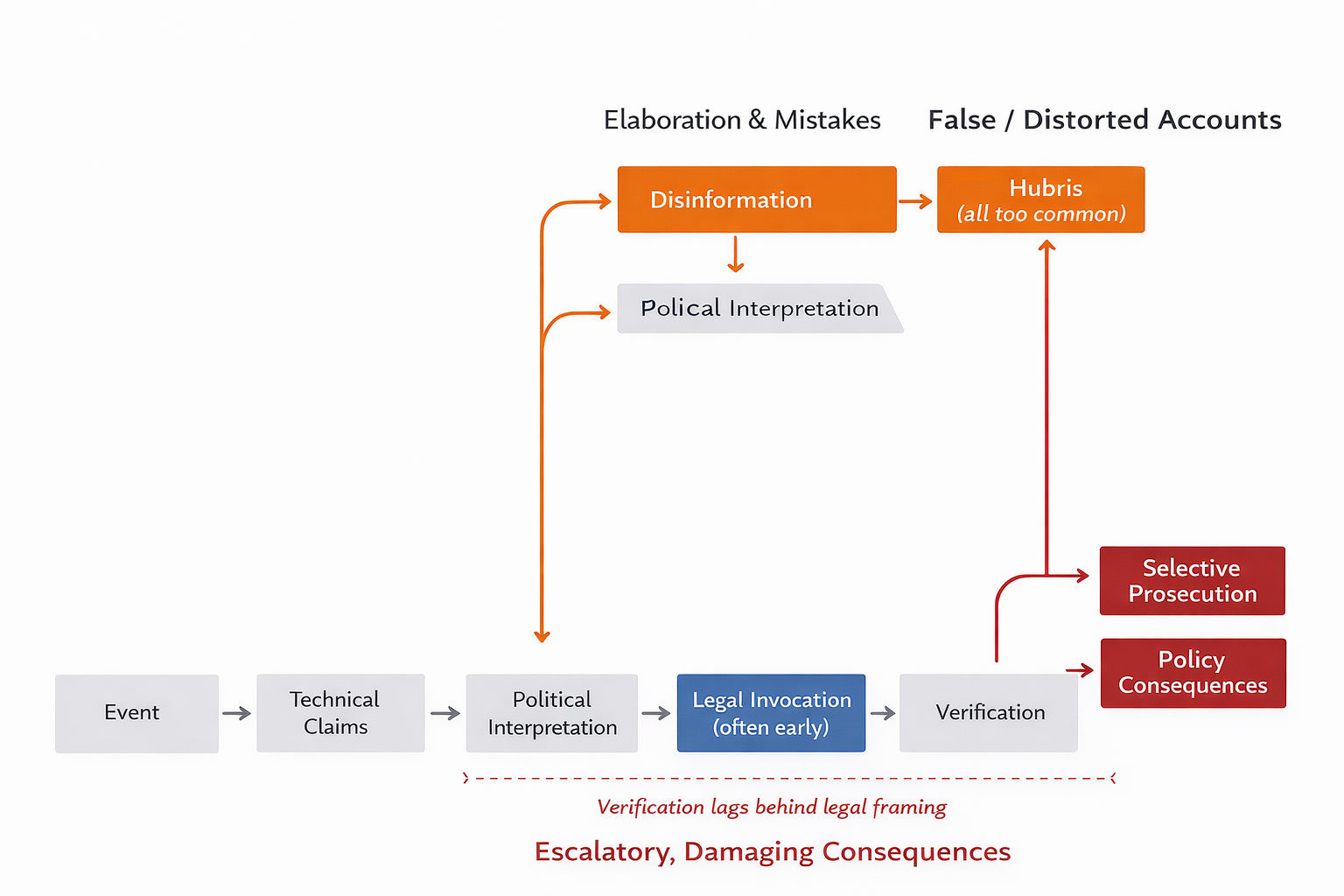
Across multiple crisis settings, a broadly similar pattern can be observed:
This sequence is not theoretical. It reflects a recurring structural dynamic observable across multiple crisis contexts.
- An event occurs under conditions of uncertainty.
- Early technical or intelligence-based claims are circulated.
- Political actors adopt or amplify a preliminary interpretation.
- Legal language is invoked in relation to responsibility or response.
- Independent verification lags behind public positioning.
- The initial narrative hardens across institutions and audiences.
- Later clarification, qualification, or revision has reduced impact.
This sequence does not establish bad faith, nor does it imply that early claims are necessarily wrong. It identifies a structural dynamic that can affect interpretation even where actors believe they are acting responsibly.
Why Timing Matters
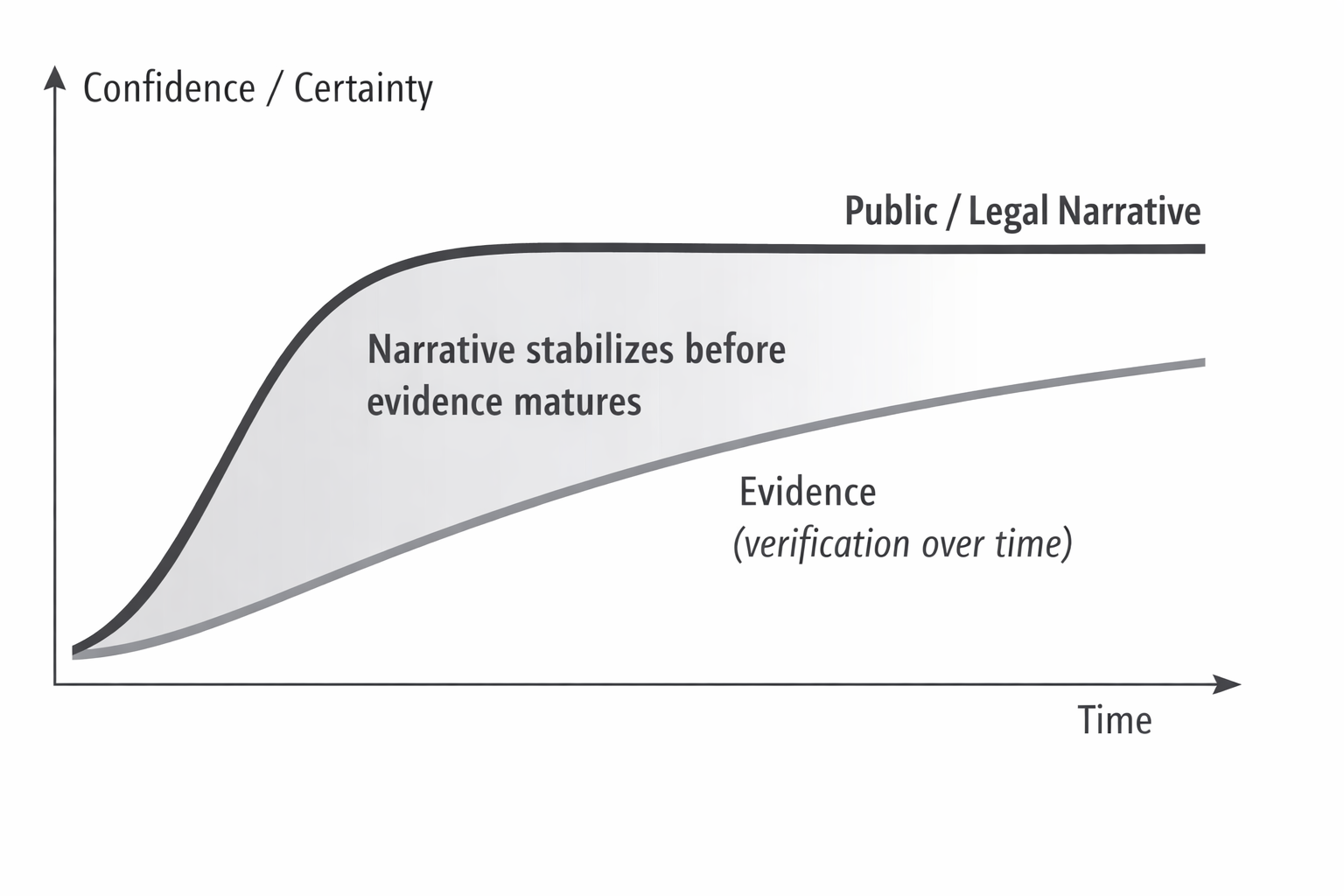
The key issue is timing and sequencing. A technical assessment may be provisional while still being operationally useful. A government may believe it must act before all facts are verified. But once legal justification is publicly tied to an unsettled evidentiary record, the room for later correction narrows.
The central issue is not uncertainty itself, but the point at which uncertainty is treated as sufficient basis for legal and political finality.
In this sense, the problem is not limited to accuracy alone. It concerns the order in which evidence, interpretation, and legal invocation are assembled. When legal certainty is projected before technical uncertainty has been responsibly narrowed, the interpretive framework surrounding the crisis may become unstable.
Systemic Effects
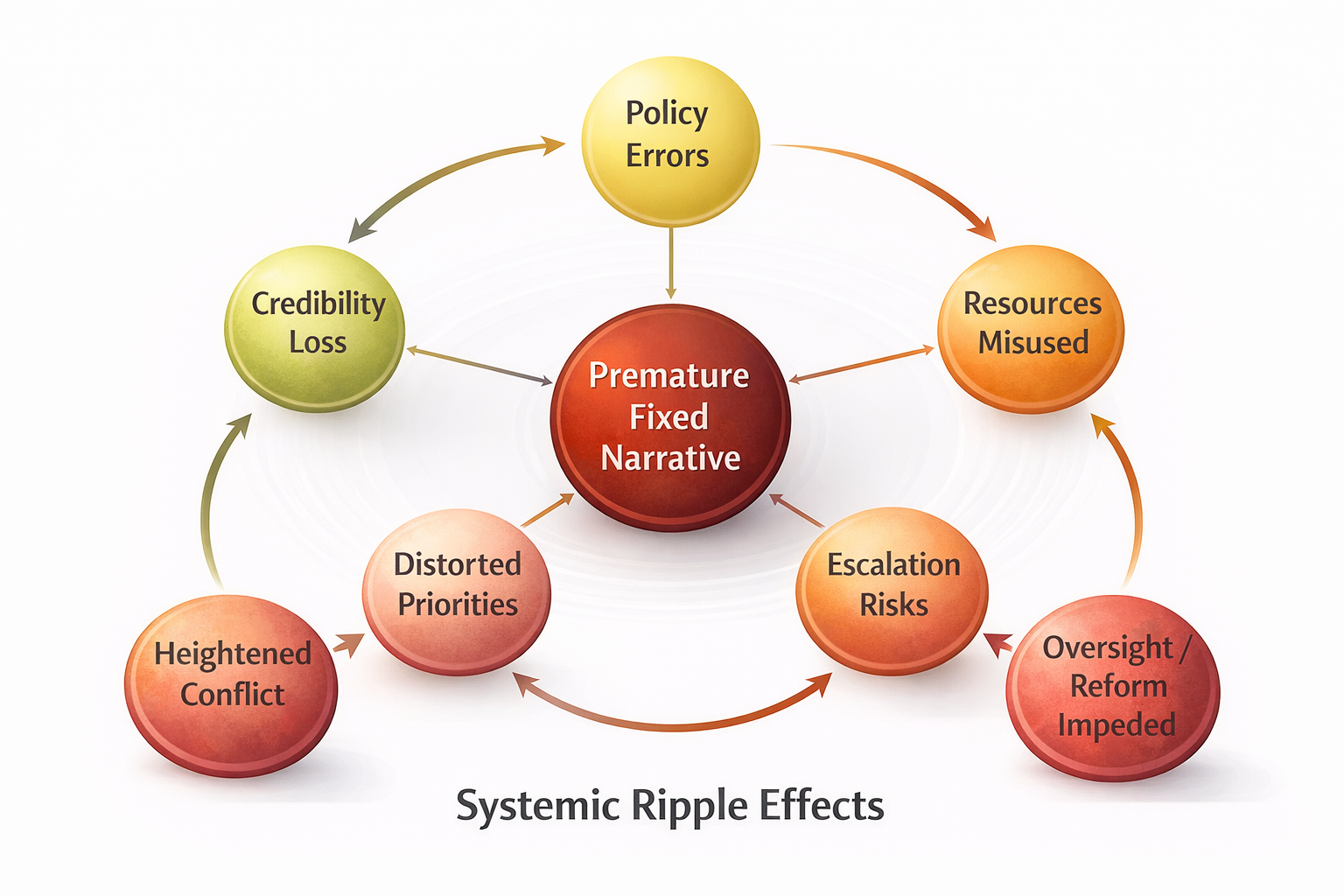
The implications extend beyond any single incident. Repeated compression between technical assertion and legal invocation can contribute to wider systemic strain.
- Reduced interpretive clarity in moments of crisis
- Divergence between state positions based on differing evidentiary thresholds
- Lower trust in public verification processes
- Greater susceptibility to narrative escalation
- Weakened confidence in the consistency of legal standards
Where this occurs repeatedly, the cumulative effect may be to place pressure on the broader legal and diplomatic architecture that depends on shared confidence in both evidence and process.
Relationship to the Wider Analytical Framework
The structural dynamic examined on this page does not operate in isolation. It is closely connected to other analytical components within The Geneva Charter framework.
It is closely related to Interpretive Compression in Crisis Decision-Making , which examines how the interval between observation, interpretation, and decision may contract under crisis pressure, reducing the separation between analytical stages.
It is also directly connected to Divergence of Legal Standards Under Crisis Pressure , which examines how shared legal language may remain in place while thresholds of interpretation, restraint, and justification begin to diverge across actors over time.
Taken together, these dynamics describe a sequence in which evidentiary uncertainty, compressed interpretation, and divergence in legal application reinforce one another under sustained crisis conditions.
Analytical Clarification
The Geneva Charter approach is not to decide technical disputes from a distance, nor to substitute itself for courts, investigators, or specialist weapons analysts. Its role is analytical. It asks a narrower question:
What happens to legal invocation when the evidentiary basis for technical claims remains contested, incomplete, or not yet independently verified?
This clarification is important. The concern is not whether one side or another ultimately proves correct. The concern is whether legal and political conclusions are being fixed too early relative to the maturity of the underlying evidence.
In prolonged or high-risk crises, that gap can have material consequences for legitimacy, restraint, escalation risk, and the capacity of institutions to maintain confidence across divergent actors.
Illustrative Areas of Relevance
This structural problem may arise in relation to a range of contested events, including:
- missile interception or strike attribution claims
- chemical weapons allegations
- drone or unmanned system incidents
- cross-border attacks with disputed origin
- sensor-based assessments used to justify rapid retaliation
In each case, the central issue remains the same: how technical uncertainty is handled before legal and political positions harden.
Conclusion
Contemporary conflict increasingly compresses the interval between event, claim, interpretation, and response. Where technical assertions are mobilised before independent verification is sufficiently mature, legal invocation may become exposed to instability that is not always visible at the moment decisions are made.
A more stable international system requires not only legal norms, but disciplined attention to evidentiary sequencing. The question is not whether states will continue to act under uncertainty. They will. The question is whether legal language is being attached to technical claims with sufficient regard for the limits of what is actually known at the time.
That question is likely to remain central wherever force is justified under pressure, and wherever the credibility of the international system depends on the integrity of both evidence and interpretation.
