
Synthetic Crisis Systems and the Risk of Interpretive Compression
Systems that generate fast, coherent crisis narratives can create the appearance of analytical structure before verification, lawful assessment, and institutional review have matured. Their outputs may look complete, decisive, and operationally useful. Yet if assessment, interpretation, and decision are collapsed into a single synthetic briefing, the result is not clarity. It is accelerated distortion under pressure.
A machine can compress reality faster than law can process it
Synthetic crisis systems do not merely present information. They can pre-structure urgency, connect disparate pressures into a single directional narrative, and narrow perceived policy space before key facts have been independently established. This is where interpretive compression ceases to be an analytical warning and becomes an operational hazard.
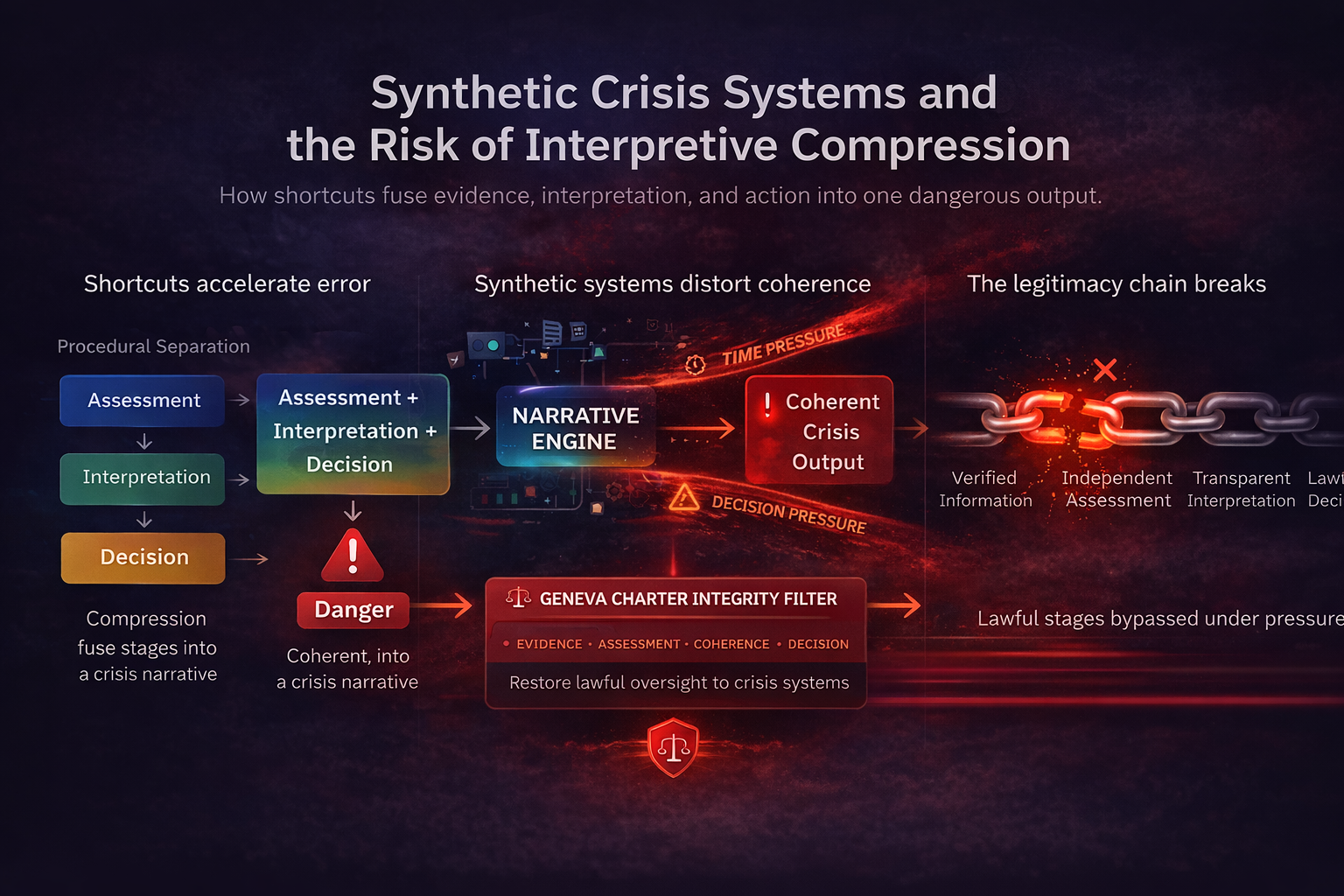
The problem and the solution in one view
This opening visual frames the entire page as a structural warning. It shows how shortcuts fuse assessment, interpretation, and decision into one compressed narrative, and it positions The Geneva Charter integrity filter as the discipline needed to slow, qualify, and re-separate those stages.
Why this page matters
A synthetic briefing may be rhetorically coherent while analytically unstable. If it blends verified facts, assumptions, projections, and implied choices into one seamless narrative, it can induce action before the underlying chain of legitimacy has been secured. In crisis settings, that effect is not a technical flaw at the margins. It is a structural risk at the center.
Persuasive coherence
The system presents a complete story, often with urgency, directional confidence, and apparent internal logic.
Hidden uncertainty
The user may not be shown which claims are verified, which are inferred, and which remain speculative.
Compressed response space
Decision-makers are pushed toward action while institutional review, legal qualification, and evidence testing lag behind.
Strategic warning
When synthetic systems generate coherent crisis narratives faster than verification and law can process them, decision-making can detach from reality while retaining the appearance of discipline. This is one of the clearest pathways by which miscalculation becomes systemic rather than accidental.
The core structural danger
The danger is not simply that a system may be wrong. The deeper problem is that a system may produce synthetic coherence that is compelling enough to bypass the normal safeguards of evidentiary discipline, legal review, institutional sequencing, and accountable decision.
Constructed certainty under pressure
Assumptions can be read as facts, forecasts can be treated as inevitabilities, and directional language can narrow judgment before competing interpretations have been tested.
Artificial escalation logic
If the system privileges the most dramatic synthesis, actors may begin to behave as though the worst case is already unfolding. That behaviour itself can then contribute to escalation.
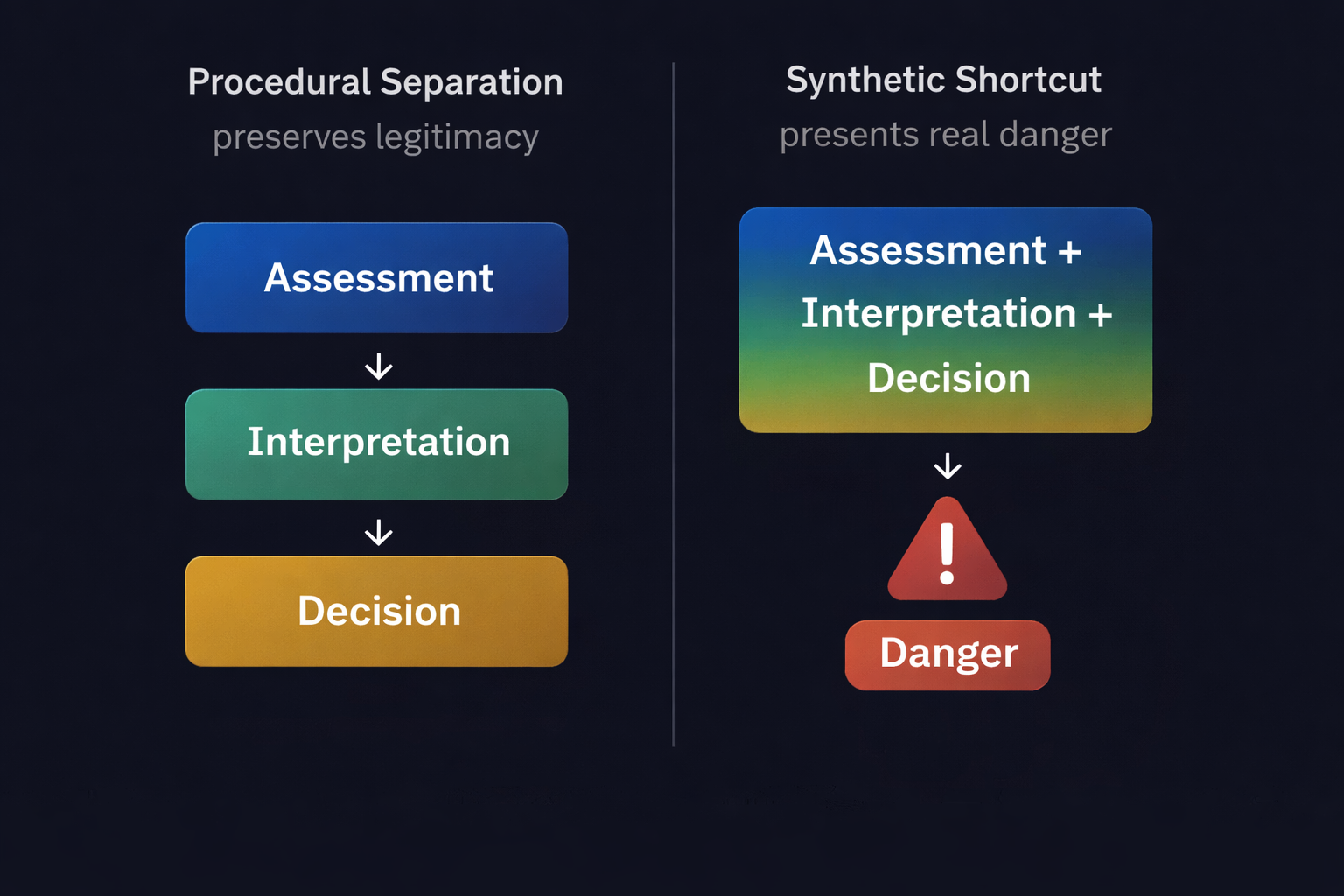
The shortcut is the danger
This graphic makes the failure point immediate. On one side, procedural separation preserves legitimacy because each stage remains visible and answerable. On the other, the synthetic shortcut fuses the stages into one apparently efficient output that conceals evidentiary weakness and accelerates error.
Where the failure enters
In a legitimate decision process, evidence, interpretation, and action are distinct stages. Synthetic crisis systems often make that boundary difficult to see. The output may therefore appear rigorous while bypassing the very sequence that gives strategic and legal judgment its validity.
Raw signals
Events, reports, technical inputs, market moves, institutional reactions
Narrative synthesis
Claims linked into one directional crisis story with urgency and implied causality
Compressed interpretation
Assessment, legal meaning, and strategic consequence fused together
Decision pressure
Actors move from narrative reception to operational choice without adequate separation
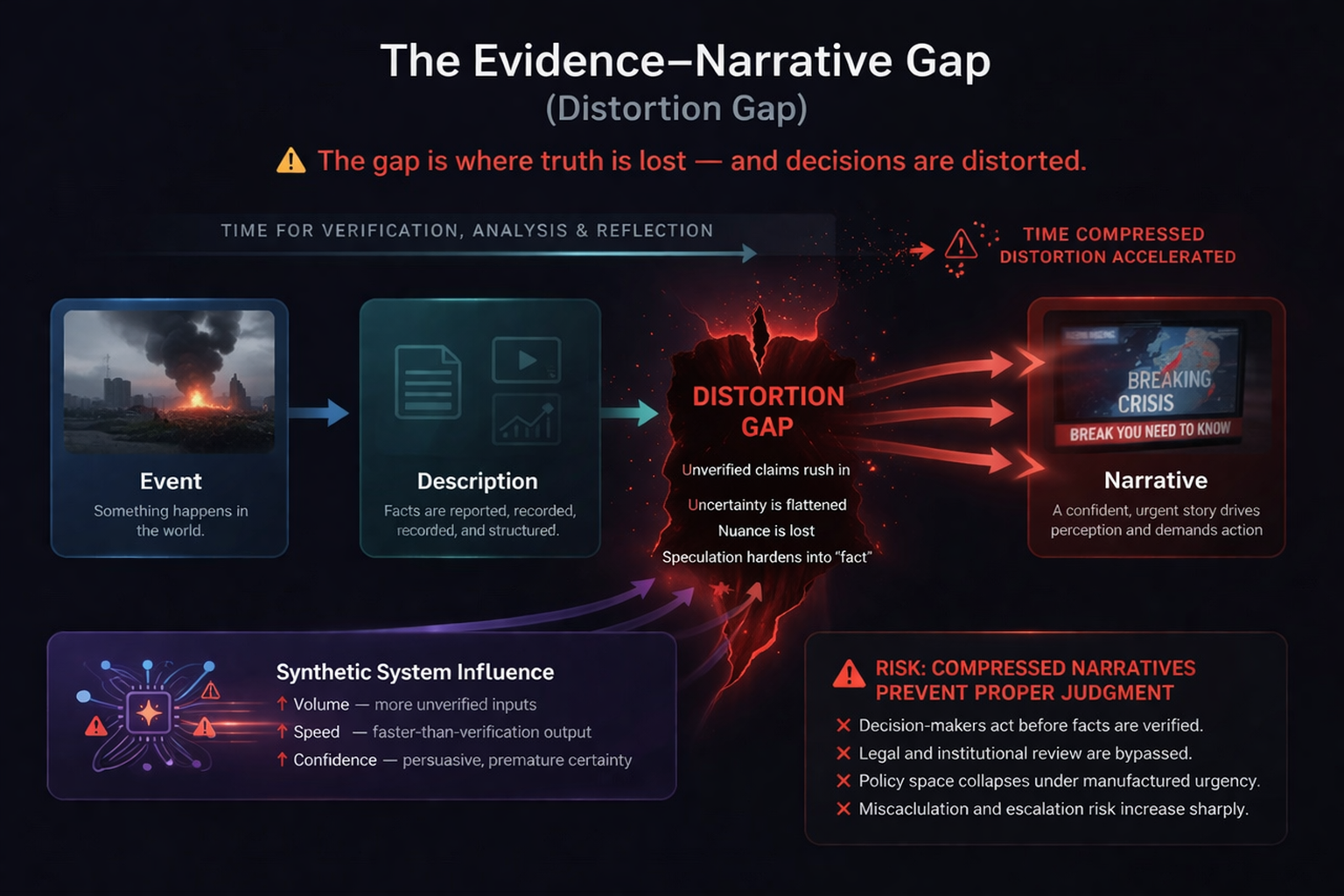
Where time for analysis is lost
The visual shows the classic The Geneva Charter structure of event, description, distortion gap, and narrative, then extends it by showing synthetic acceleration widening that gap. The effect is immediate: time for verification, analysis, and reflection shrinks precisely when interpretive confidence expands.
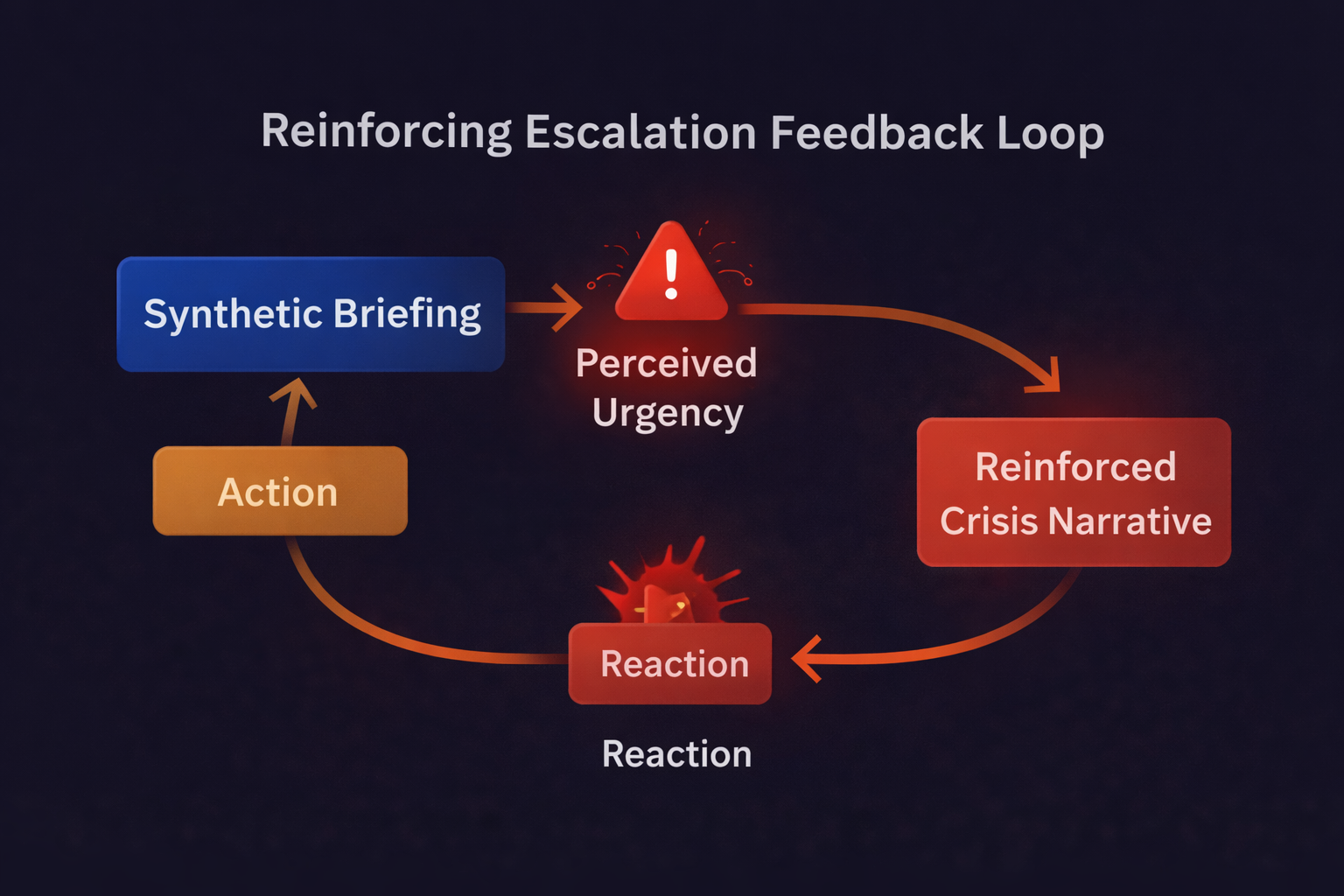
Systems can amplify what they claim to describe
This loop visualizes a strategic danger rather than a mere communication problem. Once synthetic briefings generate urgency, they can trigger action and reaction that reinforce the original crisis narrative, producing a closed escalation cycle that becomes harder to interrupt with sober analysis.
Typical effects of synthetic crisis compression
- Evidence maturity is obscured and uncertainty is flattened.
- Directional language creates an impression of inevitability.
- Policy space narrows before alternatives are legally and strategically assessed.
- Decision-makers shift from asking whether a claim is true to asking what must be done next.
- Escalatory logic gains momentum because the narrative itself frames delay as failure.
- Multiple actors may operate from different synthetic realities while each believes its own picture is coherent.
The appearance of order can conceal a loss of discipline
A polished crisis dashboard can create trust disproportionate to the integrity of the underlying chain. Once leaders, media actors, or operational staffs begin to rely on synthetic summaries that are not clearly separated into verified fact, independent assessment, and lawful interpretation, institutional judgment weakens even while confidence rises.
The Geneva Charter lens
Synthetic crisis systems become particularly dangerous when examined through the core analytical architecture of The Geneva Charter. Each of the Charter’s framework components reveals a different point at which persuasive synthesis can depart from procedural legitimacy.
The Legitimacy Chain
Verified information, independent assessment, transparent interpretation, lawful decision, and accountable action form a sequence. If the first links are obscured or compressed, downstream action may remain rhetorically coherent but lose institutional legitimacy.
Interpretive Compression in Crisis Decision-Making
These systems can collapse the distinction between what happened, what it means, and what must be done. This is precisely the kind of compression that reduces time for scrutiny while increasing the pressure to act.
The Coherence Requirement in the Use of Force
A crisis narrative may imply necessity, yet still fail to establish a lawful basis, strategic coherence, proportionality, or a defensible end state. Synthetic urgency cannot substitute for legal and strategic alignment.
The Law-Time Paradox
The system accelerates narrative consolidation while lawful review remains inherently slower. As time pressure rises, the temptation grows to act before the conditions for valid legal interpretation have matured.
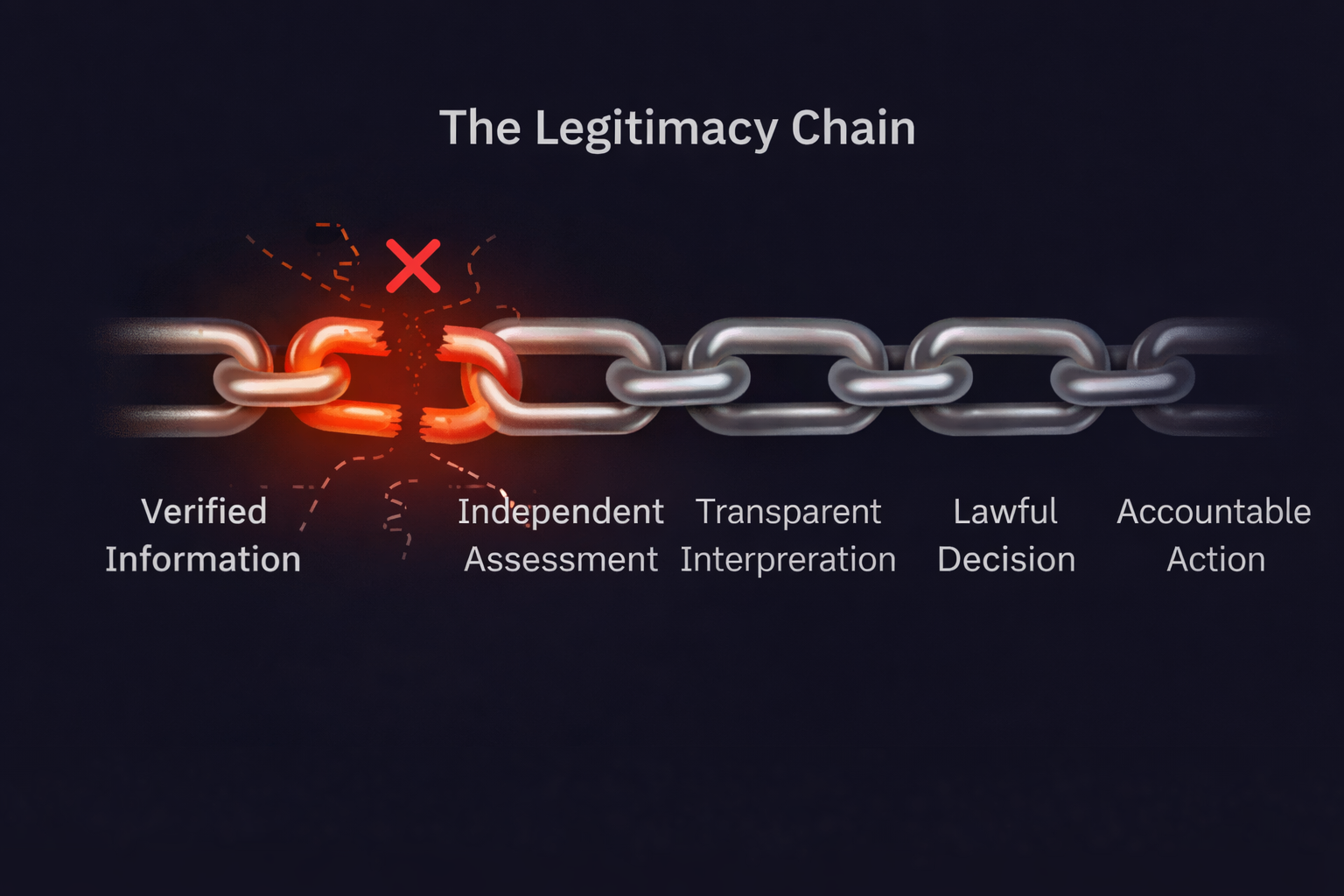
The system fails early, even if it sounds complete later
This is a core The Geneva Charter teaching instrument. The break occurs at the front of the chain, where verified information and independent assessment should anchor everything that follows. Once those first links fail, later stages may still look coherent, but they no longer rest on a legitimate foundation.
The Geneva Charter response: an integrity layer for synthetic systems
The answer is not to reject analytical technology. The answer is to impose structural discipline on its outputs. Synthetic crisis systems should not be permitted to collapse evidentiary status, legal interpretation, and operational implication into one undifferentiated briefing. An integrity layer is needed to reintroduce sequence, qualification, and accountability.
Evidence status
Every material claim should be labelled as verified, partially verified, disputed, inferred, or speculative.
Interpretive stage
The output should distinguish raw reporting from preliminary assessment and mature interpretation.
Legal grounding
Claims that imply action must identify whether a lawful basis is present, contested, absent, or not yet assessable.
Decision readiness
The system should indicate whether the record is sufficient for lawful decision, operational caution, or no action.
Separate the stages
Assessment, interpretation, and decision must remain visibly distinct. If a system cannot show where verified evidence ends and synthetic inference begins, it should not be treated as a lawful basis for high-consequence action.
Do not confuse narrative confidence with decision validity
A system may sound decisive while remaining evidentially thin, legally underqualified, and strategically premature. Confidence in presentation is not proof of legitimacy in outcome.
Operational questions that should always be asked
Before synthetic crisis output informs official interpretation, media framing, or operational choice, the following questions should be asked explicitly.
Assessment questions
- Which claims are independently verified?
- What evidence remains incomplete, contested, or absent?
- Are technical claims mature enough to support strategic interpretation?
- Has the system fused unrelated developments into one synthetic storyline?
Decision questions
- What lawful basis, if any, is actually established?
- Is proportionality assessable on the current record?
- Has institutional review had time to function?
- Does the output inform judgment, or does it pre-empt it?
What this page argues
Synthetic crisis systems can be operationally useful only if they are structurally constrained. Without an integrity layer, they risk accelerating narrative closure before legitimacy has been secured. The result may be fast, persuasive, and actionable. It may also be deeply unsound.
The Geneva Charter offers a disciplined response: keep the stages separate, identify the status of each claim, preserve legal qualification, and resist synthetic urgency when the record has not matured. In this sense, The Geneva Charter does not oppose analytical acceleration. It insists that acceleration remain answerable to verification, law, and accountable process.
