
Peace Without Justice
How Unstable Settlements Produce Future Conflict
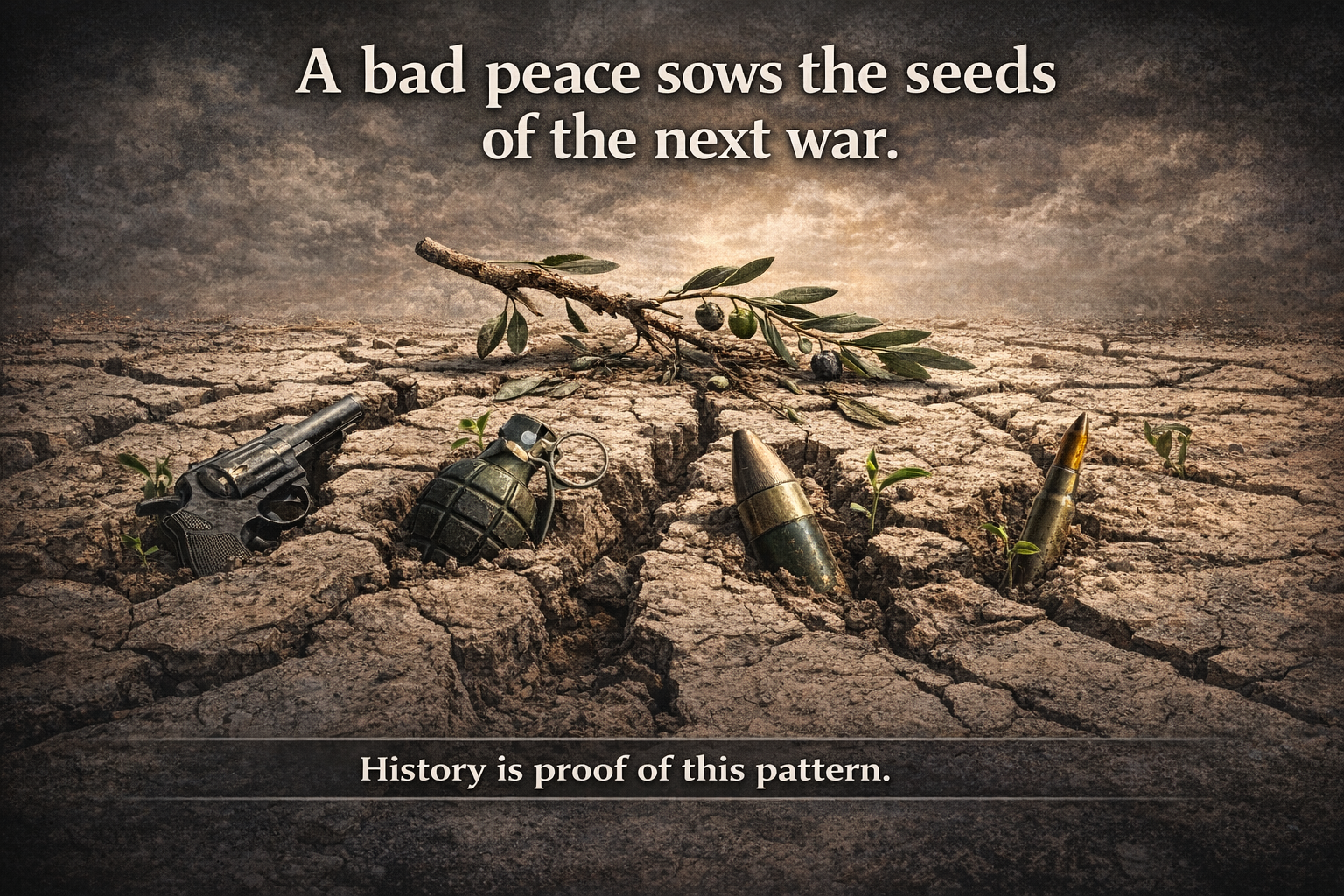
A peace that excludes justice does not end conflict.
It restructures it.
Ending violence is not the same as resolving conflict. A ceasefire can suppress visible fighting. A signed agreement can reduce immediate risk. External guarantees can produce temporary calm. But none of these, by themselves, create legitimacy. Where harm is not acknowledged, truth is not established, accountability is absent, and grievance is left structurally intact, peace does not become durable. It becomes provisional.
The Geneva Charter treats peace without justice as one of the most important forms of strategic failure. This is because unstable settlements are often mistaken for successful ones simply because they interrupt violence for a period of time. Yet a peace that leaves core injuries unresolved, rewards impunity, or freezes reality without repairing it may preserve the visible appearance of order while carrying forward the underlying architecture of the conflict itself.
This page examines that problem directly. It explains why bad peace is not the opposite of war, but often its deferred continuation. It shows how unresolved harm, weak accountability, symbolic compliance, and politically convenient closure can create the conditions for future instability. In Geneva Charter terms, justice is not an optional moral addition to peacebuilding. It is one of the structural conditions that determine whether peace can hold.
Geneva Charter doctrine: A bad peace is not a solution. It is a delayed crisis.
Core Principle
Justice is not external to peace. It is one of its preconditions. A settlement may reduce violence without producing trust. It may establish institutions without creating legitimacy. It may create procedures without establishing truth. Where that occurs, conflict is not truly resolved. It is reorganized into a less visible but still active form.
In Geneva Charter terms, peace becomes durable only where verified reality, accountable process, and enforceable legitimacy are present. Without them, peace remains vulnerable because the causes of conflict have not been transformed. They have only been contained, deferred, or politically repackaged.
Seeds of the Next War
Why Bad Peace Persists
Bad peace often looks attractive in the short term because it offers visible relief. It reduces international pressure. It allows political actors to claim success. It gives outside mediators something concrete to point to. It can calm markets, soften headlines, and generate the appearance of diplomatic closure. For these reasons, systems are often tempted to prefer speed over truth, de-escalation over accountability, and formal agreement over substantive legitimacy.
Yet this is precisely where danger enters. If peace is built on omission, selective memory, coercive compromise, or procedural thinness, then unresolved reality continues to operate underneath the settlement. Communities do not forget harm simply because institutions move on. Political actors do not become trustworthy merely because they sign. Armed structures do not disappear because they are renamed. In these conditions, instability is not removed. It is stored.
The Geneva Charter therefore treats unstable peace not as a minor policy defect but as one of the most consequential failures of post-conflict governance.
The Mechanism of Recurrence
The dynamic is usually sequential:
- Violence occurs and harm is inflicted at personal, institutional, and political levels.
- Truth remains partial because documentation is weak, access is restricted, or reality is politically managed.
- Accountability is deferred in the name of speed, compromise, or supposed pragmatism.
- Settlement language replaces substantive repair, creating a formal closure that does not correspond to lived reality.
- Grievance remains active, often transmitted socially, politically, and institutionally across time.
- Trust remains thin, making institutions fragile and compliance shallow.
- Conflict re-emerges, either in overt violence, in frozen confrontation, or in a new cycle of instability.
Peace Is Not the Same as Silence
One of the most persistent errors in conflict resolution is to equate the lowering of violence with the presence of peace. Silence can be imposed. Exhaustion can suppress conflict. Fear can freeze confrontation. International pressure can delay escalation. None of these conditions necessarily indicate that legitimacy has been restored.
Peace in the Geneva Charter sense requires more than interruption. It requires that reality be established, harms be acknowledged, structures of impunity be confronted, and future governance be capable of carrying legitimacy rather than merely claiming it. Where this does not occur, silence may be temporary while conflict remains structurally alive.
This is why an unstable settlement should never be mistaken for a resolved order simply because it reduces the immediate volume of violence.
Failure Patterns in Bad Peace
- Justice is deferred in the name of political speed.
- Verification remains too weak to establish a shared baseline of reality.
- Amnesty or quiet impunity replaces accountable consequence.
- Settlements rely on symbolic monitoring rather than enforceable oversight.
- External guarantees substitute for internal legitimacy.
- Political accommodation is achieved without meaningful trust.
- Public narrative closes the conflict before factual closure has occurred.
- Institutions are created formally, but lack lived authority among affected populations.
- Underlying grievance remains socially active and politically transmissible.
- Future instability is embedded into the settlement architecture itself.
The Predictive Value of the Framework
One reason this page matters is that it makes the framework predictive, not only descriptive. If a settlement lacks truth, accountability, enforceable review, and legitimate process, the Geneva Charter does not treat that as a secondary weakness. It treats it as an indicator of future instability.
In this sense, Peace Without Justice is not merely a moral warning. It is a structural forecast.
Brief Comparative References
The pattern is visible across multiple cases. The point is not that all conflicts are identical, but that bad peace often shows recurring structural features.
Rwanda, Arusha Accords: formal settlement language did not carry enough protective force, trust, or enforceable stabilization to withstand organized escalation. The result was catastrophic collapse rather than durable peace.
South Sudan: repeated agreements have often outpaced legitimacy on the ground. Ceasefire language, elite bargaining, and formal process did not consistently produce stable trust, accountable enforcement, or enough justice to close the recurrence cycle.
Ukraine, Minsk: the framework slowed and reframed conflict, but did not resolve underlying contradictions of force, accountability, sovereignty, and trust. The result was not a stable order, but a fragile pause before wider war.
Connection to the Wider Legitimacy Framework
This page should be read as a direct bridge between Failure of Legitimacy and From Conflict to Stable Order. Where legitimacy fails in conflict, unstable peace becomes the bridge to future war. Where legitimacy is rebuilt in peace, recurrence becomes less likely because grievance, truth, and accountability are no longer left structurally unresolved.
The page therefore occupies an important interpretive position in the wider Geneva Charter system. It shows what happens when conflict formally ends without legitimacy actually being restored.
Educational Note
Justice does not always mean one single institutional form. It may involve criminal accountability, truth processes, reparative mechanisms, constitutional restructuring, monitored guarantees, or combinations of these. What matters in Geneva Charter terms is not doctrinal rigidity about form, but whether the settlement genuinely addresses harm, restores reality, and creates a governance structure capable of carrying legitimacy forward.
A peace process may therefore be flexible in design while still failing if it leaves the legitimacy deficit untouched.
Geneva Charter Position
The Geneva Charter rejects the idea that peace can be judged solely by the reduction of immediate violence. It holds that peace must also be judged by whether justice, verified reality, accountability, and legitimate process have been sufficiently restored to prevent recurrence.
It further holds that justice is not an optional moral add-on to peacebuilding. It is a structural threshold between interruption and restoration. If that threshold is not crossed, the resulting order remains unstable regardless of the language used to describe it.
In this framework, a peace that excludes justice does not heal conflict. It transmits it forward.
Unresolved harm becomes the architecture of future violence.
Closing reflection: Peace without justice does not close the cycle of conflict. It suspends it. Where truth is partial, accountability weak, and grievance preserved, order becomes fragile and the next crisis begins to form beneath the surface. That is why bad peace is never neutral. It is often the first stage of the next war.
