
Monitoring & Charter Compliance
Monitoring is the foundation of credibility in international law.
Without structured observation, compliance becomes interpretation. With monitoring, conduct becomes visible, comparable, and accountable.
The Geneva Charter establishes a neutral, structured framework for observing conduct in relation to the principles of the Charter of the United Nations. It does not replace institutions, investigations, or courts. It connects and preserves the work already being carried out across the international system.
Monitoring Architecture
Monitoring is not a single activity. It is a connected system. Each component reinforces the others.
The Geneva Charter monitoring function is structured across interconnected layers of observation, verification, analysis, and legal accountability. The pages below present the core components of that system and should be read both individually and as part of a coherent framework.
Observation > Data > Verification > Legal Accountability > Public Record
Core Functions of Monitoring
- Observation of state conduct in relation to Charter principles
- Structured recording of events, timelines, and developments
- Identification of early warning signals and escalation patterns
- Preservation of factual and legal context over time
- Support to mediation, diplomacy, and informed public understanding
Systemic Risk & Early Warning
Monitoring is not only retrospective. It enables the identification of patterns that signal increasing instability.
By connecting observation, data, and verification, The Geneva Charter framework supports visibility into escalation indicators, repeated conduct patterns, institutional paralysis, unresolved legal tensions, and conditions under which local crises may widen into systemic events.
Method & Neutrality
The Geneva Charter maintains strict methodological neutrality.
- It does not conduct primary investigations
- It does not issue legal judgments
- It does not assign political responsibility
- It structures, connects, and preserves independently produced information within a coherent Charter-based framework
The Monitoring System
- Field observation through journalists, observers, and independent experts
- Data and systemic indicators identifying long-term trends
- Verification through investigative and analytical methods
- Legal qualification through applicable international law
- Public record ensuring continuity and accessibility over time
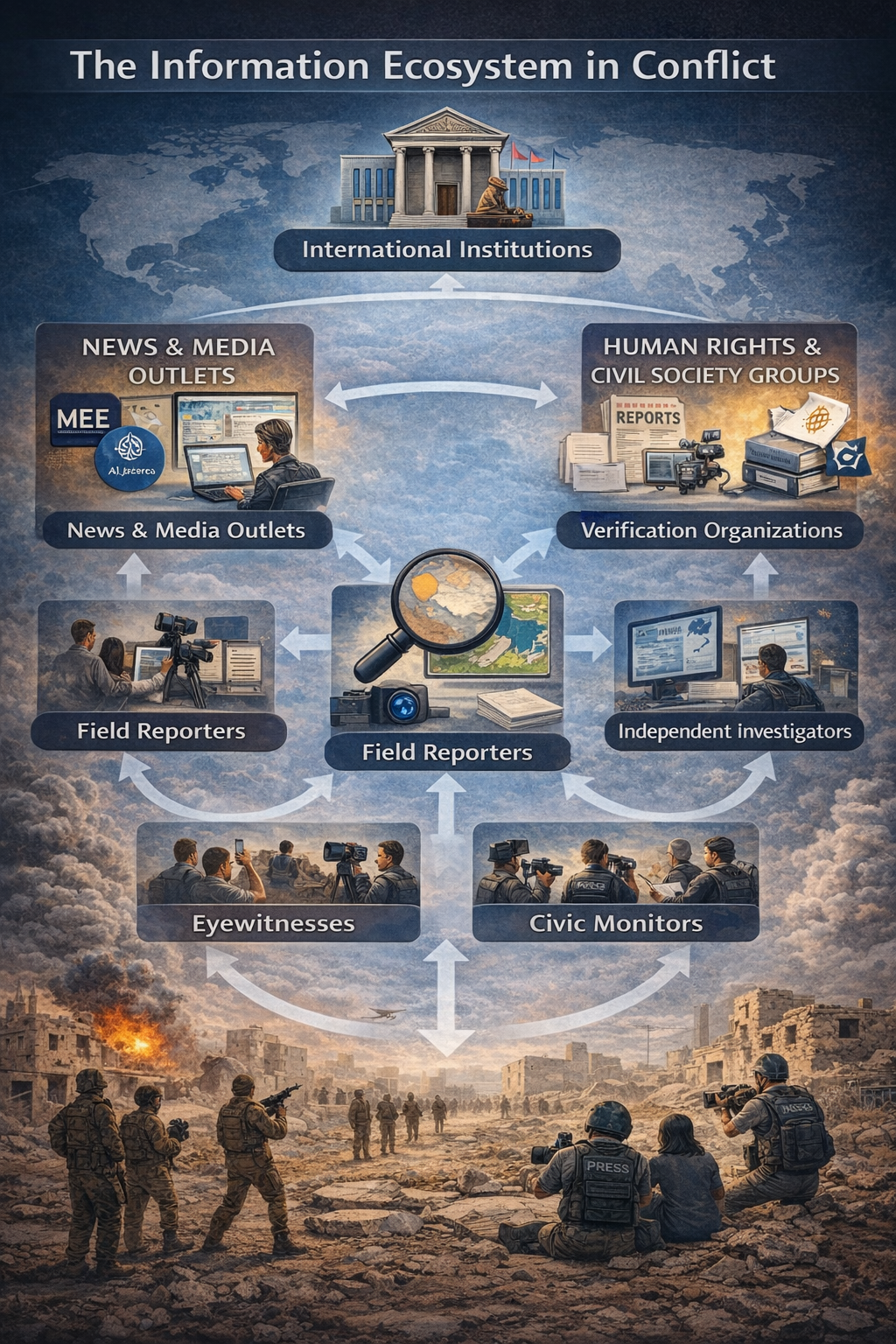
Monitoring also depends on a wider ecosystem of reporters, verification actors, civil society mechanisms, and international institutions. The Geneva Charter does not replace these actors. It connects their functions within a structured system of visibility and accountability.
The Information Ecosystem in Conflict
Information in conflict environments does not move through a single channel. It passes through eyewitnesses, field reporters, verification bodies, civic monitors, news and media outlets, civil society organisations, and international institutions. The significance of monitoring lies not only in seeing events, but in preserving the integrity of this wider ecosystem.
Recognition of Observers and Reporters
The foundation of all monitoring is the work of those who bear witness.
Journalists, correspondents, investigators, and independent observers operate in conditions of risk to document events as they unfold. Their work forms the first layer of truth upon which all further analysis, verification, and legal processes depend.
The Geneva Charter acknowledges, with respect and seriousness, those who continue to report under conditions of conflict, instability, and constraint.
We also remember those who have lost their lives while reporting from war zones and high-risk environments across the world.
You made a difference – for the peoples of the United Nations.
