
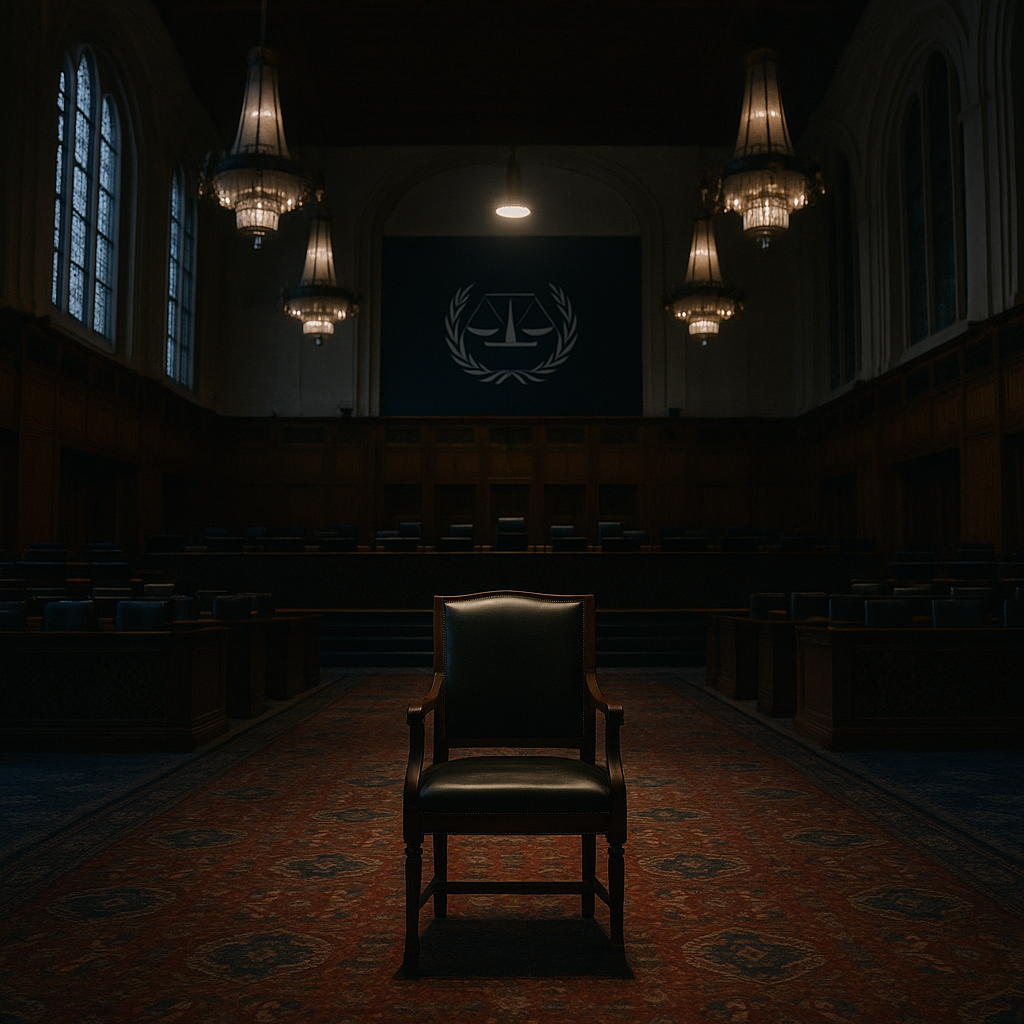
Rule of Law – The Empty Chair
A 2025 reflection on the long unravelling of international legality and why restoring it is not idealism, but survival.
Updated 12 November 2025 | Location: The Hague | Sources: UN Charter; ICJ; UNGA Archives; Santayana (1905)
This reflection accompanies The Geneva Charter as contextual material. It examines how and why the international rule of law eroded over time, and why the principles articulated in the Charter are not aspirational ideals, but survival mechanisms born of historical memory.
1. The Long Forgetting (1945-2025)
“Those who cannot remember the past are condemned to repeat it.” – George Santayana, 1905
When George Santayana wrote those words, he could not have foreseen how precisely they would describe the twentieth and twenty first centuries. After the First World War, the League of Nations was born from a single conviction: that war could be restrained through dialogue, law, and shared conscience. It failed, but its failure left a scar that became the seed of something stronger.
Out of the ruins of a second, more terrible conflict, the United Nations was created not as an idealistic experiment, but as an act of collective self preservation. Its Charter was a solemn promise: that never again would the world allow aggression, genocide, or occupation to go unchallenged. The rule of law was to be the world’s shield, its memory made permanent through institutions.
Yet eighty years later, with that Charter still intact, we find ourselves once again drifting toward confrontation among major powers, armed with the lessons of history, yet behaving as if we had learned none. The rule of law, conceived as humanity’s safety mechanism, is now treated as optional precisely because the memory of its necessity has faded.
We remember the institutions, but not the reasons they were built.
2. The Unravelling by Decades
The decay of international legality did not happen in one dramatic collapse. It unfolded slowly through tolerated contradictions, forgotten lessons, and selective enforcement. Every generation adjusted to slightly lower standards, until the extraordinary became ordinary.
| Decade | Behaviour | Consequence |
|---|---|---|
| 1945-1960s | Creation of a global legal order; early UN ideals of sovereignty and restraint | Foundational optimism |
| 1970s-1980s | Realpolitik overshadows principle; superpowers use law as leverage | Justice becomes ideological |
| 1990s | Humanitarian interventions blur legality; selective enforcement of norms | Legitimacy becomes negotiable |
| 2000s | Pre emptive war doctrine undermines UN Charter foundations | Impunity gains precedent |
| 2010s | Multilateral fatigue and veto paralysis in crises | Law yields to power |
| 2020-2025 | Charter openly ignored; international courts sidelined | Norms collapse; memory erased |
“The moment one elephant is allowed to dance on the carpet, everyone else starts looking for tap shoes.”
Each exception created the moral permission for the next. The slow corrosion of principle became the architecture of cynicism.
3. When the Rules Became Optional
There was a time when international law was not just a phrase, but a shared language of restraint. By 2025, that language has almost fallen silent. Great powers act with impunity; smaller ones imitate them. Institutions designed to uphold law stand by, muted, as missiles and narratives compete to define reality.
When the rule of law becomes optional, justice becomes theatre. The world becomes a stage where outrage replaces accountability.
4. Why It Matters
The rule of international law is not an academic ornament. It is humanity’s seatbelt. You do not wear it because you expect an accident. You wear it because you remember what happens when no one does.
- Without law, the strong dictate and the weak imitate.
- Without accountability, outrage turns into performance.
- Without memory, “never again” becomes ceremonial noise.
5. The Myth of Strategic Exception
The twenty first century perfected a dangerous rhetorical trick. Breaking rules while claiming to defend them. Strategic exception is cheating with a press release.
Every exception bends the structure. Once bent too far, it does not return.
Strategic exceptions do not preserve order. They delete the operating system of legality.
6. The Case for Return
To call for a return to rules is not nostalgia. It is recognition that civilization depends on restraint.
- The powerful must explain, not dictate.
- Victims gain justice, not hashtags.
- Small states survive without permanent mobilization.
True multilateralism depends only on whether someone still cares to uphold the rule.
7. The Return Clause
- Apply law without exception. Flags grant duty, not immunity.
- Reject strategic ambiguity. It is moral evasion.
- Rebuild institutions that outlast political moods.
- Sanction all transgressions. Especially the uncomfortable ones.
- Relearn why the law was written. Memory prevents repetition.
8. Epilogue: The Empty Chair
In The Hague stands a chair meant for accountability. It is not empty because no crimes were committed. It is empty because too many agreed to look away.
The chair waits. So does the idea of justice that built the United Nations.
The rule of law is not utopia. It is the minimum condition for decency in a dangerous world.
The Spirit of Dag Comment
Dag Hammarskjöld said the UN was not created to take mankind to heaven, but to save it from hell. Forgetting why law exists is how hell re enters. Remembering is resistance.
Where Principle Begins
The erosion described above did not happen by accident. It followed the quiet abandonment of shared principles.
The Geneva Charter sets out twelve propositions that articulate those principles clearly and without exception. They are not aspirational slogans. They are conditions for restraint, equality, and survival in a dangerous world.
