
Legal Accountability & Adjudication
From verified record to legal consequence
Legal accountability transforms verified information into formally assessed responsibility. Monitoring, verification, and documentation establish the record. Courts and legal bodies determine responsibility within defined legal frameworks. Where this connection holds, legitimacy is strengthened. Where it breaks, impunity expands.
On this page
1. Core Principle
The Geneva Charter holds that legal accountability depends on structured visibility, credible evidence, and institutions capable of evaluating responsibility. Monitoring does not replace adjudication, but adjudication cannot function in the absence of reliable record.
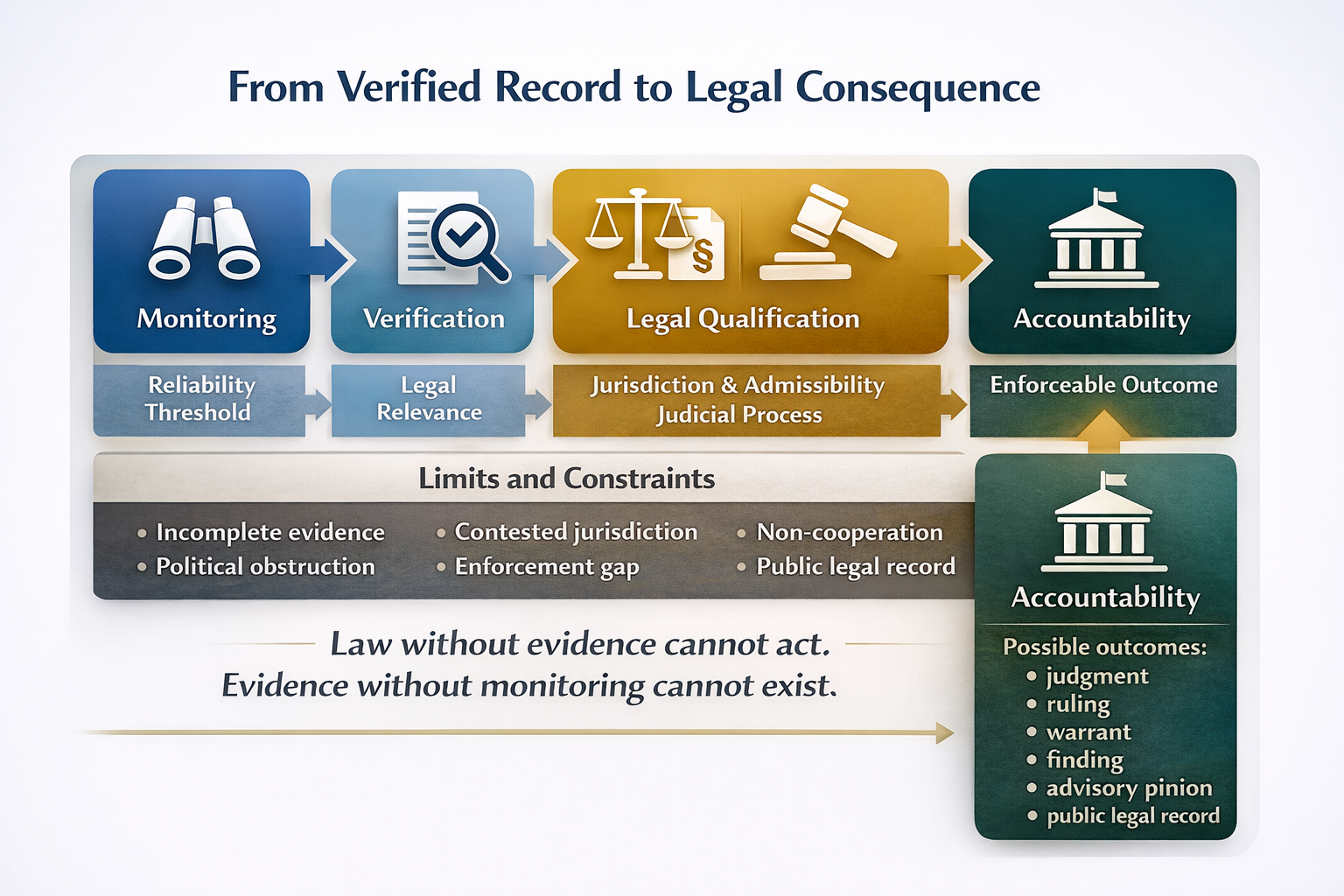
Law without evidence cannot act. Evidence without monitoring cannot exist.
2. Why Legal Accountability Matters
Legal accountability is one of the mechanisms through which legitimacy is defended against impunity. Where violations carry no consequence, repetition becomes more likely. Where responsibility is assessed and recorded, deterrence, clarity, and lawful order are strengthened.
Adjudication distinguishes allegation from formally assessed responsibility and provides a structured framework for evaluating conduct under international law.
3. Forms of Responsibility
3.1 State Responsibility
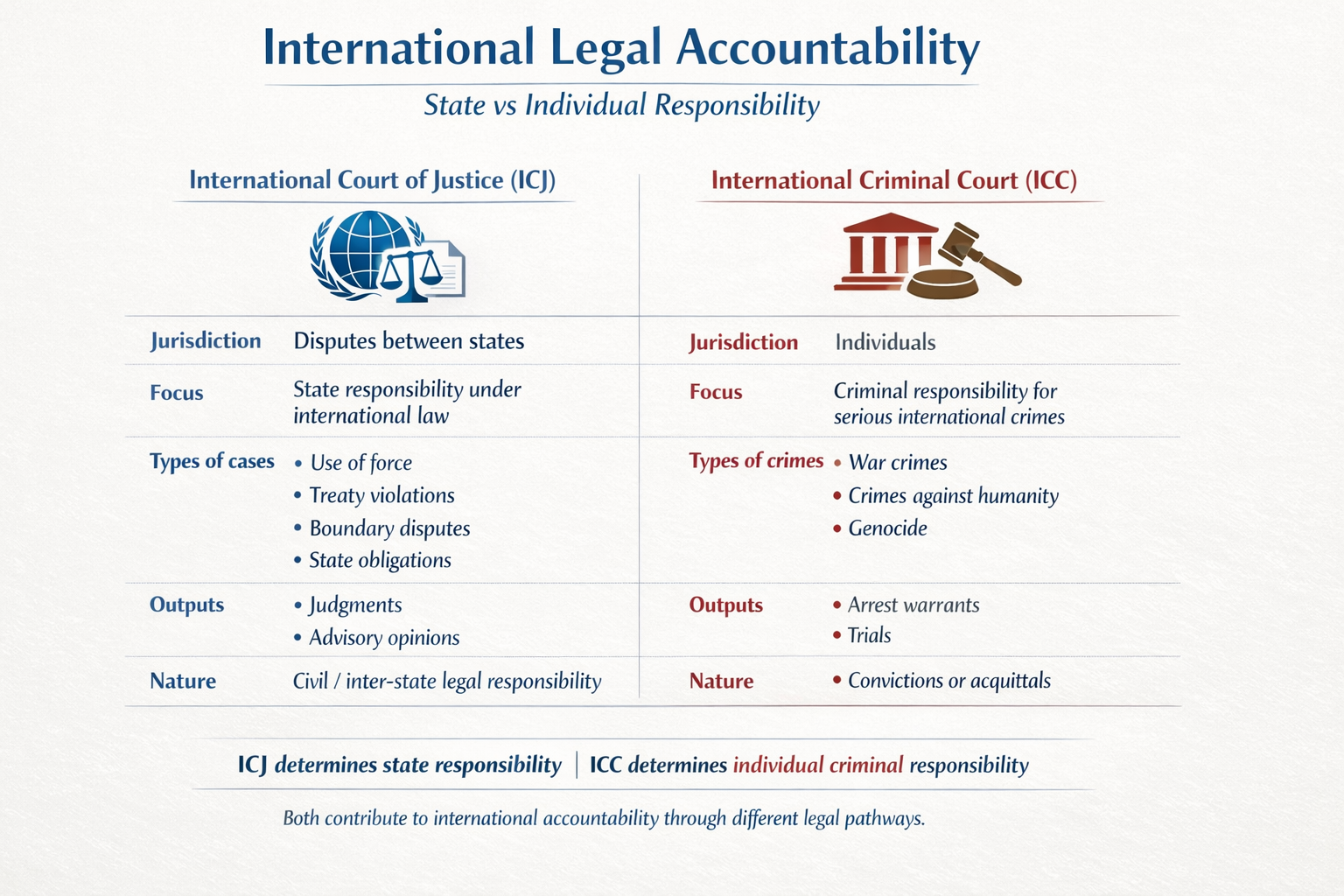
Concerns breaches of international law by states, including unlawful use of force, treaty violations, and failure to meet international obligations.
3.2 Individual Criminal Responsibility
Concerns individuals responsible for war crimes, crimes against humanity, genocide, and related violations under international criminal law.
3.3 Institutional and Political Responsibility
May not always be adjudicated in courts but remains relevant within broader systems of accountability, public record, and governance legitimacy.
4. Courts and Legal Bodies
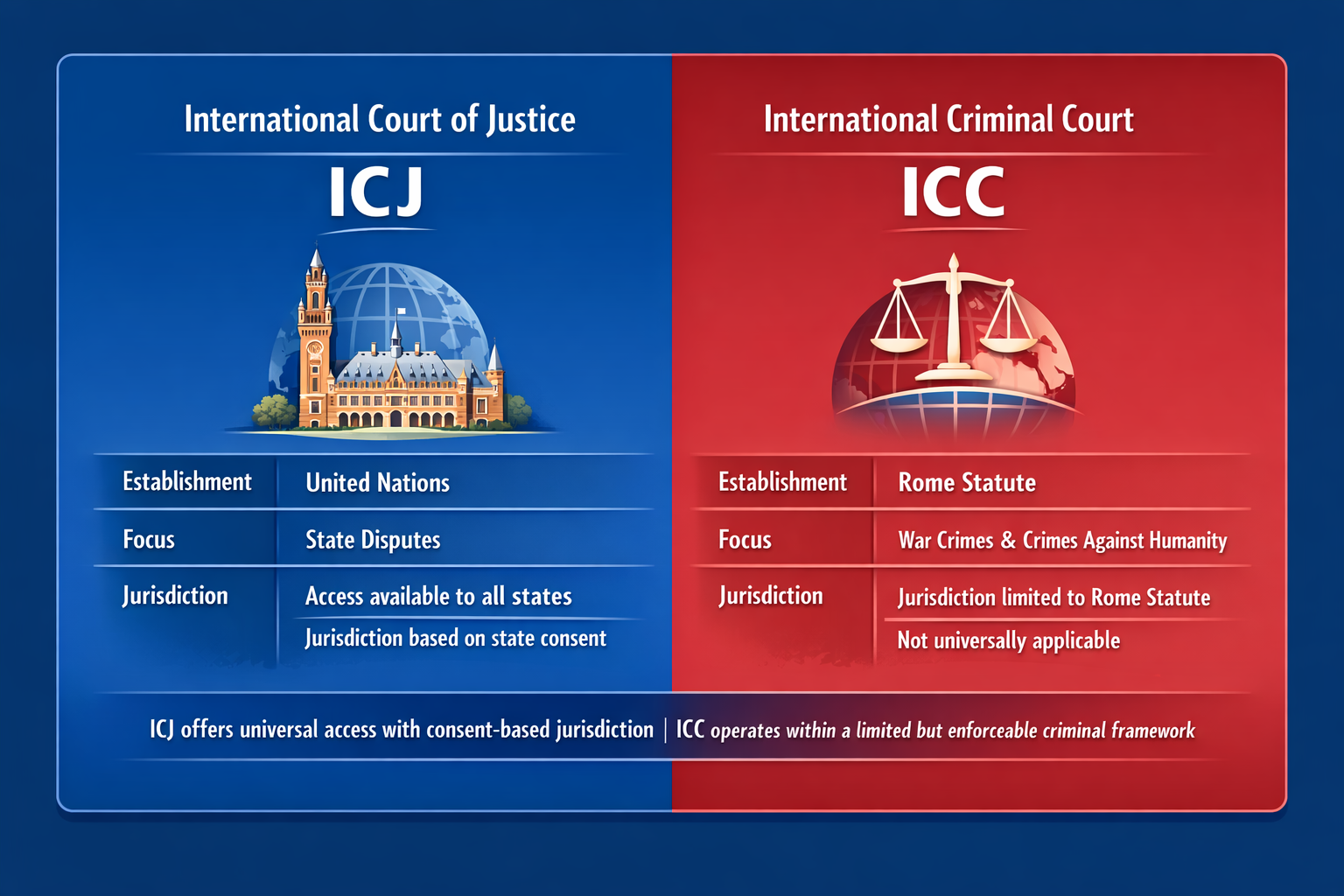
The international legal system consists of distinct institutions with different mandates:
International Court of Justice (ICJ)
Addresses disputes between states and issues advisory opinions on legal questions.
International Criminal Court (ICC)
Prosecutes individuals for core international crimes and determines individual criminal responsibility.
Additional bodies include ad hoc tribunals, hybrid courts, UN investigative mechanisms, and regional human rights courts. These form a broader ecosystem rather than a single unified system.
These institutions operate with different mandates, jurisdictions, and legal pathways. The distinction is important both for legal accuracy and for understanding how accountability functions in practice.
5. From Verified Record to Legal Consequence
Legal consequence does not arise automatically from observation. It depends on thresholds of reliability, legal relevance, jurisdiction, and judicial process.
6. Evidence and Legal Thresholds
Not all monitored or verified material becomes legal evidence. Courts require standards of admissibility, reliability, and relevance. Chain of custody, corroboration, and contextual integrity are critical.
A public record is important. A legally usable record requires further discipline.
7. Limits of Adjudication
The existence of law does not guarantee the operation of law. Jurisdictional limits, state consent requirements, non-cooperation, political obstruction, and enforcement gaps can restrict legal processes.
Legal processes may also be slow, uneven, or incomplete. These constraints do not negate the importance of adjudication, but they shape its practical reach.
8. Threats to Legal Institutions
Legal institutions may face pressure, restriction, or direct challenge from state and non-state actors. These may include:
- Non-recognition of jurisdiction
- Refusal to cooperate with investigations
- Sanctions or political pressure against legal bodies
- Delegitimisation of courts and investigators
- Restrictions on evidence access
Such actions weaken not only specific cases but the broader system of international law and accountability.
9. Monitoring and Adjudication
Monitoring preserves visibility. Verification strengthens reliability. Legal institutions assess responsibility. Public record preserves continuity even where immediate enforcement is absent.
These elements are interdependent. Weakness in one affects the others.
10. Geneva Charter Position
The Geneva Charter recognises legal accountability and adjudication as indispensable components of a lawful international order. Their function is not only punitive. It is clarifying, deterrent, and legitimacy-preserving.
Where verified conduct cannot be assessed by credible legal institutions, impunity expands and lawful order weakens.
