
Interpretive Compression in Crisis Decision-Making
This page provides an analytical lens within The Geneva Charter framework for understanding how crisis conditions compress the interval between event, interpretation, and decision. Its focus is not on the motives of any specific actor, but on the structural pressures that narrow interpretive space before evidence, verification, and institutional review have had time to mature.
In modern crises, the demand for immediate response often exceeds the time available for careful evidentiary consolidation. Political leaders, military institutions, diplomats, media actors, and publics may all operate under conditions in which delay is viewed as dangerous, weakness is seen as costly, and early clarity is rewarded even when underlying facts remain incomplete. Under such conditions, interpretation itself becomes compressed.
This page does not argue that crisis decisions can be made without urgency. Its purpose is narrower. It identifies a recurring structural dynamic in which multiple stages of analysis are effectively collapsed into the moment of decision, increasing the risk that provisional interpretations will be treated as settled conclusions.
The Problem
Crisis environments rarely permit ideal sequencing. Events unfold rapidly, the consequences of delay may be significant, and institutions are often required to respond before all relevant information is available. In such moments, the pressure to interpret is rarely separate from the pressure to act. Classification, attribution, legal framing, strategic signaling, and operational response may all begin to converge within a severely narrowed time horizon.
Under more stable conditions, interpretation is ordinarily expected to proceed through distinct stages. An event is observed. Evidence is gathered. Verification is attempted. Competing explanations are weighed. Legal and political implications are assessed. Decisions are then made with some degree of analytical separation between these stages. In crisis conditions, however, this interval may contract sharply.
The result is not merely faster decision-making. It is a structural condition in which the process of interpretation itself is shortened, such that uncertainty is managed not by patient clarification, but by premature closure.
This condition is increasingly common in contemporary conflict settings where real-time information flows, public pressure, alliance expectations, and escalation risk all converge before institutional processes can absorb them fully.
What Is Interpretive Compression
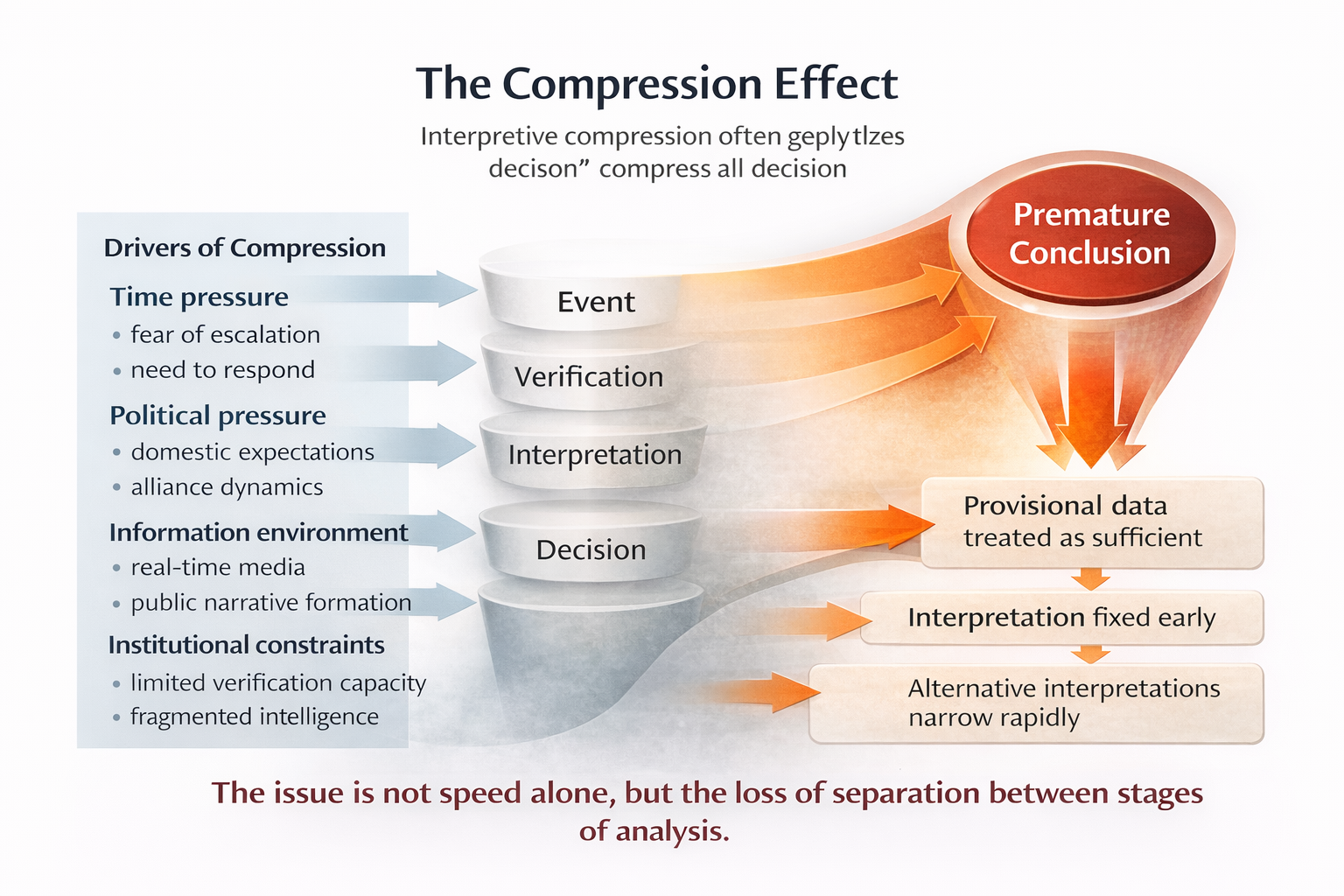
Interpretive compression refers to the shortening of the interval between event, interpretation, and decision, such that multiple analytical steps are effectively collapsed into a single moment.
In ordinary analytical sequence, distinct functions remain recognisable. Observation is followed by evidentiary collection. Verification is followed by evaluation. Interpretation remains open long enough for alternative readings to be considered. Legal and strategic judgment emerge only after at least some degree of analytical filtering has occurred.
Under crisis conditions, this separation may erode. Observation moves rapidly into interpretation. Interpretation moves rapidly into legal or strategic framing. Framing moves rapidly into public commitment or operational response. Steps that would normally be distinguishable become compressed into a chain so short that their differences are no longer meaningfully preserved.
The issue is not speed alone. It is the loss of analytical distance between stages that ordinarily serve as safeguards against premature certainty.

Drivers of Compression
Interpretive compression is driven by several mutually reinforcing pressures. These pressures do not require bad faith. They arise from the structure of crisis environments themselves.
Time pressure
Leaders may believe that delayed response increases vulnerability, weakens deterrence, or allows adversaries to shape the strategic environment first.
Political pressure
Domestic audiences, institutional constituencies, and alliance partners may expect immediate interpretation and visible resolve.
Information pressure
Real-time media and rapidly circulating claims compress interpretive timelines.
Institutional pressure
Verification and legal assessment processes may lag behind expectations.
The Compression Effect
Once interpretive compression takes hold, provisional data may begin to function as though it were sufficient. Early claims can acquire status beyond what their evidentiary maturity warrants.
Interaction with Technical Claims
Interpretive compression is especially consequential where crisis decisions rely on technical or intelligence-based claims.
This dynamic is examined in greater detail in Technical Claims and Verification , which focuses on how evidentiary uncertainty interacts with legal invocation under time pressure.
Conclusion
Understanding interpretive compression is essential to understanding how modern crises generate premature closure and systemic risk.
This dynamic is also closely related to Divergence of Legal Standards Under Crisis Pressure , which examines how shared legal language may remain in place while thresholds of interpretation, restraint, and justification begin to diverge across actors under sustained pressure.
