
The Geneva Charter Monitoring Model
A structured framework for visibility, verification, and legitimacy in international conduct
Monitoring is not a single activity. It is a layered system. The Geneva Charter Monitoring Model defines how observation becomes evidence, how evidence becomes accountability, and how accountability sustains legitimacy. Without structure, monitoring produces information. With structure, monitoring produces usable reality.
On this page
1. The Monitoring Model
The Geneva Charter Monitoring Model is a layered framework for understanding how fragmented observation becomes structured visibility, how structured visibility becomes verified record, and how verified record supports accountability and legitimacy. It does not replace institutions. It clarifies the functional chain through which they become effective.
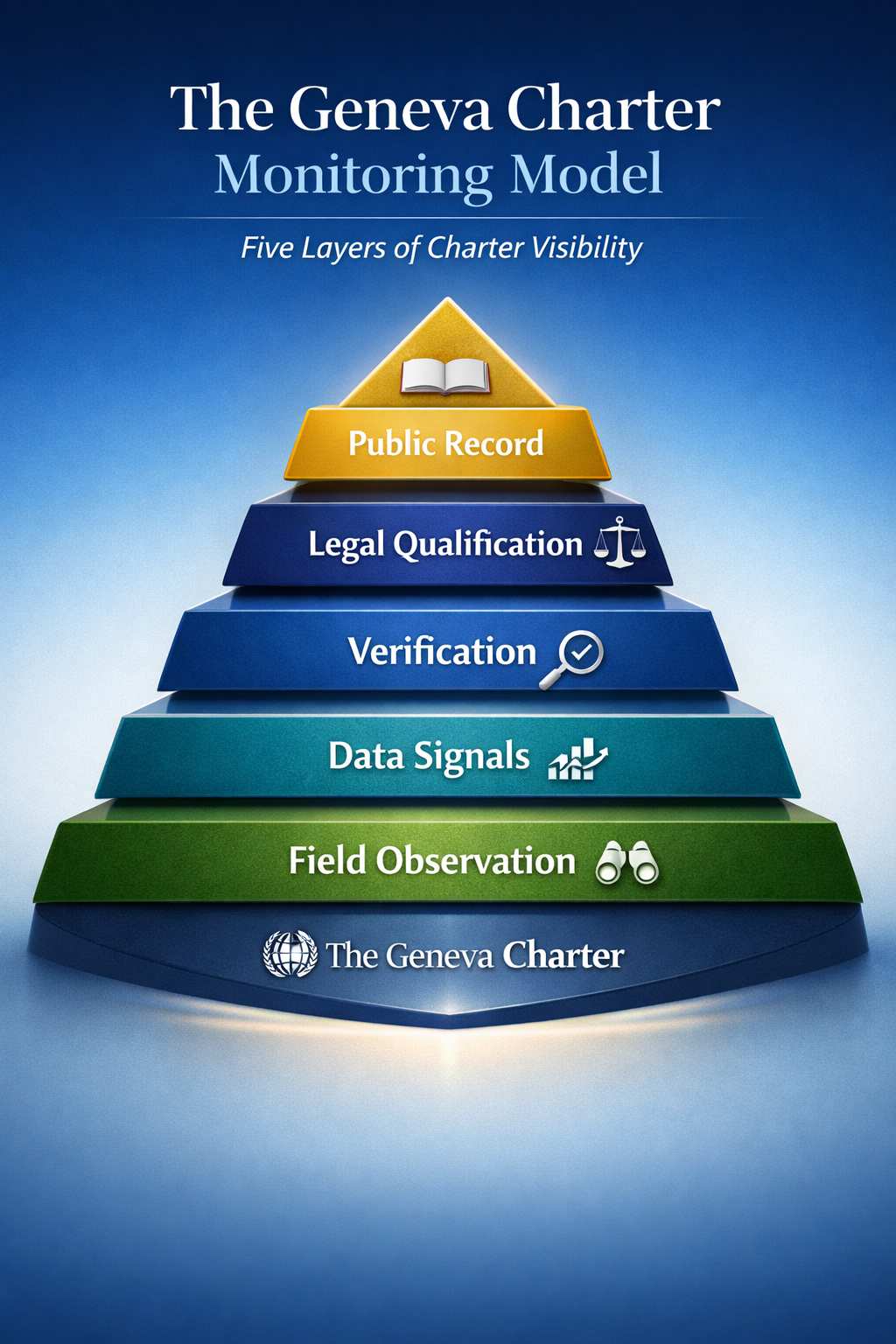
2. The Five Layers of Charter Visibility
The model is built on five interdependent layers. Each layer performs a distinct function. Each depends on the integrity of the layers below it. Together they form a monitoring chain that can support visibility, verification, legal consequence, and continuity of record.
These layers are not decorative categories. They are operational components of a functioning accountability system.
3. Field Observation
Field observation is the first layer of reality capture. It includes journalists, observers, rapporteurs, local reporting, eyewitness documentation, and direct situational visibility from affected environments.
Its function is to establish immediate, ground-level visibility. Without this layer, events may still occur, but they enter no credible record and remain vulnerable to denial, distortion, or silence.
Failure at this layer often takes the form of obstruction, censorship, intimidation, targeting, or absence of access.
4. Data Signals
Data signals form the pattern-recognition layer. They include conflict datasets, governance indicators, event frequency analysis, media-freedom measures, displacement figures, and other structured indicators that show whether isolated incidents are part of a larger trajectory.
Their function is to reveal systemic patterns beyond individual events. This is the layer where escalation becomes visible as a trend rather than only as a sequence of separate episodes.
Failure at this layer produces blindness to structural stress, hidden deterioration, and early warning loss.
5. Verification
Verification is the truth-validation layer. It includes source review, geolocation, metadata analysis where available, cross-source corroboration, sequence reconstruction, forensic assessment, and contextual integrity checks.
Its function is to separate claims from verified facts. In contested environments, and especially in an era of synthetic media and manipulated context, this layer is indispensable.
Failure at this layer allows rumor, fabrication, recontextualisation, and narrative distortion to enter the record as though they were established fact.
6. Legal Qualification
Legal qualification is the translation layer between verified reality and international law. It includes legal framing, categorisation of conduct, assessment of responsibility, and the identification of applicable legal standards or potential legal consequences.
Its function is to convert verified material into legally meaningful categories that can support adjudication, institutional response, and public legal understanding.
Failure at this layer means evidence may exist but remain unusable, legally inert, or disconnected from systems of formal accountability.
7. Public Record
Public record is the continuity and accountability layer. It includes archiving, documentation, public reference, preserved findings, structured summaries, and the long-term retention of verifiable record.
Its function is to ensure permanence, traceability, and future referenceability. Even where immediate adjudication is delayed or blocked, public record preserves continuity against erasure, revisionism, and institutional forgetfulness.
Failure at this layer leads to fragmented memory, weakened accountability, and the loss of cumulative institutional learning.
8. The Functional Chain
Field Observation -> Data Signals -> Verification -> Legal Qualification -> Public Record
No observation, no initial visibility.
No data signals, no systemic pattern recognition.
No verification, no reliable evidence.
No legal qualification, no structured legal consequence.
No public record, no continuity of accountability.
Break any layer, and the system degrades.
9. System Insight
The Geneva Charter does not replace journalists, observers, data institutions, investigative bodies, or legal systems. It connects them into a single functional chain. That is the central insight of the model.
In practice, the global accountability system is often fragmented. Observation exists without verification, data exists without legal consequence, evidence exists without public continuity, and institutions operate without structured connection. The Monitoring Model addresses this fragmentation at the level of framework and design.
10. Strategic Value
The Geneva Charter Monitoring Model provides strategic value by clarifying how visibility becomes usable. It supports early warning of escalation, strengthens evidentiary development, improves the conditions for legal process, supports mediation and diplomacy with better structured information, and preserves long-term continuity against denial and erasure.
Its importance lies not only in what it records, but in how it organises the path from fragmented observation to accountable understanding.
11. Geneva Charter Position
The Geneva Charter Monitoring Model is not an institution. It is a framework.
It provides a structured method through which fragmented observation can become visible, verifiable, legally meaningful, and publicly durable. In this sense, legitimacy is not merely declared. It is constructed through visible, verifiable, and recorded reality.
