
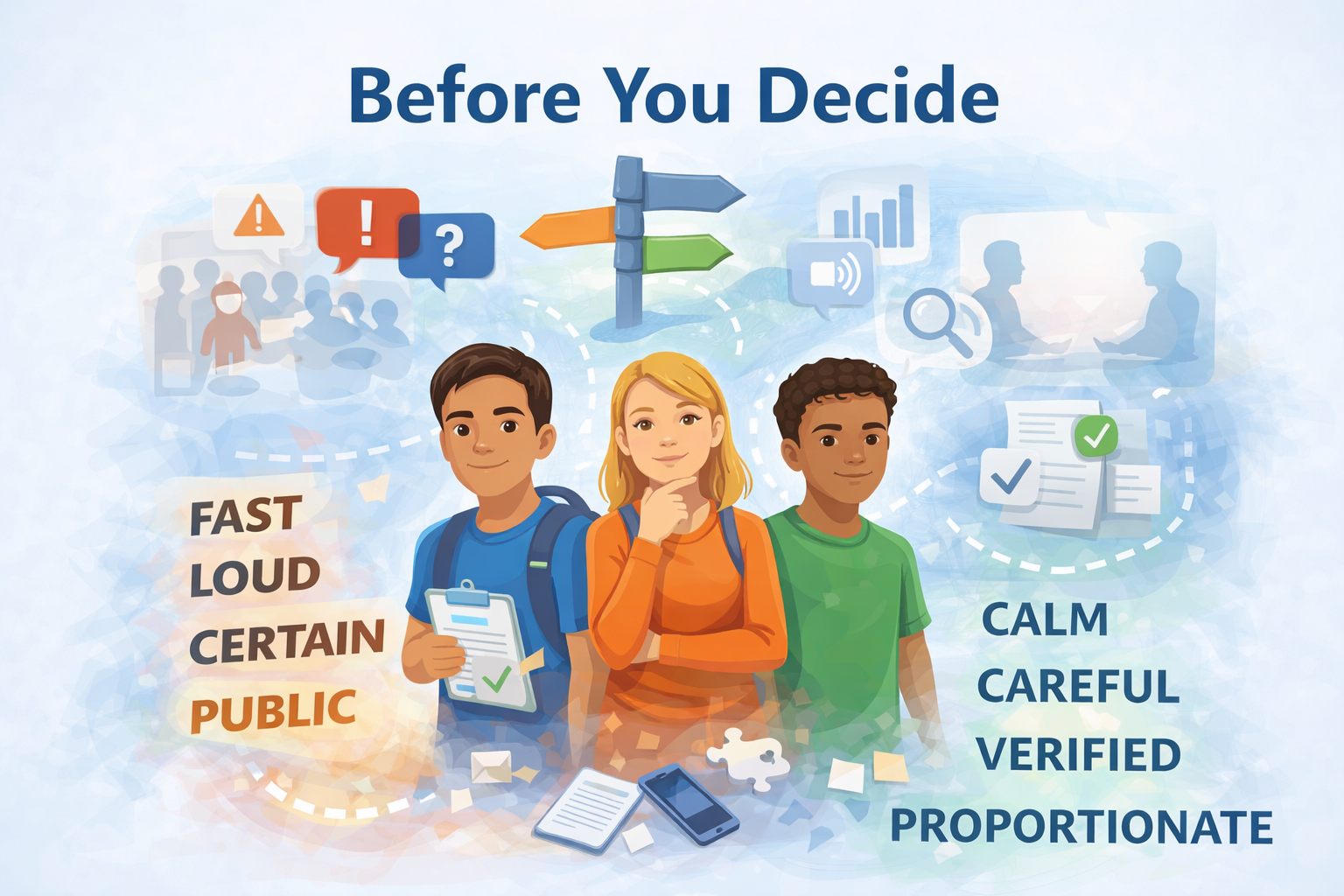
Crisis, Decision-Making, and Responsibility
At 16 to 18, you are old enough to see that many serious decisions are not made in calm conditions. They are made under pressure, with incomplete information, strong emotions, time pressure, reputation risk, and people demanding certainty before certainty exists.
This page is about what happens when a situation begins to feel like a crisis, and why responsibility means more than reacting fast. It means learning how to think, judge, and act when the pressure to get it wrong is rising.
Why this matters
By this age, you are already making decisions that affect other people. In school, online, in friendships, in sports, in leadership roles, and in public discussion, your words and reactions can shape how others understand events.
In difficult moments, the question is not only what happened.
The question is also how people decide what happened, how quickly they move, and who bears the cost when judgment outruns evidence.
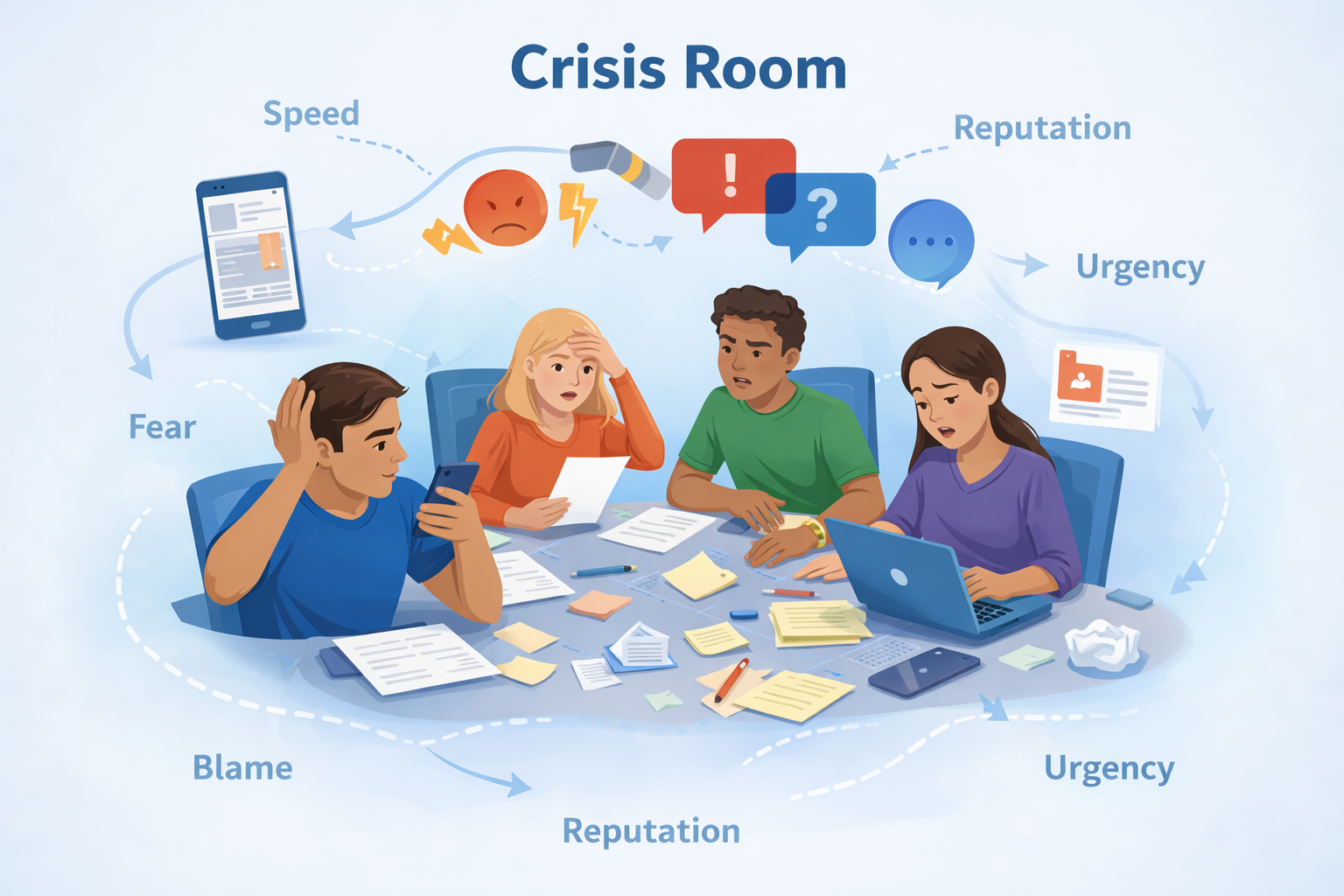
What a crisis often looks like
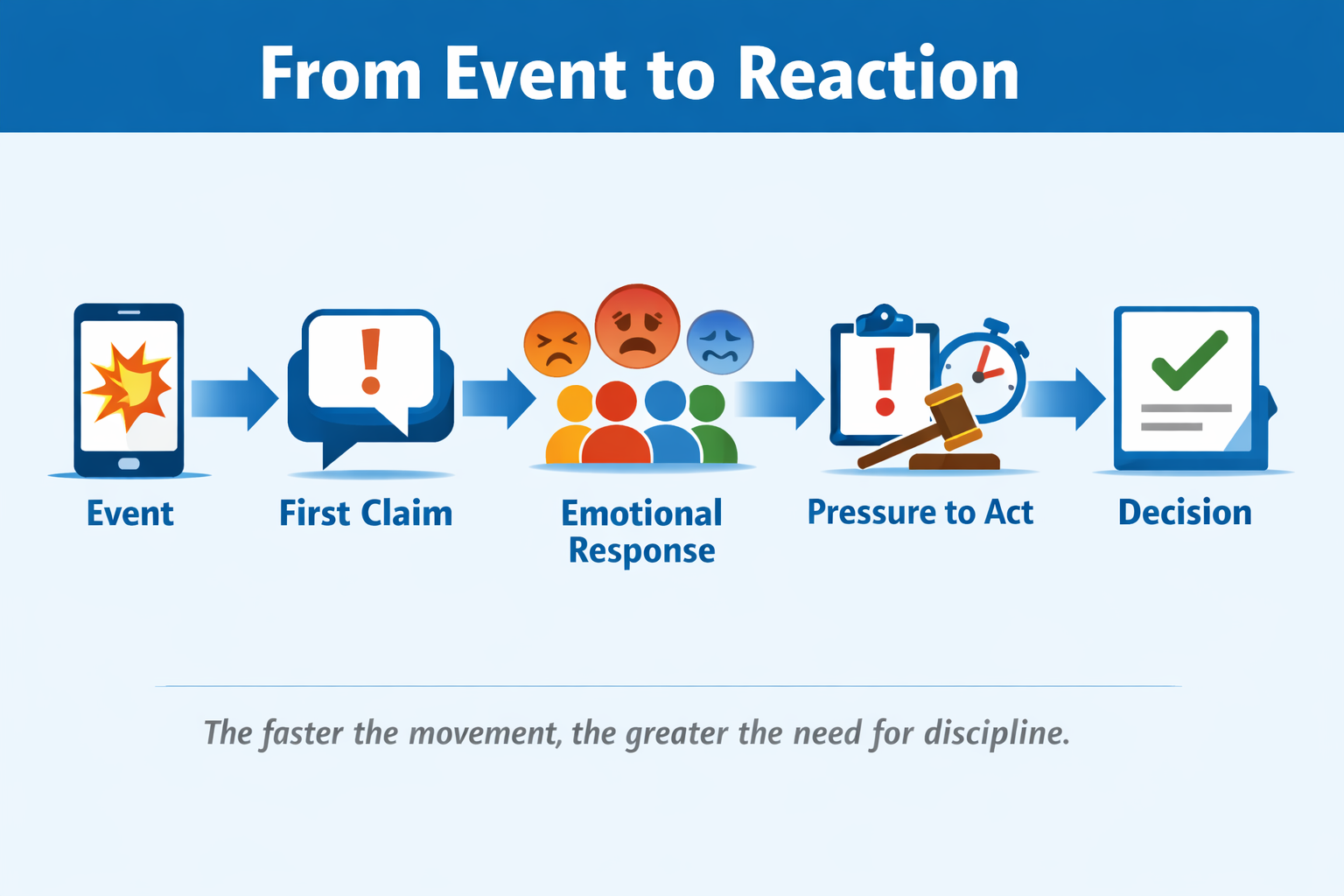
A message spreads. A claim is made. A clip appears. People start reacting before the full context is known.
Some demand immediate action. Others say waiting is dangerous. A few people ask questions, but they start sounding slow, difficult, or disloyal.
Very soon, speed starts to look like strength, and caution starts to look like weakness.
This is how many bad decisions begin.
A crisis does not only create urgency. It can also distort judgment.
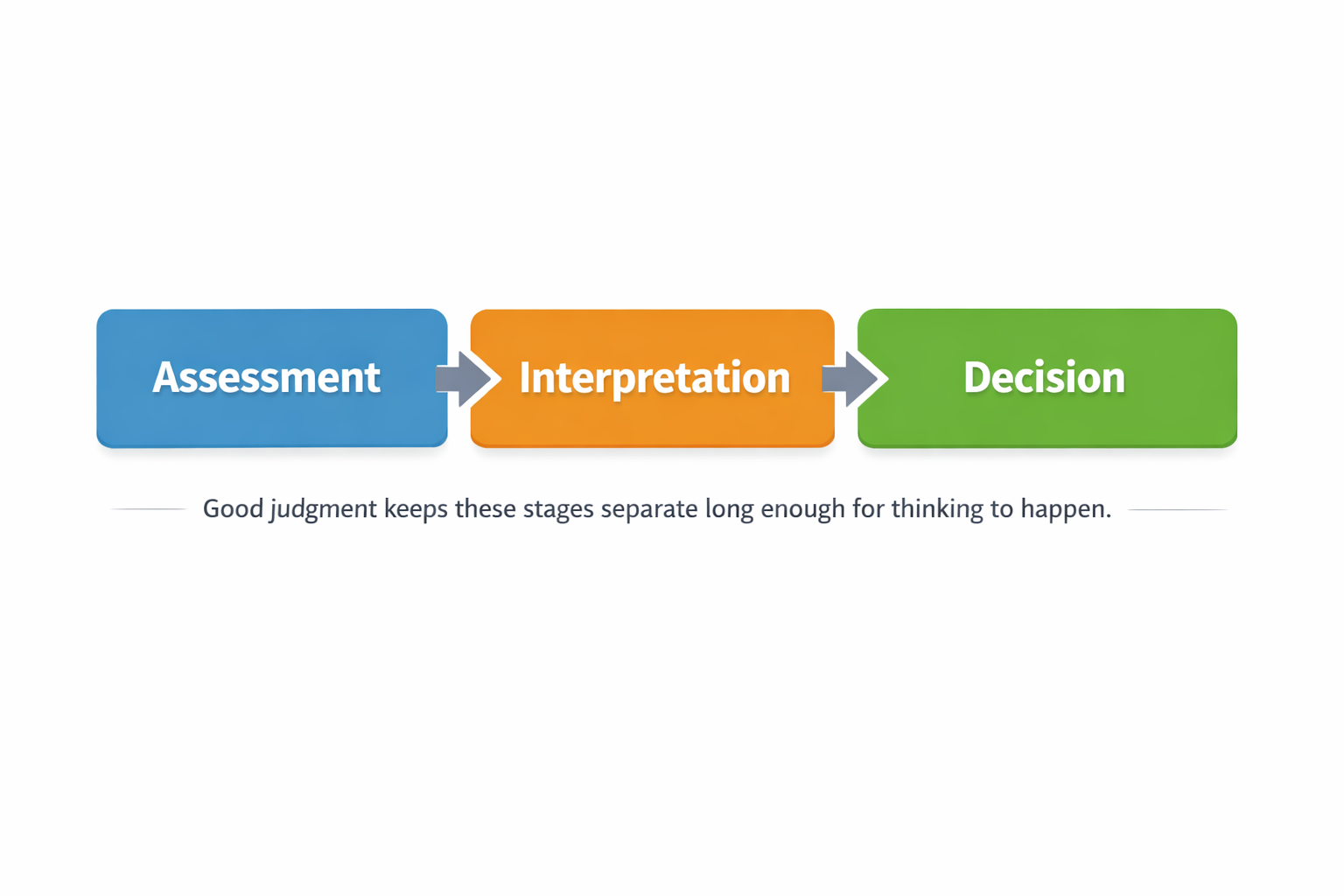
The three stages that often collapse
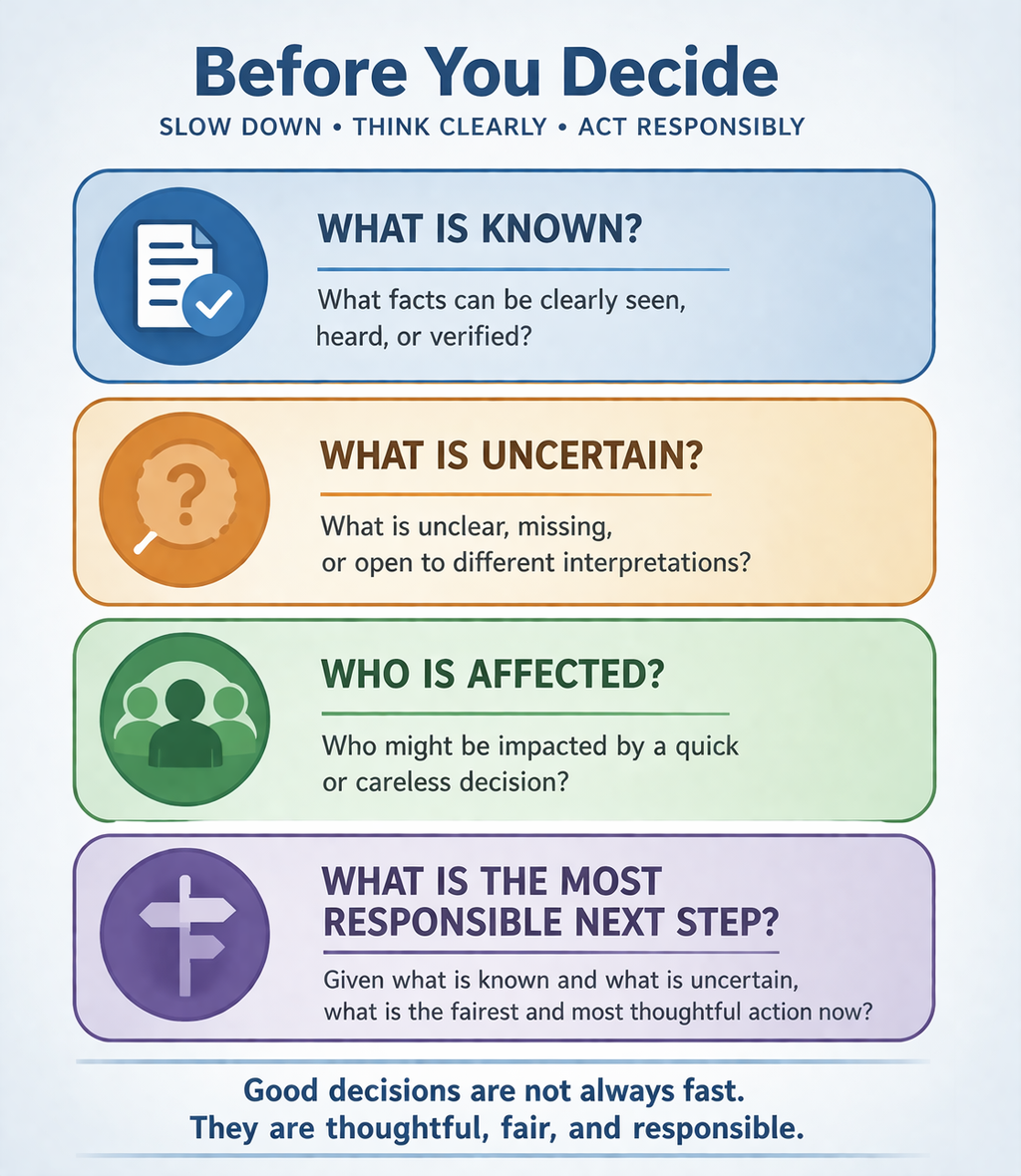
Assessment
What actually happened? What is confirmed? What is still unclear? What evidence exists?
Interpretation
What does it mean? Is it serious? Is it accidental, deliberate, exaggerated, incomplete, or misunderstood?
Decision
What should be done next? Speak, wait, verify, respond, report, protect, de-escalate, or reconsider?
In healthy decision-making, these stages remain separate long enough for thought to happen.
In unhealthy crisis decision-making, they collapse into each other. People move from fragment to meaning to action in one jump.
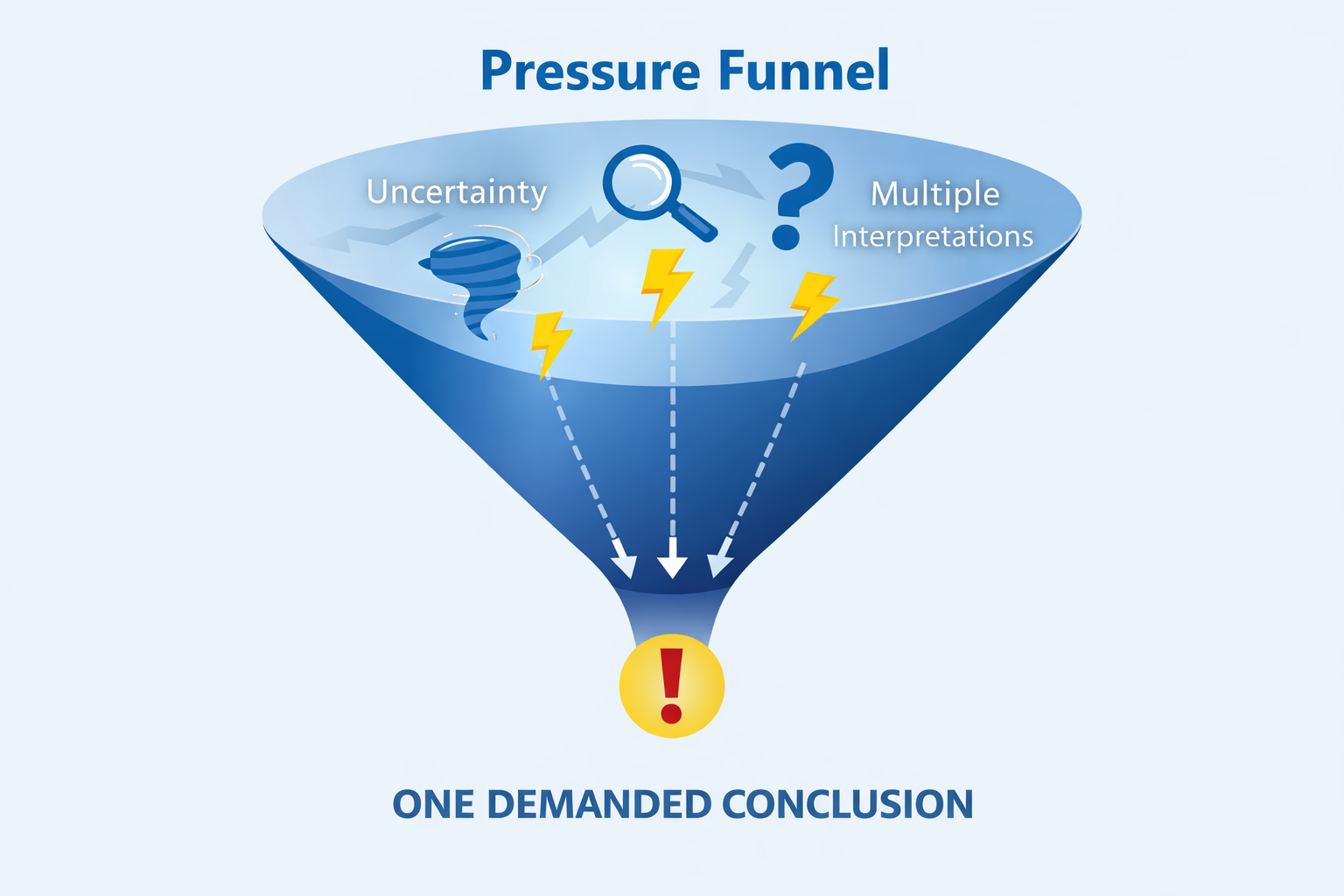
Why people make worse decisions under pressure
Common pressures
- fear of acting too late
- fear of looking weak or passive
- fear of being blamed afterwards
- group emotion and moral intensity
- public visibility and social media speed
- desire for a clear story before one exists
Common effects
- less patience for uncertainty
- stronger attraction to simple explanations
- greater trust in confident voices
- less room for nuance
- more pressure to choose a side immediately
- more risk of unfair or irreversible decisions
Pressure can make people feel morally certain before they are evidentially ready.
A situation to think about
Students repost fragments. Some say action must happen immediately. Others say silence is complicity. Some staff hear about it second-hand. By morning, the atmosphere has changed before any formal clarification has taken place.
In a situation like this, there may be genuine urgency. But urgency does not remove the need for fairness.
Responsible action is not slower because it cares less. It is slower because consequences are real.
Responsibility is not the same as reaction
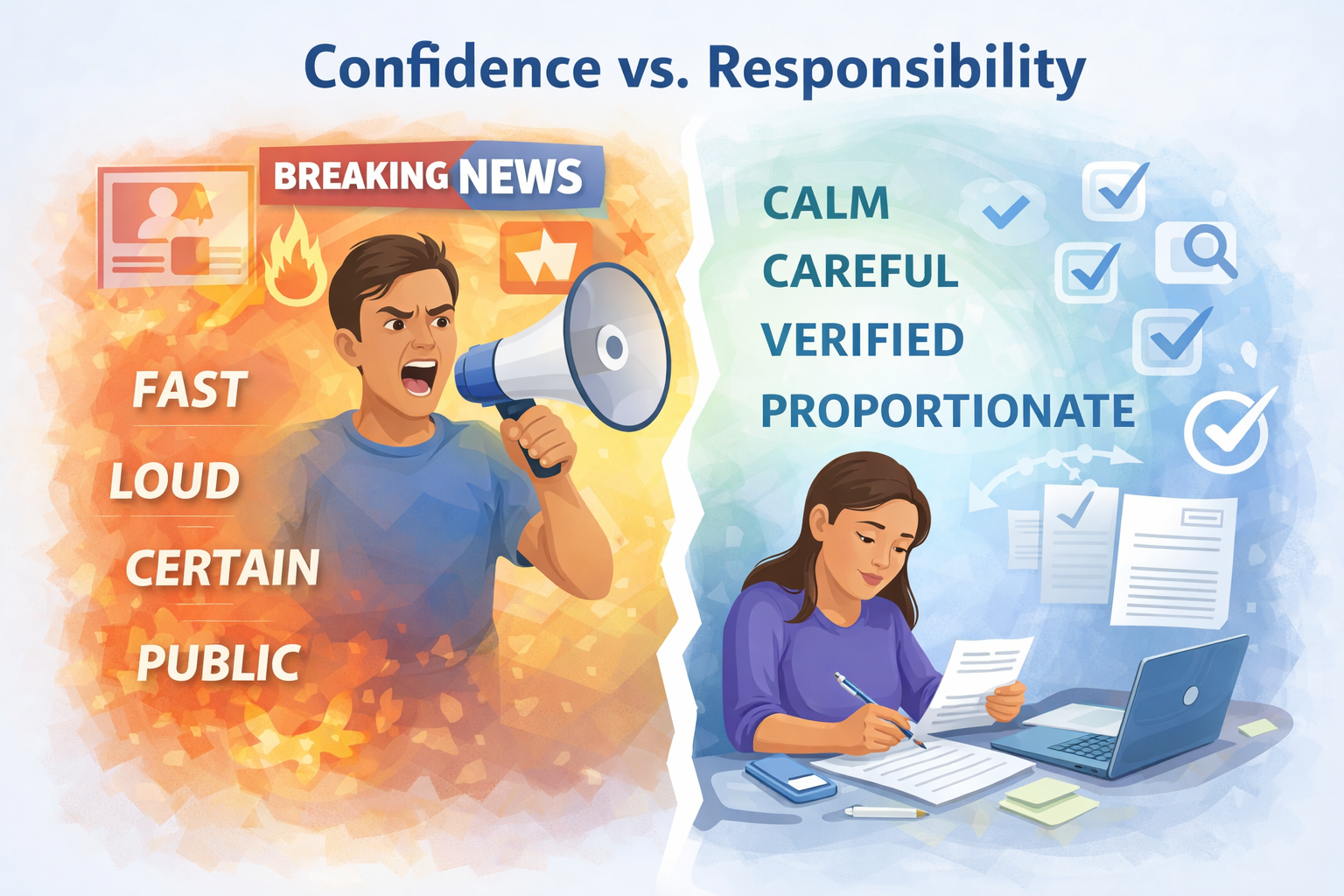
Many people think responsibility means stepping in immediately and forcefully. Sometimes it does. But very often, responsibility means something harder:
Reactive response
- moves quickly to show certainty
- treats doubt as weakness
- copies the speed of the crowd
- may create new harm while trying to stop harm
Responsible response
- protects people without inventing certainty
- distinguishes fact from assumption
- asks what is known and what is not
- understands that judgment has consequences
The more serious the claim, the greater the duty to think clearly.
What strong judgment sounds like
Strong judgment does not always sound dramatic. Often it sounds calm, precise, and disciplined.
Examples of disciplined thinking
- “We need to separate what is confirmed from what is being said.”
- “This may be serious, but we still need to know more.”
- “Protecting people and checking facts are not opposites.”
- “A fast conclusion is not always a fair conclusion.”
Examples of weak thinking under pressure
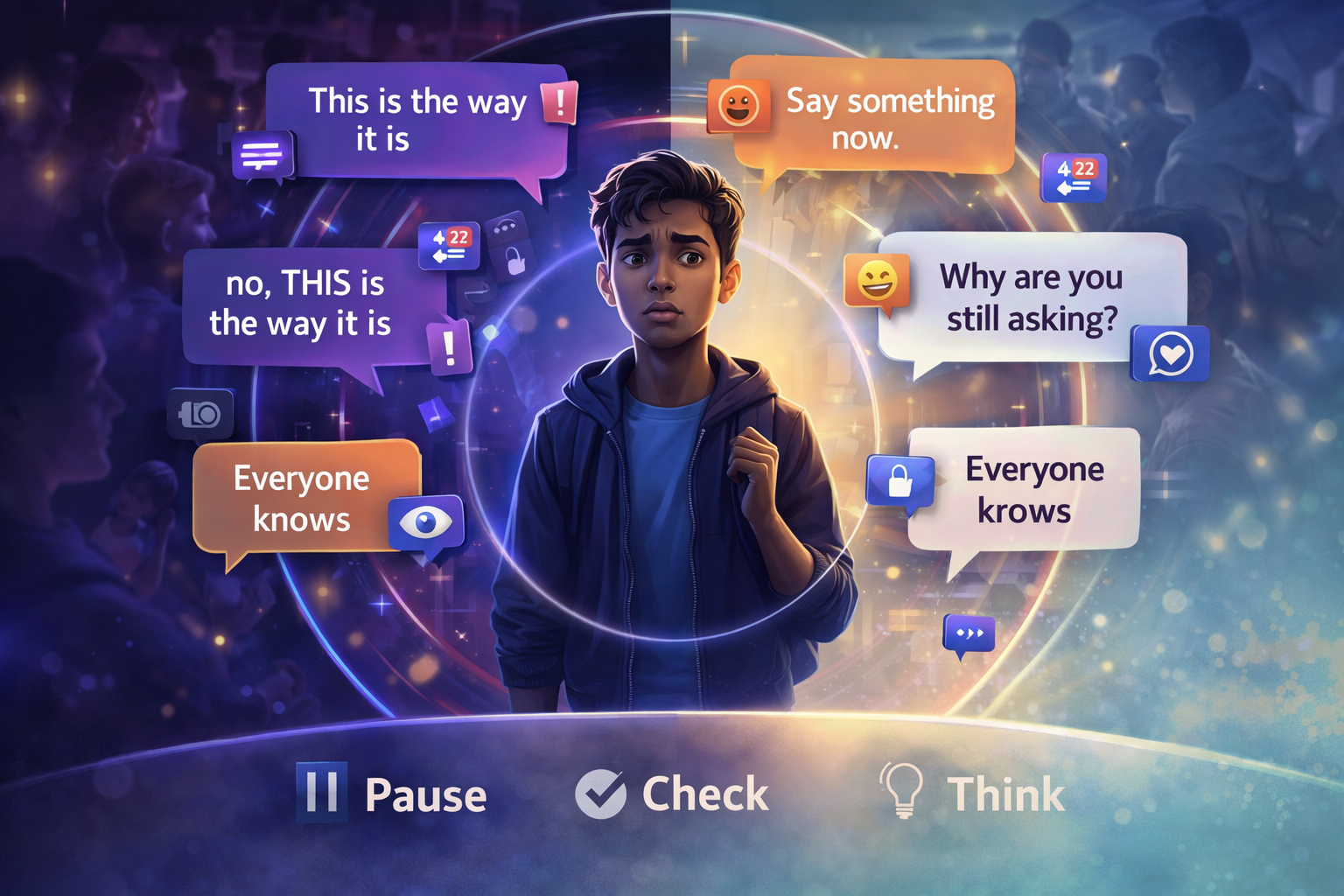
- “Everyone knows already.”
- “If you question this, you are part of the problem.”
- “We do not have time to think.”
- “If the clip exists, that is enough.”
What makes a decision fairer?
- clear distinction between report and interpretation
- attention to missing context
- space for correction if first impressions were wrong
- awareness of who is under pressure and who is not
- protection against public piling-on before facts are established
- willingness to slow the process where fairness requires it
Fairness is not indecision. It is disciplined judgment under conditions where mistakes can spread quickly.
Why this matters beyond school
The same patterns appear in media, politics, public crises, institutional leadership, and international affairs. A fragment appears. Pressure rises. Interpretations harden. Action is demanded. The cost of being wrong increases, but so does the pressure to sound certain.
Learning how crisis judgment works at your age is not a small skill.
It is preparation for citizenship, leadership, and responsibility in a world where speed often outruns wisdom.
Exercise 1: Crisis room simulation
Give students a short scenario in stages, not all at once.
Round 1
Students receive only the first fragment and must state what is known and what is not known.
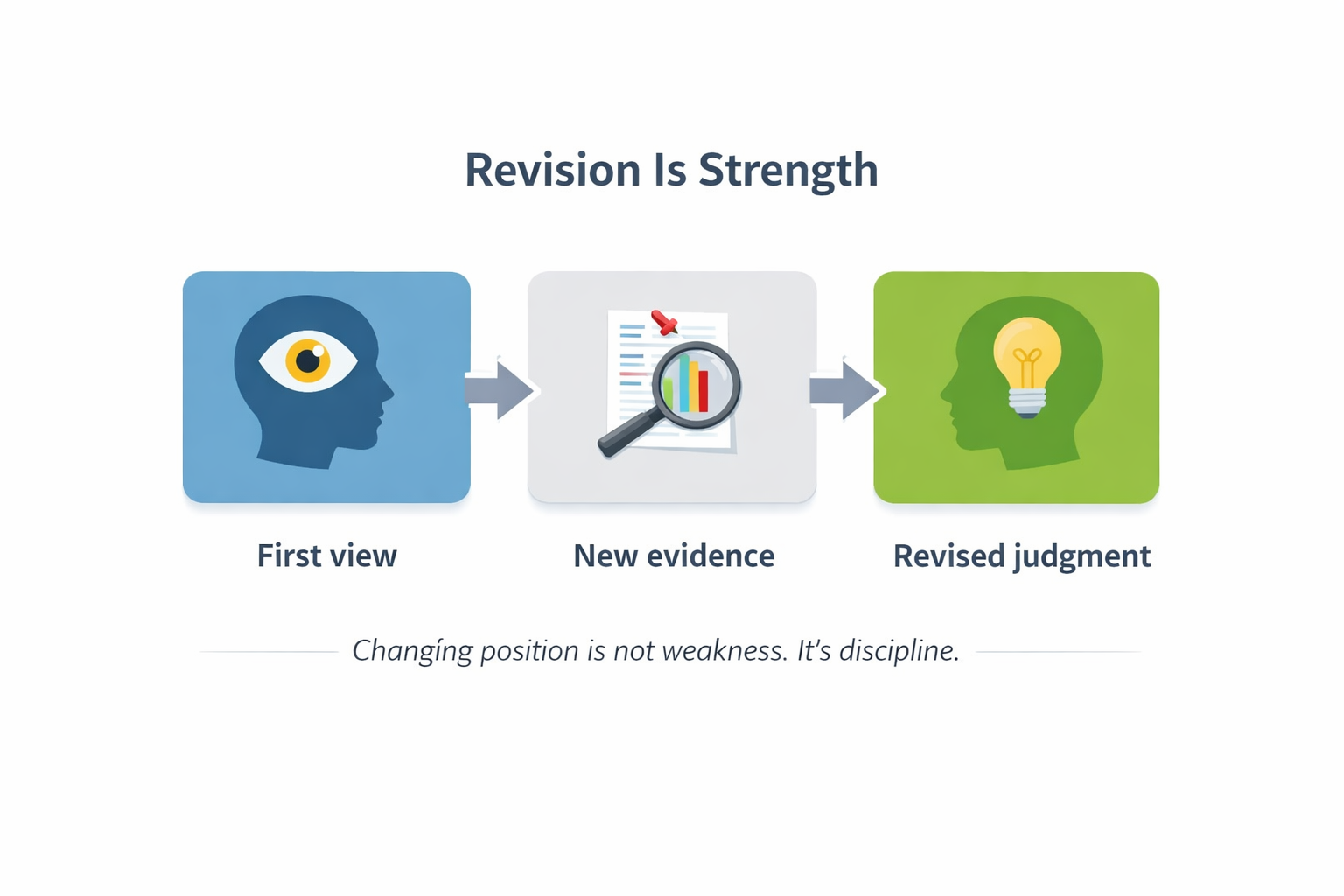
Round 2
A new piece of information arrives that changes the picture. Students revise their earlier assessment.
Round 3
Social pressure is added. Students must decide what a responsible next step would be.
Exercise 2: Separate assessment from decision
Give students a scenario and ask them to complete three boxes:
Assessment
List only what can be directly supported.
Interpretation
List possible meanings, but rank them by confidence.
Decision
Choose the fairest and most proportionate next step.
Exercise 3: The cost of getting it wrong
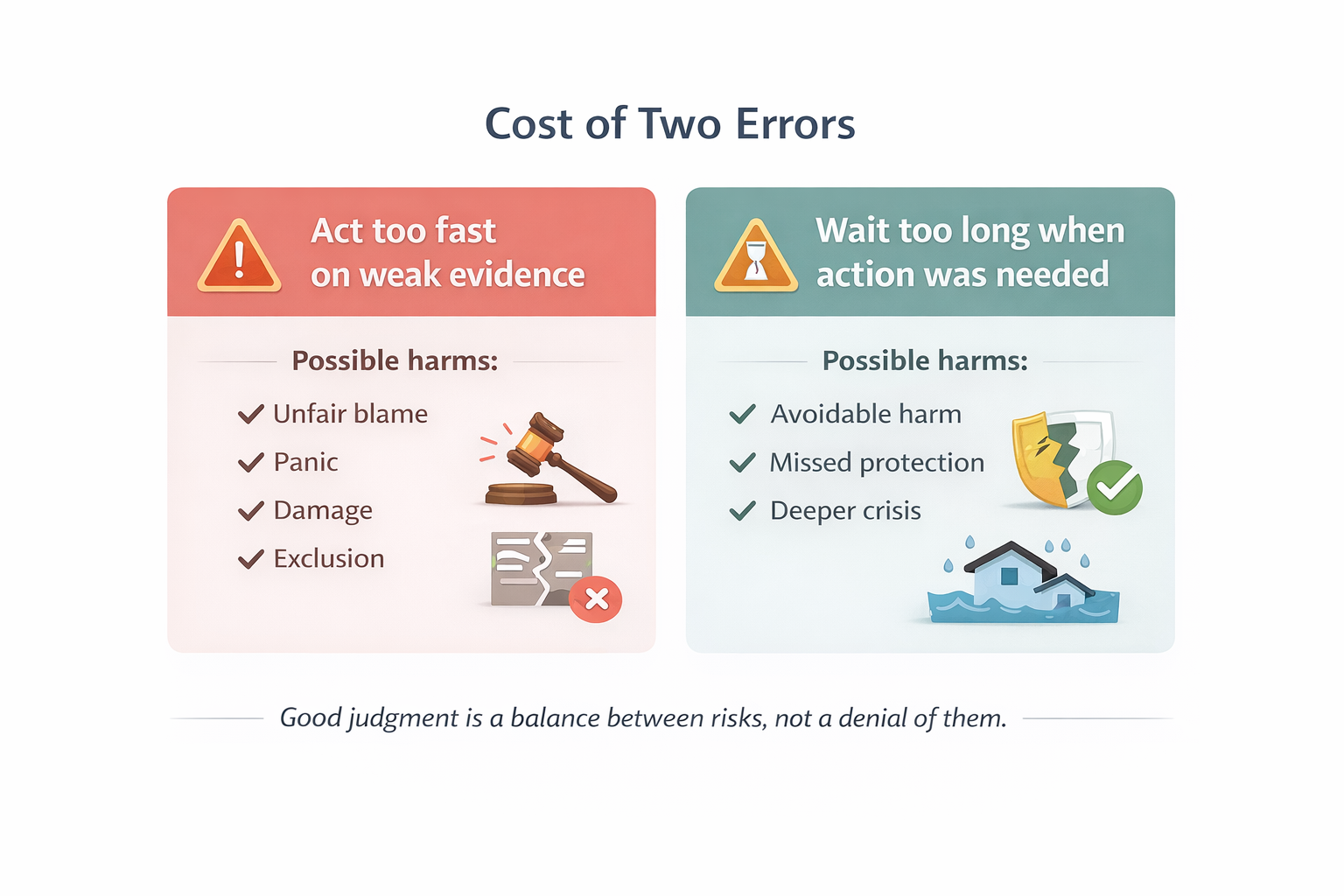
Split the room into small groups. Each group must assess the consequences of two kinds of error:
Error A
Acting too fast on weak evidence.
Error B
Waiting too long when genuine action was needed.
Then ask:
- Which error is discussed more often?
- Which error is easier to see afterwards?
- How should good judgment balance the two?
Exercise 4: Rewrite the public statement
Give students an overly confident, emotionally charged public statement about a confusing incident.
Ask them to rewrite it so that it becomes:
- factually cleaner
- fairer to those involved
- clear about uncertainty
- still responsible and serious
Exercise 5: Decision ladder
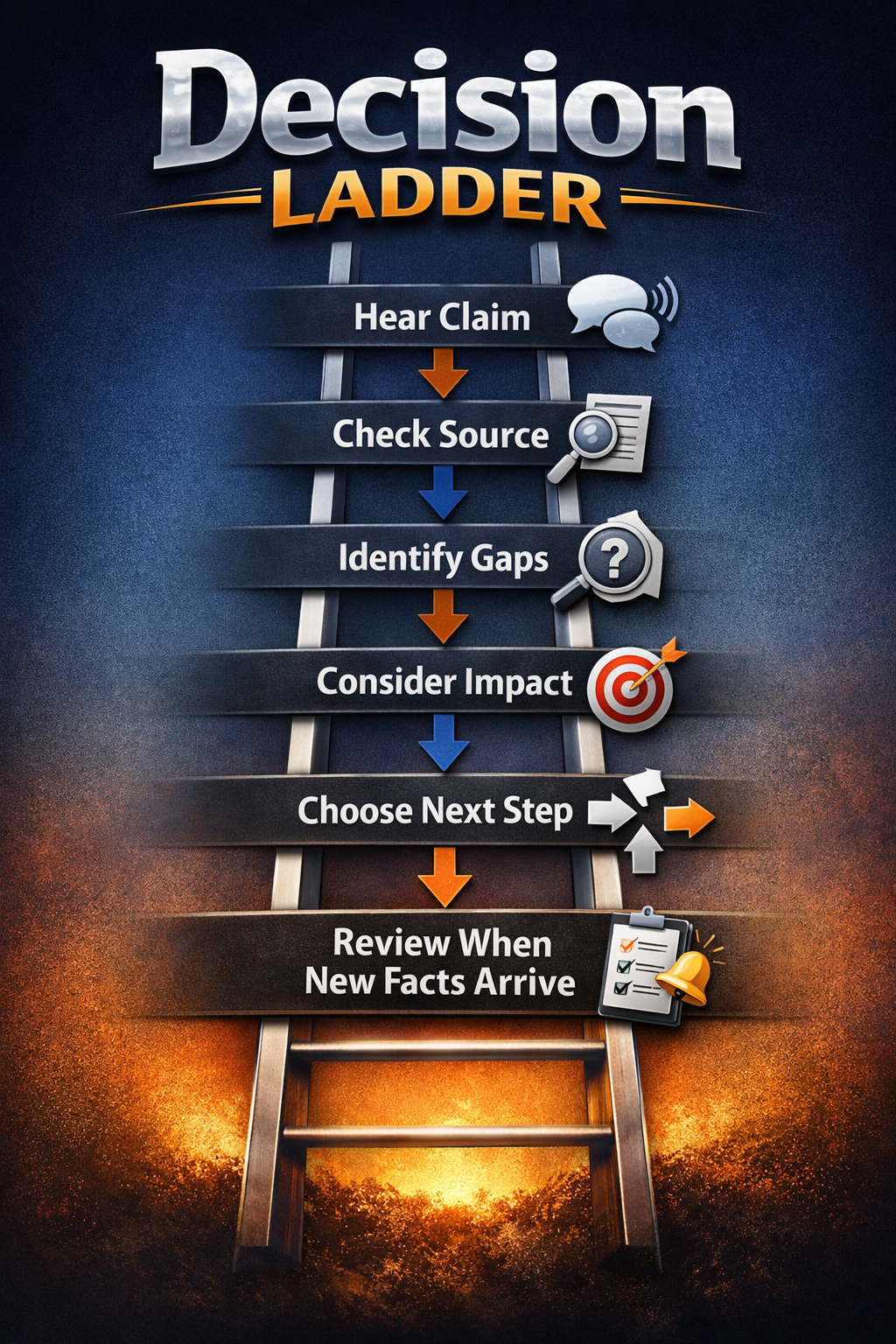
Put the following steps on cards and ask students to arrange them in the most responsible order:
- hear the claim
- repeat the claim
- check the source
- identify what is missing
- consider who may be harmed
- choose a proportionate next step
- review when new facts arrive
The goal is to show that responsibility is a sequence, not a mood.
Suggested examples for this age group
Examples that work well
- a serious rumor spreading before verification
- a clip that appears clear but lacks context
- pressure on student leaders to react publicly
- a group demanding immediate certainty
- an online claim that triggers strong moral reactions
Examples to handle carefully
- live conflicts involving identifiable students
- highly traumatic cases without support
- examples so politically loaded that the class leaves the core lesson
- cases where students may feel personally exposed
What this page is really teaching
It is teaching that crisis changes judgment.
It is teaching that pressure can compress thinking.
It is teaching that fairness becomes more difficult, and more important, when people are scared, angry, or pushed to move fast.
Above all, it is teaching that responsibility is not only about doing something. It is about making sure that what you do is worthy of the seriousness of the moment.
Teacher Note
This page suits older secondary students because it respects their ability to think about fairness, institutional trust, leadership, public pressure, and consequences. The tone should remain serious, not melodramatic. Students at this age can handle complexity if the structure is clear.
The most useful classroom atmosphere is one where uncertainty can be spoken aloud without being treated as moral weakness. The aim is not passivity. The aim is disciplined judgment under pressure.
