
Divergence of Legal Standards Under Crisis Pressure
This page provides an analytical lens within The Geneva Charter framework for understanding how legal standards may begin to diverge under conditions of crisis, prolonged pressure, and institutional strain. Its focus is not on whether law formally disappears, but on how shared legal language may remain in place while thresholds of interpretation, application, and enforcement begin to separate across actors.
In many contemporary crises, legal rules continue to be invoked by all sides. References to self-defence, proportionality, necessity, distinction, civilian protection, humanitarian access, and institutional legitimacy often remain central to public justification. Yet the persistence of legal language does not by itself guarantee convergence in legal meaning. Under pressure, states and institutions may begin to apply similar legal terms at different evidentiary thresholds, with different tolerances, different classifications, and different operational consequences.
This page does not argue that disagreement over law is new, nor that all legal divergence is illegitimate. Its purpose is narrower. It identifies a recurring structural dynamic in which crisis pressure, compressed interpretation, strategic asymmetry, and prolonged exposure contribute to widening divergence in how legal standards are understood and operationalised in practice.
The Problem
Shared legal frameworks depend not only on formal texts, but also on a sufficient degree of common interpretive discipline. Where multiple actors invoke the same legal system while applying it through increasingly different thresholds, the stabilising function of law may weaken even though the language of legality remains active.
This problem becomes especially visible in crisis settings. Events unfold under pressure. Evidence remains incomplete. Decisions are made quickly. Political alignment and reputational risk shape public positioning. Institutional review may lag behind operational tempo. In such conditions, the practical meaning of legal rules can begin to diverge even before that divergence is openly acknowledged.
The result is not necessarily a formal rejection of law. It is a structural condition in which the same legal categories are used across actors, but applied through increasingly different assumptions, tolerances, and standards of proof.
This distinction matters. A system may continue to speak in legal terms while losing coherence in legal application.
What Divergence Means
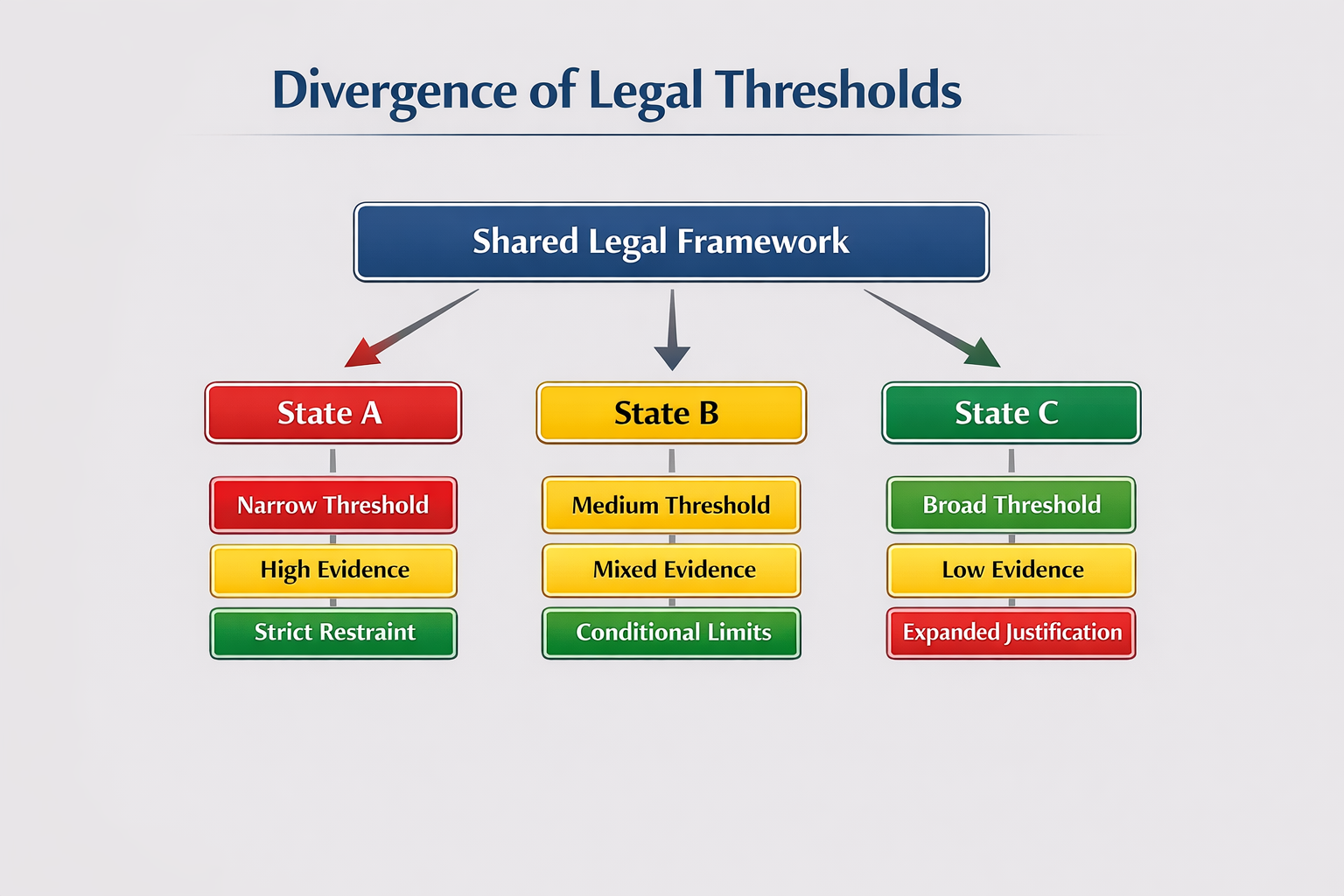
Divergence of legal standards refers to the widening gap between formally shared legal rules and the practical thresholds through which those rules are interpreted, invoked, and applied under pressure.
Such divergence does not require the disappearance of legal language. It may occur while all parties continue to affirm commitment to international law, the UN Charter, and international humanitarian law. The divergence emerges at the level of application. Similar conduct may be classified differently by different actors. Comparable evidentiary material may be treated as sufficient by some and insufficient by others. Identical legal terms may retain formal continuity while their operational meaning drifts apart.
This can affect several dimensions at once:
- thresholds for attribution and responsibility
- tolerances for evidentiary uncertainty
- definitions of imminence, necessity, and proportionality
- expectations regarding civilian protection and precaution
- standards for institutional response, scrutiny, and enforcement
The issue is not simply that legal disagreement exists. The issue is when disagreement becomes patterned, recurrent, and asymmetrical under conditions of sustained crisis pressure.
Why Divergence Emerges
Divergence of legal standards does not arise from a single cause. It is typically driven by several pressures acting at once. These pressures do not require open rejection of law. They arise from the interaction between legal interpretation, strategic incentives, institutional delay, and crisis tempo.
Strategic asymmetry
States do not enter crises with identical security positions, alliance structures, military capabilities, or exposure to reputational cost. These asymmetries can shape how legal thresholds are calibrated in practice.
Compressed interpretation
Under crisis conditions, legal framing may be attached to events before evidence and institutional review have matured sufficiently to support stable consensus.
Selective evidentiary thresholds
Similar forms of uncertainty may be treated differently depending on political alignment, institutional interest, or perceived strategic necessity.
Institutional strain
International institutions may face delay, fragmentation, capacity limitations, or political obstruction, reducing their ability to maintain consistent interpretive reference points.
Alliance expectations
Partnerships and bloc dynamics may influence how quickly legal positions are adopted, defended, qualified, or softened in public.
Duration and repetition
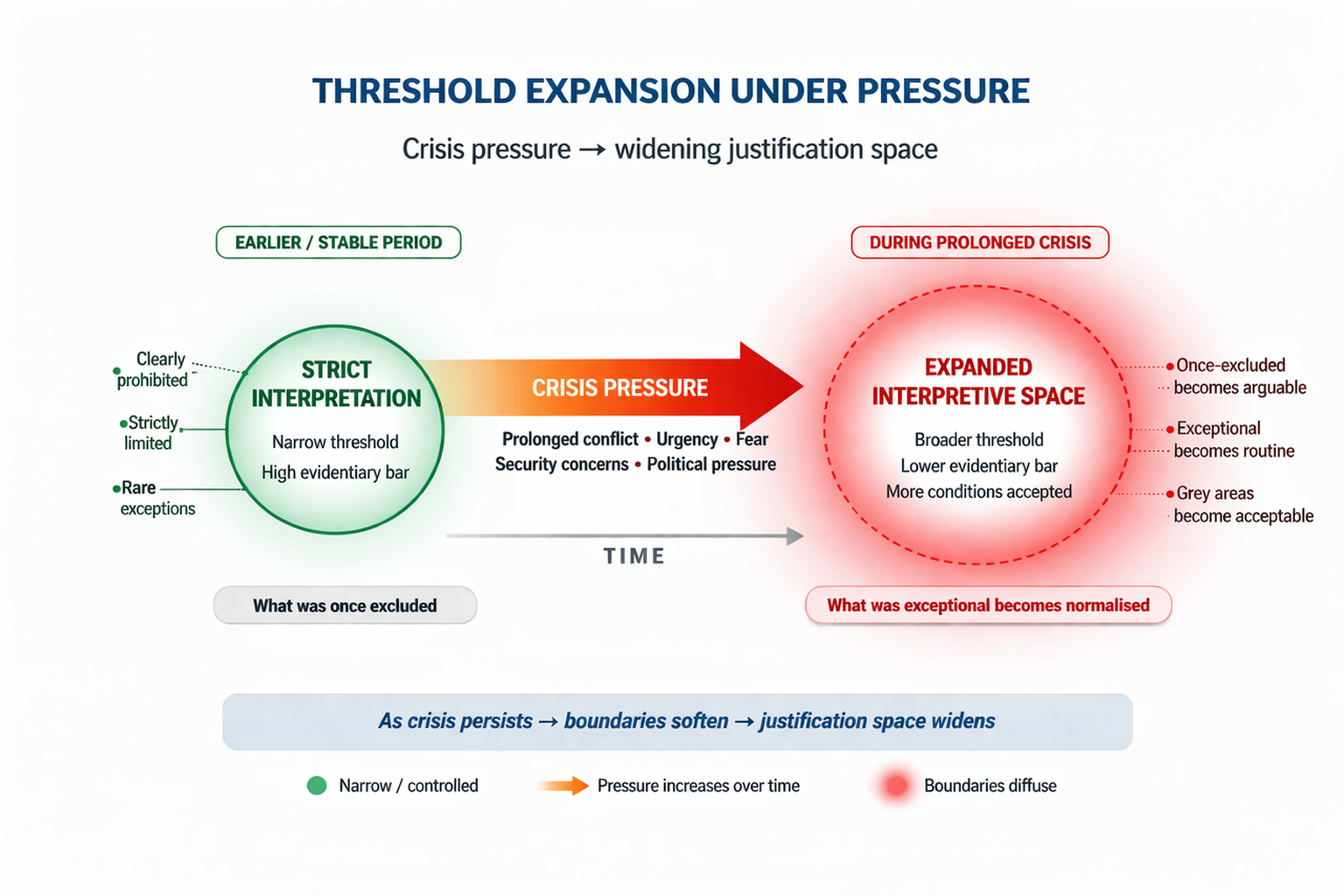
Over time, repeated exception-making can normalise broader interpretive pathways, making divergence appear operationally routine rather than situationally exceptional.
Where these pressures converge, legal language may remain shared while legal application becomes increasingly differentiated.
How Divergence Manifests
Divergence of legal standards becomes visible not only in formal declarations, but in patterns of description, classification, tolerance, and response. The same event may be presented through markedly different legal vocabularies depending on the actor describing it. Similar conduct may trigger urgent legal scrutiny in one context and strategic hesitation in another.
This divergence may manifest through:
- different classifications of comparable conduct
- different thresholds for accepting claims of self-defence or necessity
- different tolerances for evidentiary incompleteness
- different levels of urgency regarding investigation and accountability
- different expectations regarding restraint, precaution, and civilian risk
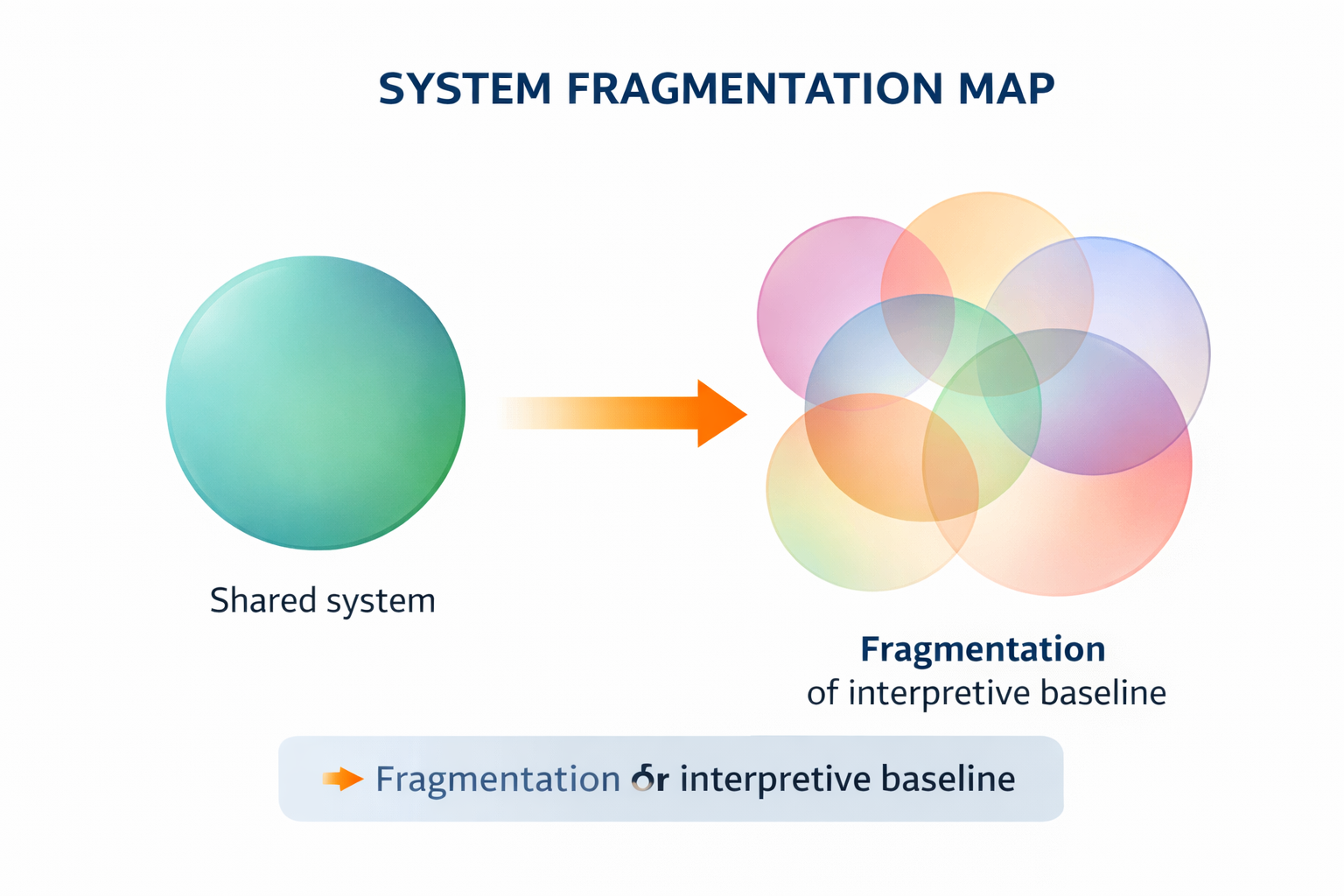
In such settings, legal divergence is often experienced less as open contradiction than as patterned inconsistency. The appearance of continuity remains, but the interpretive baseline begins to fragment.
Operational Consequences: Threshold Shift in Targeting and Protection
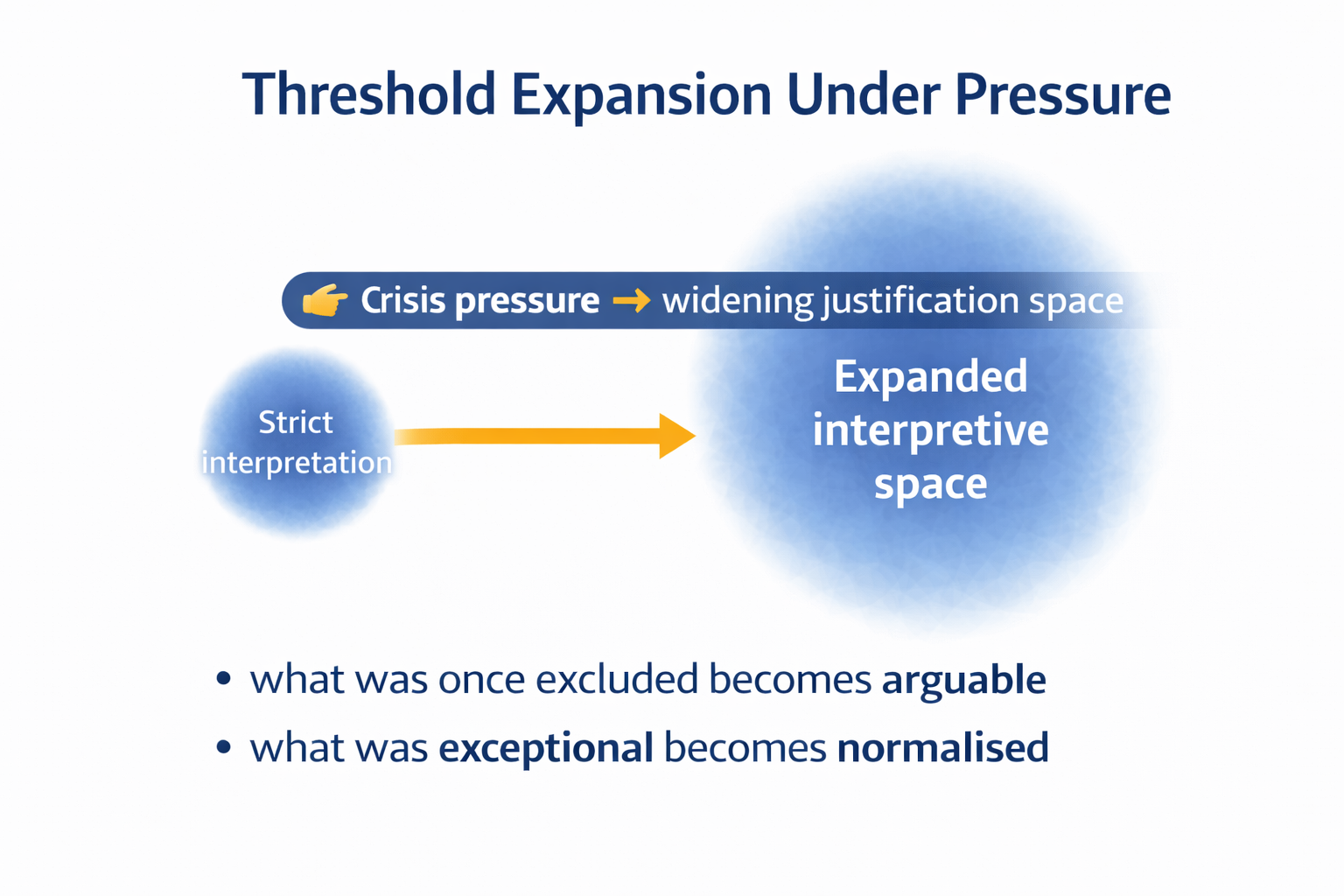
Divergence in legal standards may affect not only formal legal positioning, but operational practice. In high-intensity or prolonged crisis environments, thresholds governing targeting, classification, precaution, and proportionality may begin to shift under pressure, particularly where urgency, strategic necessity, or exceptional circumstances are invoked to justify accelerated decision-making.
The issue is not necessarily the formal removal of legal protections. It is the widening of interpretive pathways through which protections may be qualified, narrowed, or set aside in practice. Categories of objects and sites traditionally afforded heightened protection under international humanitarian law may become subject to broader claims of exception, association, dual-use reasoning, or proximity-based justification.
Under such conditions, the distinction between protected and targetable objects may become increasingly dependent on contested classification rather than stable shared thresholds. This may affect civilian infrastructure as well as facilities and sites ordinarily regarded as requiring heightened caution, including medical facilities, places of worship, educational institutions, cultural sites, cemeteries, displacement areas, and refugee-related sites.
The analytical concern is not confined to formal doctrine. It lies in the operational effects of interpretive elasticity. Where crisis pressure widens the range of what can be argued to fall within military logic, protective rules may remain textually intact while becoming less predictably constraining in practice.
Duration Effects: Degradation of Restraint Under Prolonged Exposure
Prolonged crisis environments may affect not only legal interpretation at the institutional level, but also the consistency of restraint at the operational level. Duration matters. What is initially treated as exceptional may, through repetition, fatigue, and continued exposure to violence, become operationally normalised over time.
This does not eliminate formal legal obligations. However, it may affect how consistently those obligations are applied in practice across units, situations, and time. Sustained exposure to high-intensity conditions, cumulative psychological strain, repeated confrontation with destruction, and prolonged uncertainty may all contribute to reduced consistency in precaution, classification, and restraint.
The issue is not the disappearance of legal norms, but the gradual erosion of consistency in their application under sustained pressure. Over time, prolonged exposure may shift the operational baseline, such that actions previously regarded as exceptional come to be treated as situationally acceptable within an expanded field of tolerance.
This can increase the risk of:
- reduced sensitivity to exceptional harm
- greater tolerance for ambiguity in targeting decisions
- increased reliance on simplified or accelerated classifications
- weakened consistency in the observance of precautionary measures
- higher risk of deviation from established rules of engagement and protective norms
In this sense, duration does not merely prolong a crisis. It can alter the behavioural and interpretive environment within which restraint is expected to operate.
Systemic Consequences
Once divergence in legal standards becomes patterned, the consequences extend beyond any individual incident. Confidence in shared interpretation may weaken. Institutional responses may appear increasingly selective. Multilateral coordination becomes more difficult when actors invoke common rules while operating with materially different thresholds.
Over time, this can contribute to:
- reduced interpretive clarity across the international system
- declining confidence in consistency of legal application
- weaker stabilising effect of formally shared rules
- greater susceptibility to escalation under contested legal narratives
- expanded opportunities for strategic manipulation of legal ambiguity
The cumulative result is not necessarily the collapse of legal order, but a weakening of its common reference function. Law may remain present, but its ability to stabilise expectations across actors may diminish.
Relationship to the Wider Analytical Framework
Divergence of legal standards under crisis pressure should not be viewed in isolation. It is closely related to other structural dynamics examined within The Geneva Charter framework.
It is examined alongside Technical Claims and Verification , which focuses on how evidentiary uncertainty interacts with legal invocation under time pressure.
It is also closely related to Interpretive Compression in Crisis Decision-Making , which examines how decision processes contract under pressure, reducing the separation between observation, interpretation, and action.
Taken together, these pages describe a sequence in which evidentiary instability, compressed interpretation, and patterned divergence in legal application reinforce one another under prolonged crisis conditions.
Analytical Clarification
The Geneva Charter approach does not assume that legal disagreement can be eliminated from international life. Nor does it suggest that all variation in legal interpretation is illegitimate. Its concern is narrower and more structural.
The issue is not that legal disagreement exists. The issue is when crisis pressure produces recurrent, asymmetrical, and operationally consequential divergence in the application of formally shared rules.
This distinction matters. A legal system can survive disagreement. What places strain on its stabilising function is the growth of patterned divergence under conditions where law is still publicly invoked as common ground.
In this sense, divergence of legal standards under crisis pressure is not simply a matter of doctrine. It is a structural diagnostic category for understanding how legal order may persist formally while weakening operationally as a shared reference framework.
Conclusion
Shared legal texts do not automatically produce shared legal thresholds. Under crisis pressure, prolonged exposure, strategic asymmetry, and institutional strain, the practical meaning of legal standards may begin to diverge even while the language of legality remains active across all parties.
The resulting problem is not merely interpretive disagreement in the abstract. It is the weakening of law’s ability to function as a stable common reference point across actors, institutions, and operational environments. Where divergence deepens, restraint becomes less predictable, protection less secure, and multilateral coordination more difficult.
Understanding divergence of legal standards under crisis pressure is therefore essential to understanding how the international system may retain formal legal continuity while experiencing practical fragmentation in the application of law.
