
Distortion Gap Analysis
Measuring the Divergence Between Events and Narrative
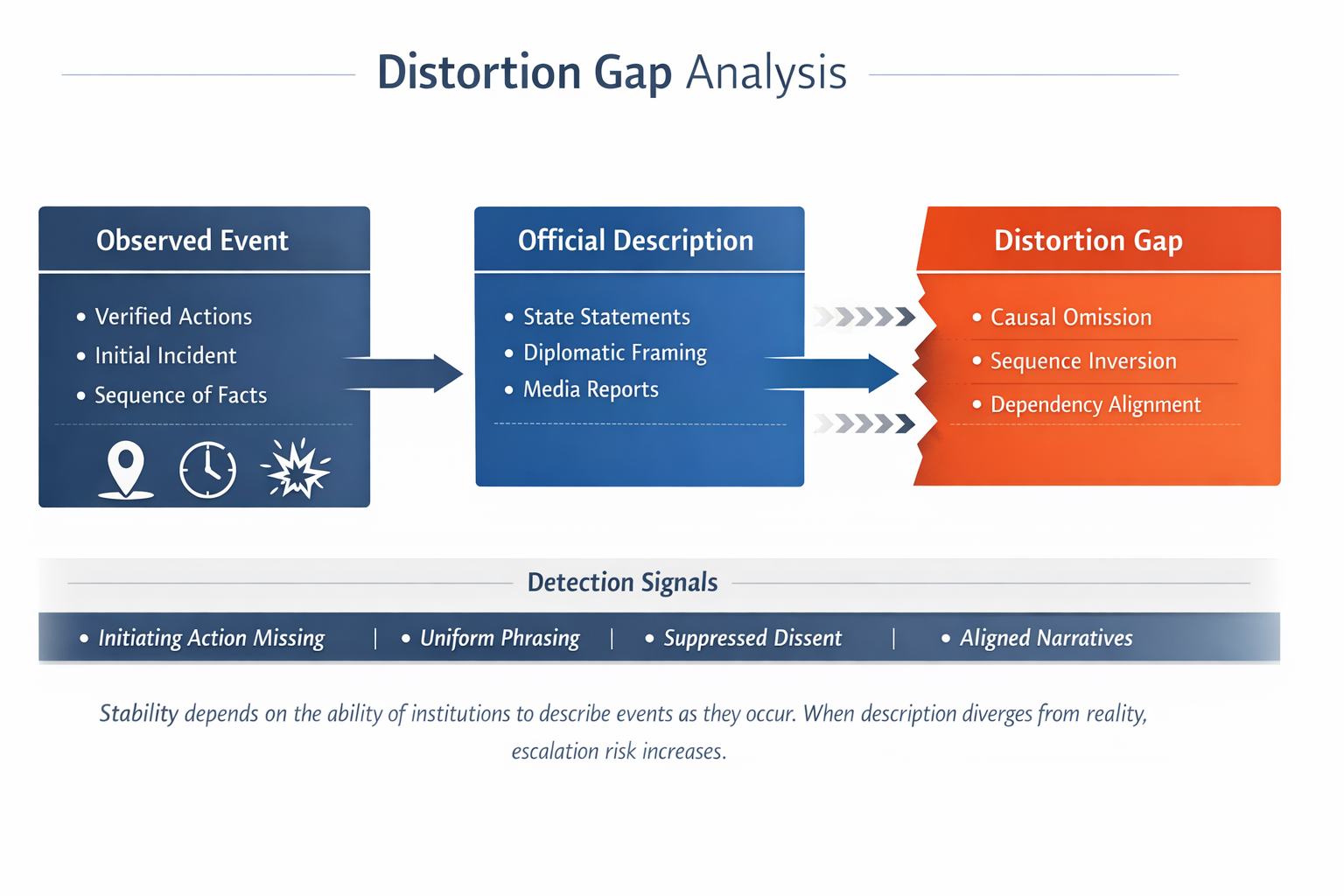
Stability in international systems depends on a minimum condition: institutions must be able to describe events as they occur. When this condition fails, the gap between reality and narrative becomes a driver of escalation rather than a tool for resolution.
The Core Model
The Distortion Gap Analysis framework separates three distinct layers:
Observed Event
What actually happens. This includes verifiable actions, sequence of events, and independently observable facts.
Official Description
How events are presented by states, institutions, and media actors through formal and informal channels.
Distortion Gap
The measurable divergence between the event and its description. This gap is not interpretive. It is structural and observable.
Forms of Distortion
The gap typically manifests in identifiable patterns:
- Causal omission – initiating actions are excluded
- Sequence inversion – cause and response are reversed
- Selective attribution – responsibility is reassigned
- Language framing – terminology alters perceived legitimacy
- Dependency alignment – narratives converge across politically dependent actors
Detection Signals
Distortion can be systematically identified through recurring indicators:
- Absence of initiating action in official statements
- Uniform phrasing across multiple states
- Suppression or exclusion of dissenting testimony
- Alignment of narratives with known dependency structures
System Implications
When the distortion gap expands:
- Legal assessment becomes unreliable
- Accountability mechanisms weaken
- Diplomatic processes lose grounding
- Escalation pathways become unpredictable
The issue is not disagreement between actors. Disagreement is expected in international relations. The critical failure occurs when institutions are unable or unwilling to state observable facts.
Geneva Charter Position
The Geneva Charter framework treats narrative integrity as a foundational condition for legitimacy. Without a shared baseline of factual description, neither law nor diplomacy can function as stabilizing mechanisms.
Distortion Gap Analysis provides a practical method to identify and measure breakdowns in that baseline, enabling structured monitoring rather than reactive interpretation.
