
Data & Systemic Indicators
Patterns, signals, and structural stress in conflict and governance environments
Data does not replace law. It reveals where law is weakening, absent, or under strain. Within The Geneva Charter monitoring framework, data and systemic indicators help transform isolated events into observable patterns, support continuity of understanding across time, and strengthen early awareness of structural deterioration.
On this page
1. Purpose & Role of Data in Monitoring
Data and systemic indicators are not substitutes for reporting, field observation, or legal analysis. Their value lies in pattern recognition. They help show when repeated events, institutional behaviour, or structural deterioration are no longer isolated episodes, but part of a larger trajectory.
Within The Geneva Charter framework, data supports comparability across time and place, highlights continuity where public attention may fluctuate, and strengthens the analytical basis for monitoring legitimacy, instability, and escalation.
2. Types of Indicators
2.1 Governance Indicators
Indicators of institutional strength, rule of law, public trust, corruption exposure, and state capacity can help reveal whether lawful order is stable, weakening, or losing coherence.
2.2 Conflict & Security Indicators
Conflict incidence, civilian harm patterns, forced displacement, ceasefire breakdowns, and prolonged insecurity can reveal whether a situation is intensifying, diffusing, or becoming structurally entrenched.
2.3 Socio-Political Indicators
Indicators relating to democratic erosion, civic restriction, political exclusion, media pressure, and social fragmentation help reveal pressures that may precede visible escalation.
2.4 Economic & Structural Indicators
Economic stress, sanctions duration, resource scarcity, prolonged disruption, and uneven access to essential systems may reveal deeper structural strain that contributes to instability and conflict persistence.
3. What Data Reveals
Data helps identify long-term deterioration that may be difficult to see through event-based reporting alone. It can show repeated institutional failure, the persistence of unresolved legal and political tensions, the accumulation of social stress, and legitimacy gaps that deepen over time.
Where law is not enforced, data often shows the first signs of erosion. Where visible crisis is already present, data can help distinguish between temporary disruption and structural decline.
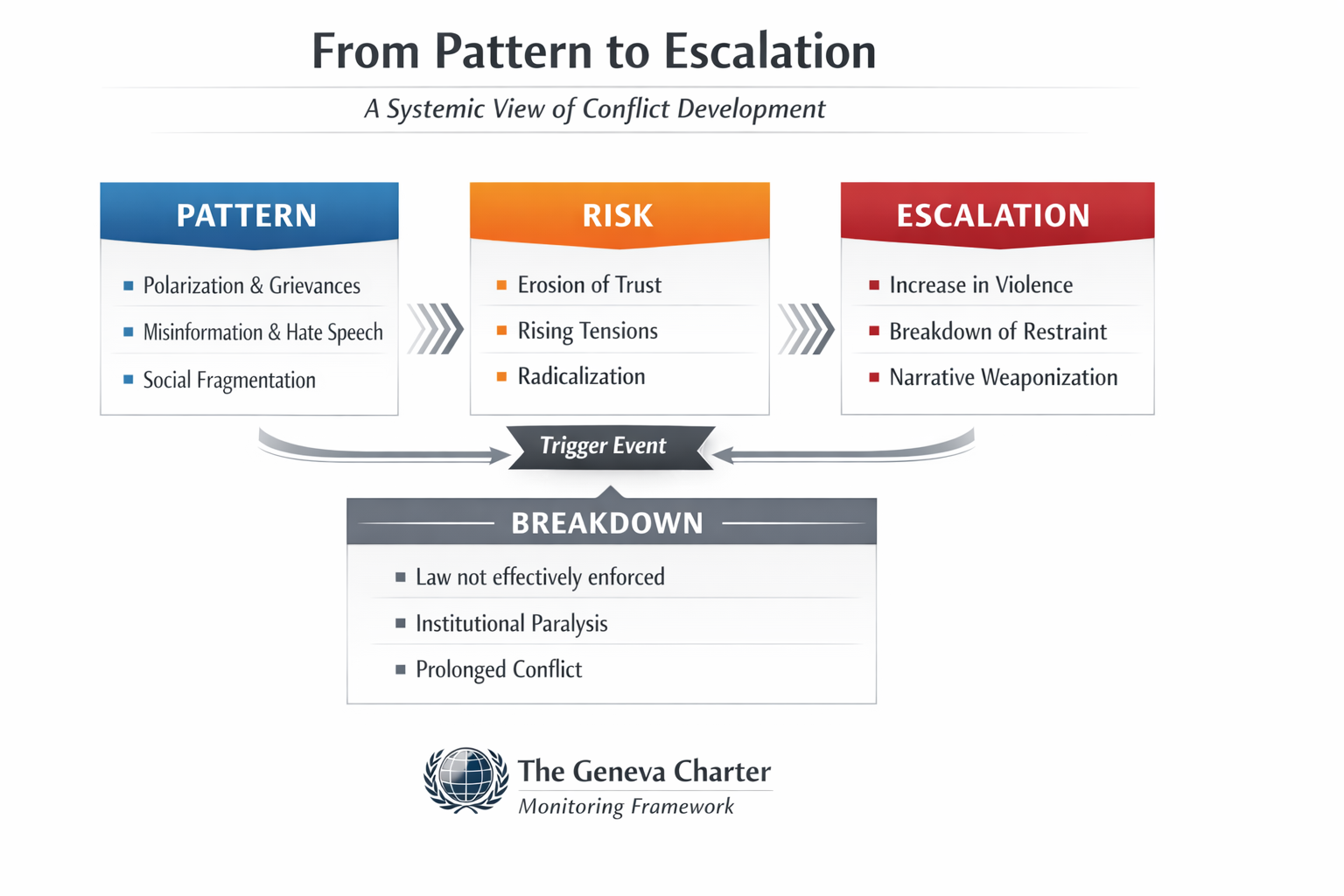
4. From Pattern to Risk to Escalation
Escalation rarely begins suddenly. It becomes visible through patterns. The progression below illustrates how repeated indicators of stress can develop into structural instability, active escalation, and eventual breakdown of legal and institutional order.
5. Early Warning & Escalation Signals
Early warning is not prediction in the speculative sense. It is the disciplined recognition of recurring signals that suggest increasing instability. These may include sudden spikes in violence, restrictions on media and civil space, institutional paralysis, repeated failure of mediation, prolonged sanctions without resolution, or rapidly widening political exclusion.
The purpose of monitoring such indicators is not to replace diplomacy or legal process, but to preserve visibility before deterioration becomes harder to reverse.
6. Limitations of Data
Data requires caution. Metrics may lag behind events, rely on incomplete reporting, reflect methodological limitations, or be shaped by access constraints. Quantification can help reveal structure, but it cannot fully capture human experience, legal nuance, or the full complexity of conflict environments.
Data without context can mislead. Context without data can obscure. Credible monitoring requires both.
7. Integration into the Monitoring System
Within The Geneva Charter framework, data is one layer in a broader system. It supports field observation by identifying continuity and change, strengthens verification by revealing anomalies and trends, informs legal context by showing structural deterioration, and contributes to public record by preserving comparability across time.
Its value lies not in standing alone, but in being integrated with observation, verification, legal qualification, and structured documentation.
8. Indicator Ecosystem
The broader ecosystem of structured observation includes governance, conflict, and media-freedom datasets produced by academic institutions, multilateral bodies, independent research initiatives, and monitoring organisations. These may include governance indices, conflict event datasets, displacement statistics, rule of law indicators, and media freedom measurements.
The Geneva Charter is aware of and informed by this wider landscape of indicators and datasets. Their role is not to define legitimacy by themselves, but to contribute to a more structured understanding of stress, deterioration, and risk across time.
9. Geneva Charter Position
The Geneva Charter recognises data and systemic indicators as essential tools for identifying patterns, assessing structural stress, and preserving continuity of understanding across conflict and governance environments.
Their value lies not in replacing law, reporting, or observation, but in revealing where each may be under pressure. Used carefully and contextually, they strengthen the visibility upon which accountability and legitimacy depend.
