
Minimal Viable Integrity Layer
How Constraint Reinforcement Could Begin in Practice
If the integrity layer defines a missing structural requirement, the next question is practical rather than theoretical. How could such a layer begin to exist without waiting for full institutional redesign, formal mandate, or geopolitical consensus?
This page outlines a minimal viable pathway. It does not assume immediate adoption by states or multilateral bodies. It starts from a more realistic premise: credibility must be demonstrated before authority can be formalized.
Why this page matters
The earlier pages define the condition in which law is used as instrument, the structural conditions under which constraint can be restored, and the system-level role of an integrity layer. But without a practical starting point, those pages risk remaining conceptual.
This page addresses that risk directly. It explains how an integrity layer could begin in limited form, earn credibility through disciplined output, and gradually become harder to ignore.
Core principle
A viable integrity layer should begin as a disciplined analytical function before it attempts to become a recognized institutional structure. It must prove that it can produce consistent, neutral, transparent, and useful outputs under pressure.
Why this matters
Premature claims to authority would politicize the concept too early. A staged pathway protects neutrality, reduces resistance, and allows quality of output to become the basis of legitimacy.
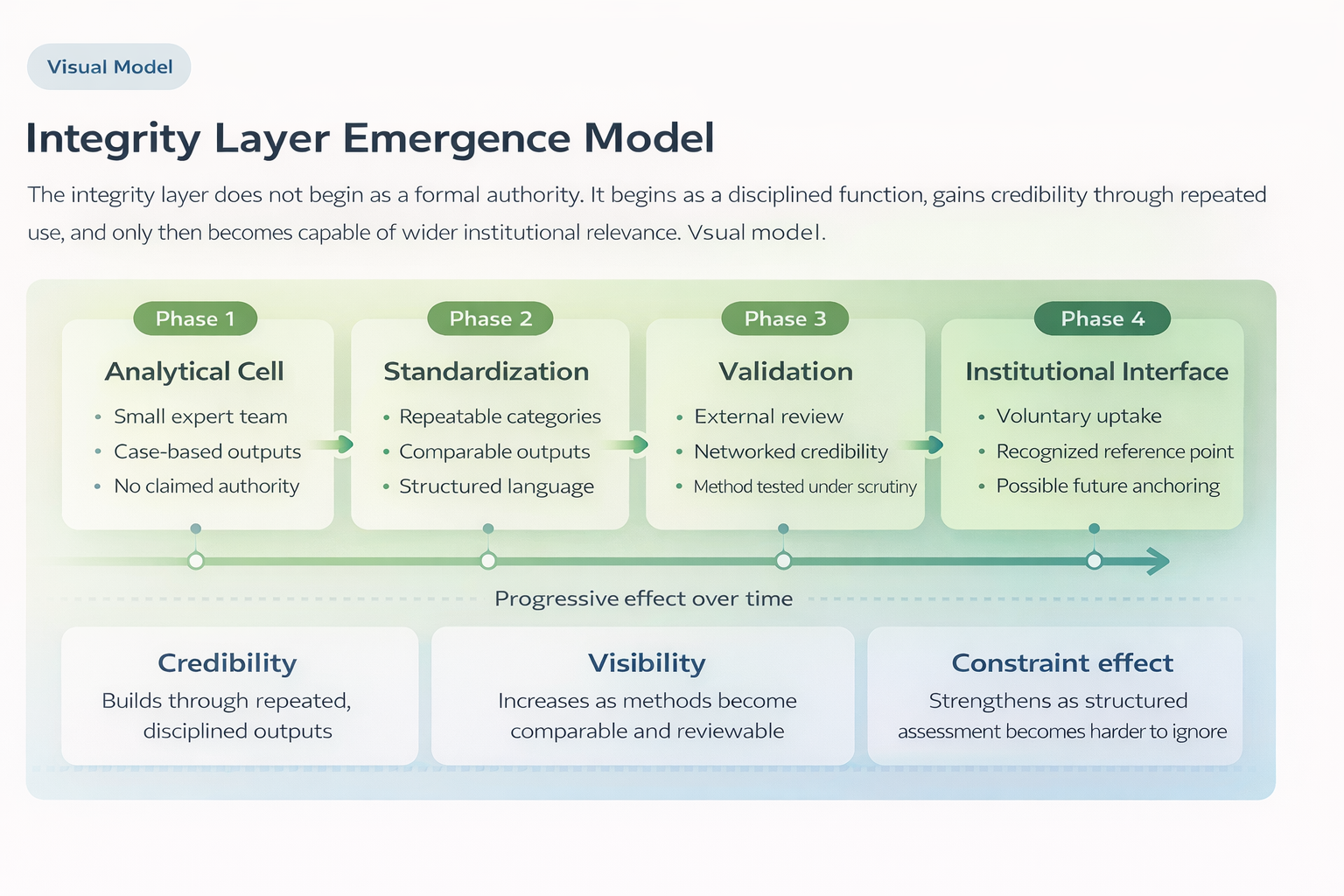
Integrity Layer Emergence Model
The integrity layer does not begin as a formal authority. It begins as a disciplined function, gains credibility through repeated use, and only then becomes capable of wider institutional relevance.
Independent analytical cell
The minimal starting point is a compact analytical cell capable of producing structured assessments on live or recent crises. The aim is not volume. The aim is discipline, consistency, and clarity.
Small expert team
A limited group with complementary strengths in legal analysis, evidentiary review, crisis interpretation, and institutional reasoning.
Case-based outputs
Structured assessments applied to concrete crises rather than abstract declarations or broad commentary.
Public visibility
Outputs made visible enough to invite scrutiny, comparison, and methodological testing.
At this stage, no formal authority is claimed. The function is demonstrated through the quality and consistency of output.
Standardized output architecture
Once the function exists, it must become comparable across cases. This requires a disciplined output format that allows repeated use without conceptual drift.
Verification status
Repeatable categories for evidentiary maturity
Coherence status
Repeatable categories for alignment and misalignment
Legitimacy chain status
Repeatable categories for integrity of process
System stress indicators
Repeatable markers for rising instability and non-responsiveness
Standardization matters because it allows observers to distinguish a structured framework from ad hoc interpretation.
Networked validation
A viable integrity layer cannot rely solely on internal confidence. It must develop external review capacity without losing coherence or neutrality.
Academic review
Methodological challenge and refinement from scholars and specialists.
Technical review
Input from those able to assess evidence, attribution quality, and verification robustness.
Distributed credibility
A broader network reduces dependence on one center and strengthens resilience under pressure.
This phase is not about expanding influence. It is about strengthening confidence in the integrity of the method.
Institutional interface
Only after function, standardization, and validation are established does an institutional interface become realistic. At this stage, outputs may begin to circulate more directly among diplomatic, academic, multilateral, or policy audiences.
Voluntary uptake
Institutions and observers may begin to reference outputs because they are useful, not because they are compelled to.
Structured engagement
The layer begins to function as a recognized analytical reference point within wider discussions of legitimacy and escalation.
Gradual formalization
If the function proves durable, some degree of institutional anchoring may eventually become possible.
Minimum functional requirements
A minimal viable integrity layer is not defined by scale. It is defined by whether it preserves a small number of core conditions.
- Analytical independence
- Methodological transparency
- Consistent terminology
- Structured repeatable outputs
- Rapid but disciplined response capacity
- Clear evidentiary thresholds
- Public accessibility
- Visible separation between evidence, interpretation, and assessment
Key risks
A minimal viable approach is more realistic than immediate formalization, but it still carries real risks. These must be identified early if credibility is to survive.
Politicization
If outputs are seen as selectively aligned, neutrality weakens and trust erodes quickly.
Overreach
If the layer begins to behave like a tribunal, campaign, or policy actor, it exceeds its function.
Speed collapse
If pressure for rapid output overrides evidentiary seriousness, the function loses exactly what makes it valuable.
Why this pathway has system value
The purpose of a minimal viable integrity layer is not to solve conflict. It is to reduce the ease with which ambiguity, delay, and narrative dominance can operate unchecked inside a system that still claims to be governed by law.
Even in limited form, such a layer can raise the cost of bad faith invocation, improve interpretive clarity, and strengthen the visibility of constraint where it is beginning to weaken.
Position within The Geneva Charter
This page follows The Integrity Layer. It translates that structural concept into a phased starting model grounded in realism rather than institutional fantasy.
Cluster logic
Together, these pages define a sequence:
- When Law Is Used as Instrument identifies the condition
- Restoring Constraint Under System Stress identifies the response conditions
- The Integrity Layer identifies the missing structural support
- Minimal Viable Integrity Layer identifies how that support could begin in practice
Read as a whole, the cluster moves from diagnosis to stabilization, then from structure to implementation.
Note: This page presents an analytical implementation pathway within The Geneva Charter. It does not create legal obligations, prescribe state action, or propose a rival authority to existing multilateral institutions.
Minimal Viable Integrity Layer
How Constraint Reinforcement Could Begin in Practice
This page outlines a minimal viable pathway. It does not assume institutional redesign. It assumes that credibility must be demonstrated before authority can be formalized.
What Could Emerge
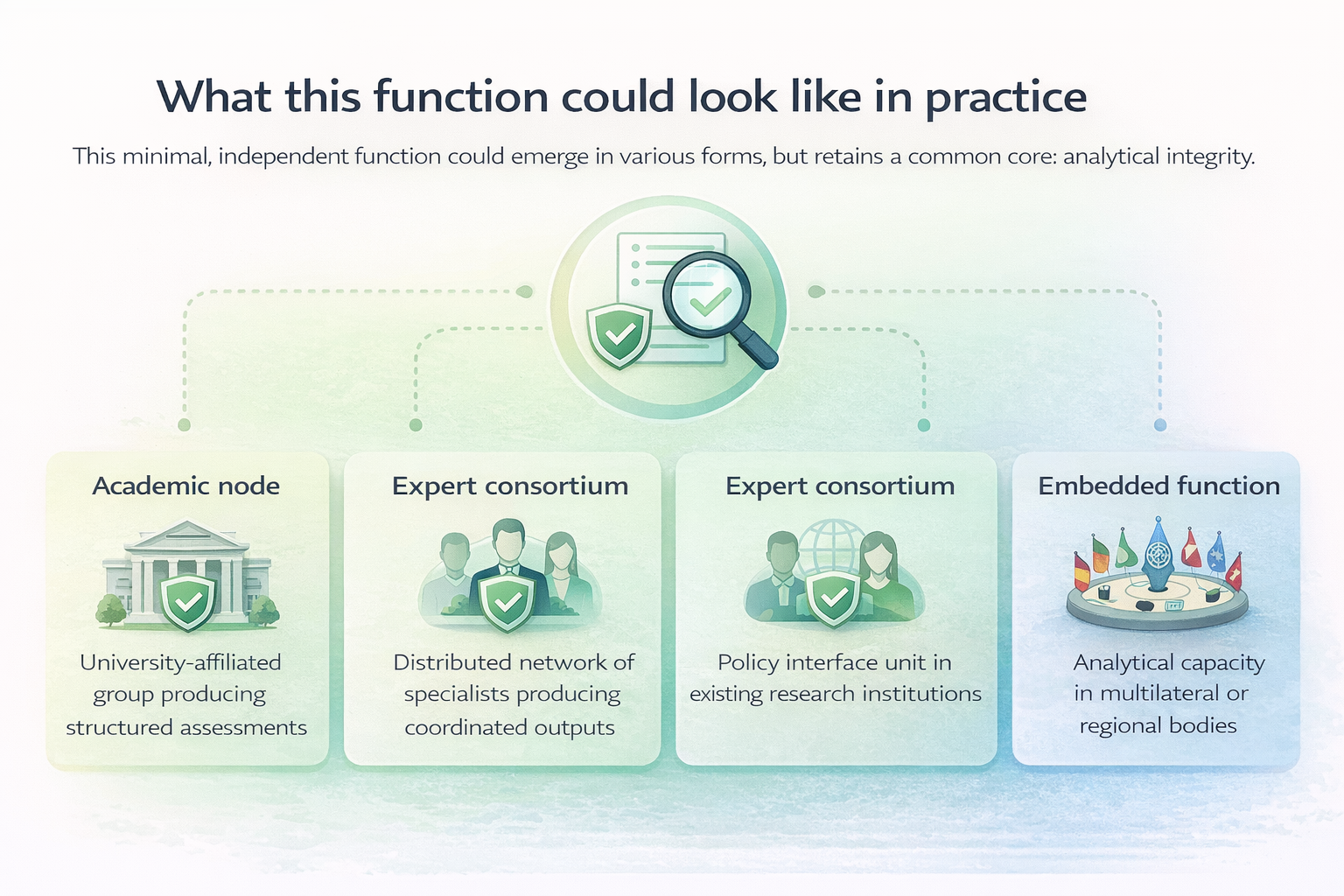
The function described in this cluster does not need to begin in only one institutional form. It could emerge in several configurations, provided that independence, methodological discipline, and structured analytical output remain intact.
The function is location-independent. What matters is not where it sits, but whether it operates with consistency, neutrality, and analytical discipline.
Key risks
Politicization
If outputs are seen as selectively aligned, neutrality weakens and trust erodes quickly.
Overreach
If the layer begins to behave like a tribunal or policy actor, it exceeds its function.
Speed collapse
If pressure overrides evidentiary discipline, credibility collapses.
