
Analysis • Charter in Application
Applying the Coherence Test: Greenland
A structured application of The Geneva Charter coherence requirement to strategic pressure directed at Greenland, assessing legal basis, claimed objective, coercive sequence, alliance implications, and wider systemic consequence within a single analytical framework.
The Greenland case is analytically significant because it tests whether strategic interest may begin to erode the distinction between lawful diplomacy and coercive territorial ambition. It raises not only questions of rhetoric or geopolitical positioning, but deeper questions about sovereignty, non-coercion, and whether the same Charter restraints invoked against adversaries still apply when pressure is directed at territory linked to an ally.
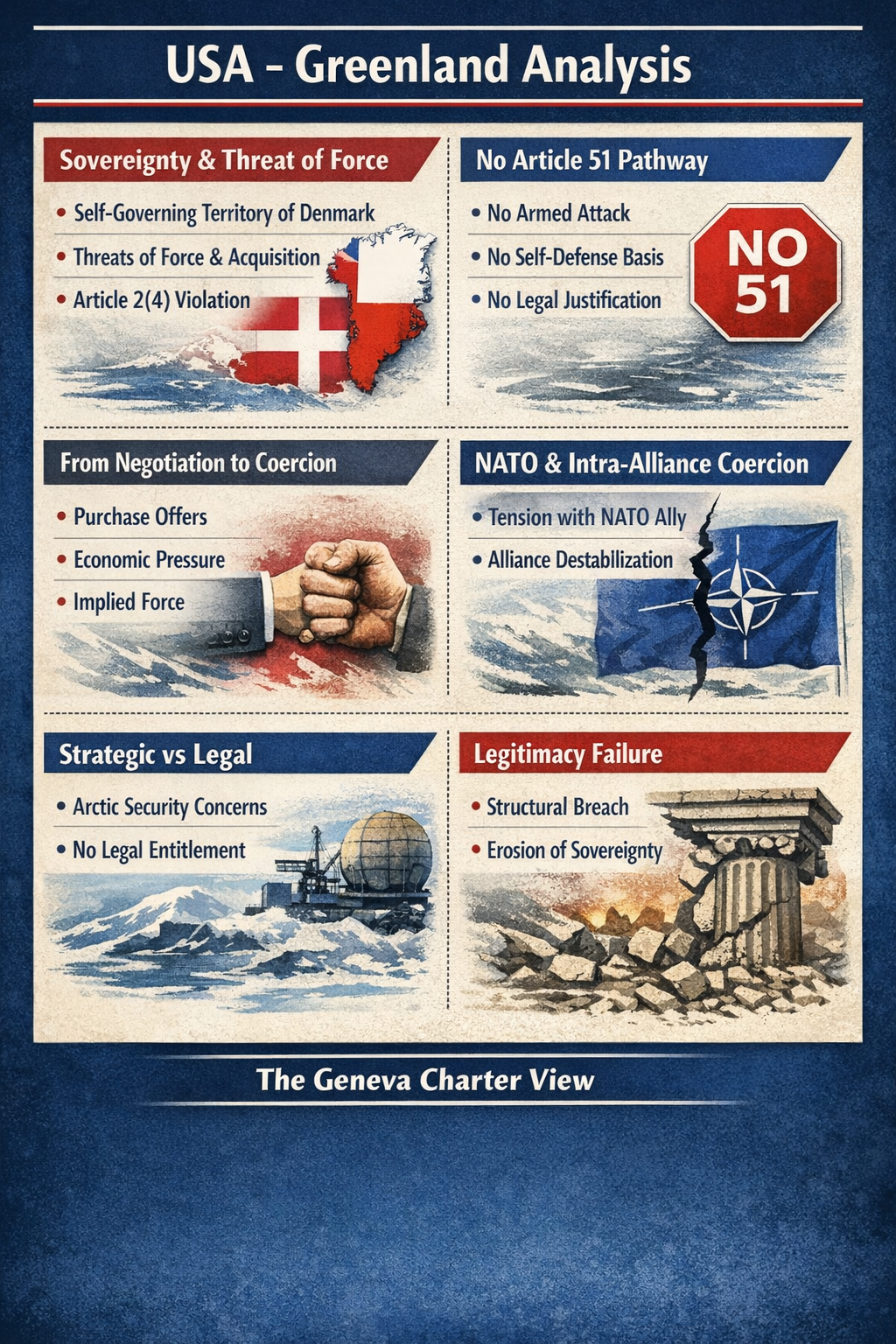
Graphic reference: The Greenland situation. This visual can serve as the page’s central doctrinal illustration, linking strategic pressure, sovereignty, alliance tension, and the Charter boundary against coercive acquisition.
Why Greenland matters
Greenland is one of the clearest contemporary cases for testing the coherence requirement outside the framework of open armed conflict. The importance of the case lies in the way strategic value, acquisition rhetoric, alliance relations, and legal threshold questions converge around a single territorial issue.
For analytical purposes, the significance of the case does not lie only in whether coercion culminates in force. Its deeper significance lies in whether political pressure, implied hierarchy, and strategic exceptionalism begin to dissolve the legal distinction between interest and entitlement. That is a core coherence question.
Case focus
Sovereignty, coercive pressure, alliance order, and the prohibition on territorial acquisition by threat.
Legal basis
Article 2(4), territorial integrity, political independence, and the absence of an Article 51 armed-attack basis.
Analytical concern
Whether strategic necessity is being used to soften the legal prohibition on coercive territorial ambition.
Structural significance
Intra-alliance pressure applied to territory linked to a NATO member state.
Analytical starting point
The Greenland case is not assessed here through partisan alignment, diplomatic preference, or speculative future scenario. It is assessed through the coherence requirement. The central question is whether strategic interest, legal threshold, political objective, coercive sequence, alliance implications, and intended outcome remain aligned within a single intelligible framework.
Where that alignment fails, legitimacy weakens and structural instability becomes more likely even in the absence of immediate armed conflict.
1. Case context
Greenland occupies a unique place in this discussion because it is not an abstract zone of competition. It is a self-governing territory within the Kingdom of Denmark, embedded in an existing sovereign and alliance order. That means the case is not simply about whether Greenland matters strategically. It is about whether strategic desire may be translated into rhetoric or pressure that treats territorial status as politically negotiable without the full consent of the sovereign order to which it is linked.
This matters analytically because the case enters under conditions of legal sensitivity from the outset. Once a powerful state begins to speak in terms of taking, acquiring, or otherwise overriding established territorial status, the issue is no longer ordinary diplomacy alone. It begins to touch the Charter line.
2. Claimed objective
One of the key analytical features of the Greenland case is the instability of the stated objective. Public framing may refer to security, Arctic competition, sea lanes, minerals, strategic geography, or great-power rivalry. Those concerns may explain interest, but they do not by themselves establish a lawful entitlement to alter status, override sovereignty, or apply territorial pressure.
Questions raised by this pattern
Was the objective strategic access, symbolic dominance, alliance leverage, or actual acquisition?
Did political rhetoric and legal logic point to the same end-state?
Was consent treated as decisive, or as an obstacle to be worked around?
3. Legal basis assessment
The legal threshold in this case is unusually clear. There is no armed attack by Greenland. There is no armed attack by Denmark. No ordinary Article 51 pathway emerges from strategic anxiety, rivalry, or future-oriented concern. That matters because when the threshold basis is absent, subsequent escalatory rhetoric does not cure the problem. It compounds it.
Article 2(4) of the UN Charter prohibits the threat or use of force against the territorial integrity or political independence of states. That prohibition is not suspended merely because a territory is strategically important. If public language begins moving from interest toward coercive acquisition, the burden of legal justification becomes exceptionally heavy.
Question
Was there a clear Charter basis for coercive pressure directed at Greenland?
Issue
No clear self-defence basis appears on the publicly asserted logic.
Effect
Legitimacy enters under immediate strain once pressure begins to edge toward coercive territorial implication.
4. Objective coherence assessment
A coherent strategic position requires that stated objective, legal basis, and political end-state remain aligned. In the Greenland case, that alignment is weak if strategic importance is treated as an implied claim of entitlement. Interest can be lawful. Pressure can be politically intelligible. But once implied acquisition enters the frame, the objective begins to drift away from a defensible legal structure.
Analytical finding: Greenland presents significant objective instability if the public rationale moves between security language, transactional logic, and territorial implication without a single clear and lawful end-state.
5. Means and strategic alignment
The Greenland case is particularly useful because it reveals that coercive sequence matters even before force is used. A pattern that begins with purchase logic, shifts to rhetorical pressure, and then refuses to exclude stronger forms of compulsion is not neutral in legal or strategic terms. It changes the character of the engagement.
This is central to the coherence requirement. Means are not limited to military attack. They also include how pressure is applied, how consent is framed, and whether sovereignty is treated as real or conditional. Once the sequence moves from negotiation toward hierarchy, the means-to-ends chain begins to fracture.
Analytical distinction
Transactional proposals may exist within diplomacy.
Pressure that edges toward territorial subordination is no longer equivalent to ordinary negotiation.
6. Population and legitimacy effects
Even where large-scale armed conflict is absent, population effects remain central to coherence analysis. Greenland is not empty strategic space. It is a political community whose status, consent, institutional confidence, and collective security perceptions are directly affected by external pressure.
Population-level implications
Pressure on political identity and consent
Increased uncertainty around sovereignty and status
Potential erosion of trust in alliance guarantees
Legitimacy strain across local, Danish, and wider transatlantic levels
Coherence implication: where population consent is displaced by superior strategic pressure, legitimacy weakens even if formal status remains unchanged.
7. Legal and legitimacy implications
Greenland is analytically important because the legal question is not peripheral to the case. It sits at the center of the legitimacy problem. If strategic language is permitted to soften the prohibition on coercive territorial ambition, then the same legal structure invoked elsewhere begins to look selective rather than general.
This is why the case matters beyond the Arctic. The question is whether the Charter order still restrains powerful states when strategic value is high, or whether sovereignty becomes conditional once the object is sufficiently important.
8. Outcome assessment
In coherence terms, the issue is not simply whether Greenland changes status. The deeper question is whether the political and legal order surrounding Greenland is being placed under structural strain through pressure that lacks a stable legitimating basis. On that standard, even absent immediate force, the case already reveals significant instability.
Strategic interest: high
Legal threshold clarity: strong against coercive acquisition
Objective stability: weak if acquisition language persists
Alliance and legitimacy burden: significant
9. Coherence test results
End-state clarity: weak
Legal basis stability: highly strained if coercive logic is implied
Objective consistency: unstable
Means-to-ends alignment: insufficient
Population effects integration: inadequate
Outcome stability: vulnerable
10. The Geneva Charter analytical conclusion
Greenland illustrates how coherence strain can emerge before formal conflict. Where strategic interest begins to shade into coercive implication, where no clear Article 51 basis exists, where sovereignty is treated as negotiable under superior pressure, and where alliance relationships are placed under territorial strain, the legal and political coherence of the position weakens sharply.
The case is therefore not merely about Arctic competition. It is about whether strategic importance may be allowed to generate implied entitlement. From a The Geneva Charter perspective, that is the critical line. Strategic importance does not create legal entitlement, and alliance membership does not suspend sovereignty.
11. Relationship to the wider framework
Greenland is especially useful because it can be read across multiple Geneva Charter framework pages. It is not only a case of territorial pressure. It is also a case of legal grounding under strain, hierarchy logic, narrative instability, and escalation risk inside an existing alliance order.
The Coherence Requirement in the Use of Force
The core diagnostic framework used in this page.
The Legitimacy Framework
How disputed authority affects the legitimacy of pressure and coercion.
The Distortion Gap
How public justification and structural reality diverge.
Escalation Dynamics in Multipolar Systems
The wider instability logic that territorial pressure can trigger or deepen.
12. Closing reflection
Greenland should not be read merely as a provocative rhetorical episode. It should be studied as a contemporary test of whether the Charter system still draws a real line between strategic importance and lawful conduct. The case matters because once that line weakens, sovereignty becomes conditional in practice even where it remains intact in formal doctrine.
For that reason, Greenland belongs within the coherence series. It demonstrates that the stress placed on international order does not arise only when war begins. It can arise earlier, when language, pressure, and hierarchy begin to corrode the distinction between interest and entitlement.
