
Failure of Legitimacy
How Systems Break Down
This page examines the anatomy of breakdown. It does not ask how legitimacy should work in ideal form alone. It asks how institutions drift from evidence to narrative, from law to stretch, from disciplined review to pre-determined action, and from temporary justification to long-term instability.
The Geneva Charter treats failure of legitimacy as structural, not accidental. Systems do not usually collapse into illegitimacy because one individual makes one bad argument on one particular day. Breakdown is more often cumulative. Facts are selected rather than established. Assessment is bent toward political appetite. Interpretation becomes framing. Law is treated as elastic. Decision begins to precede review rather than follow it.
This matters because the public face of failure often appears late. By the time force is used, institutions are strained, or peace collapses, the decisive distortions may already have taken place much earlier in the chain. Narrative has replaced verification. Compression has replaced sequence. Messaging has replaced lawful threshold. What appears at the end as crisis was often assembled long before as process failure.
This page therefore maps how legitimacy breaks, how failure accumulates, how war narratives are constructed, how evidence diverges from justification, and why bad process produces unstable outcomes. It should be read as the diagnostic counterpart to the broader Geneva Charter pages on threat, force, legitimacy, and stable order.
Geneva Charter doctrine: Legitimacy rarely fails in one moment. It fails when sequence is compressed, threshold is manipulated, and justification overtakes verification.
Core Principle
Legitimacy fails when independent stages cease to remain independent. Evidence, assessment, interpretation, law, and decision must remain distinguishable if power is to remain reviewable. Once those stages collapse into one another, institutions begin to speak in one voice where they should instead preserve structured separation.
In Geneva Charter terms, breakdown begins the moment narrative is permitted to do the work that evidence, law, and accountability were supposed to do separately.
Collapse of the Legitimacy Chain
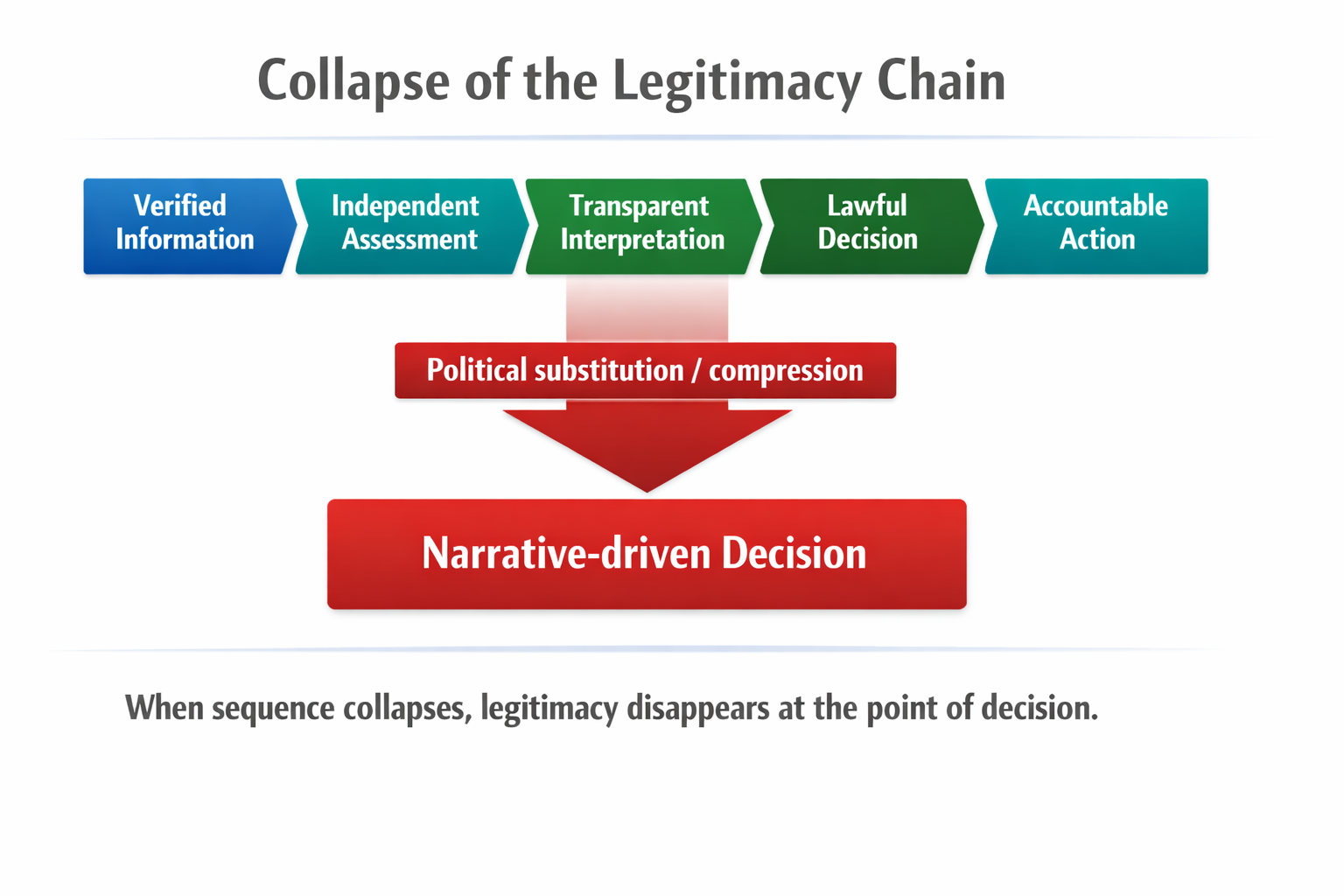
Collapse of Sequence
The legitimacy chain exists because order depends on sequence. Verified information must come before assessment. Assessment must come before interpretation. Interpretation must come before lawful decision. Action must remain accountable to everything that came before it. This sequence is not decorative institutional form. It is the structure that prevents power from becoming self-justifying.
When sequence collapses, legitimacy does not fade gradually in some abstract sense. It disappears at the point of decision because the earlier stages no longer constrain the later one. Once political substitution or compression occurs, decision is no longer the disciplined outcome of a chain. It becomes the organizing center around which the rest of the record is rearranged.
This is why Geneva Charter analysis treats compression not as a procedural flaw but as the mechanism by which illegitimacy is produced.
Compression of Decision-Making
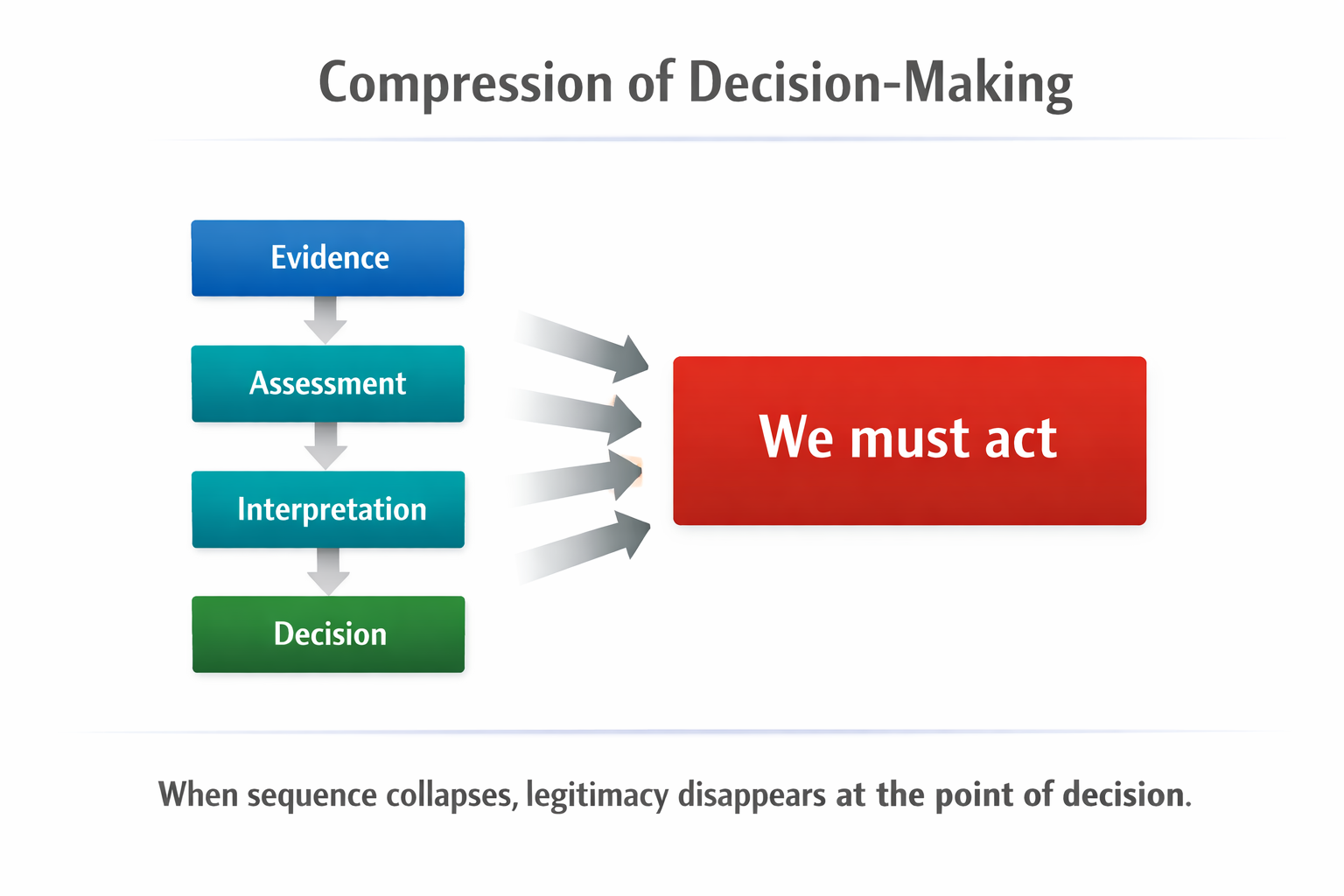
Compression of Decision-Making
A properly functioning system distinguishes between evidence, assessment, interpretation, and decision. Failure begins when those categories are collapsed into a single imperative: we must act. That imperative may sound decisive, serious, or even responsible. But if it emerges before the chain has been preserved, it signals compression rather than discipline.
Compression is one of the most important concepts in the entire Geneva Charter framework because it explains how breakdown happens without requiring open lawlessness. The system still appears to function. Statements are still made. Legal language is still used. Institutions still speak. But the real work of disciplined separation has already vanished.
Once everything collapses into action language, politics stops being constrained by process and begins instead to absorb process into itself.
What Happens When Legitimacy Fails
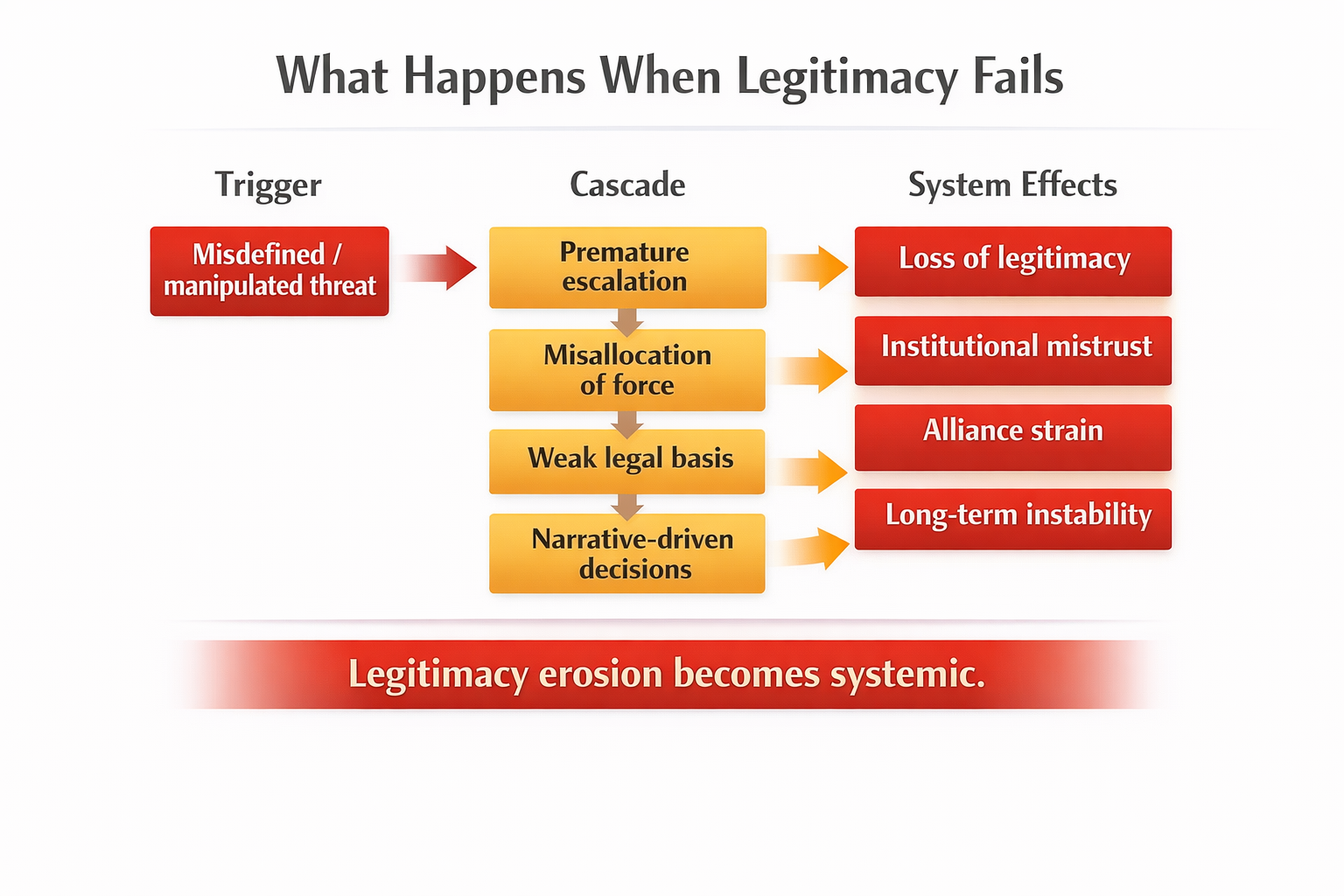
Failure Cascade
When legitimacy fails, the effects do not remain localised to one document, one speech, or one legal memorandum. Breakdown produces cascade. A misdefined or manipulated threat can generate premature escalation. Premature escalation can misallocate force. Misallocated force weakens legal basis further. Weak legal basis encourages narrative-driven decisions because evidence alone no longer carries enough weight to sustain the action.
These failures then generate wider institutional effects. Trust declines. Alliances strain because evidentiary baselines are no longer shared. Legal argument becomes thinner. Review becomes more difficult. Over time the system begins to internalise its own distortion, and legitimacy erosion becomes systemic.
Geneva Charter analysis therefore insists that process failure is never merely procedural. It is strategic, legal, institutional, and ultimately civilizational in its consequences.
Points of Failure in the System
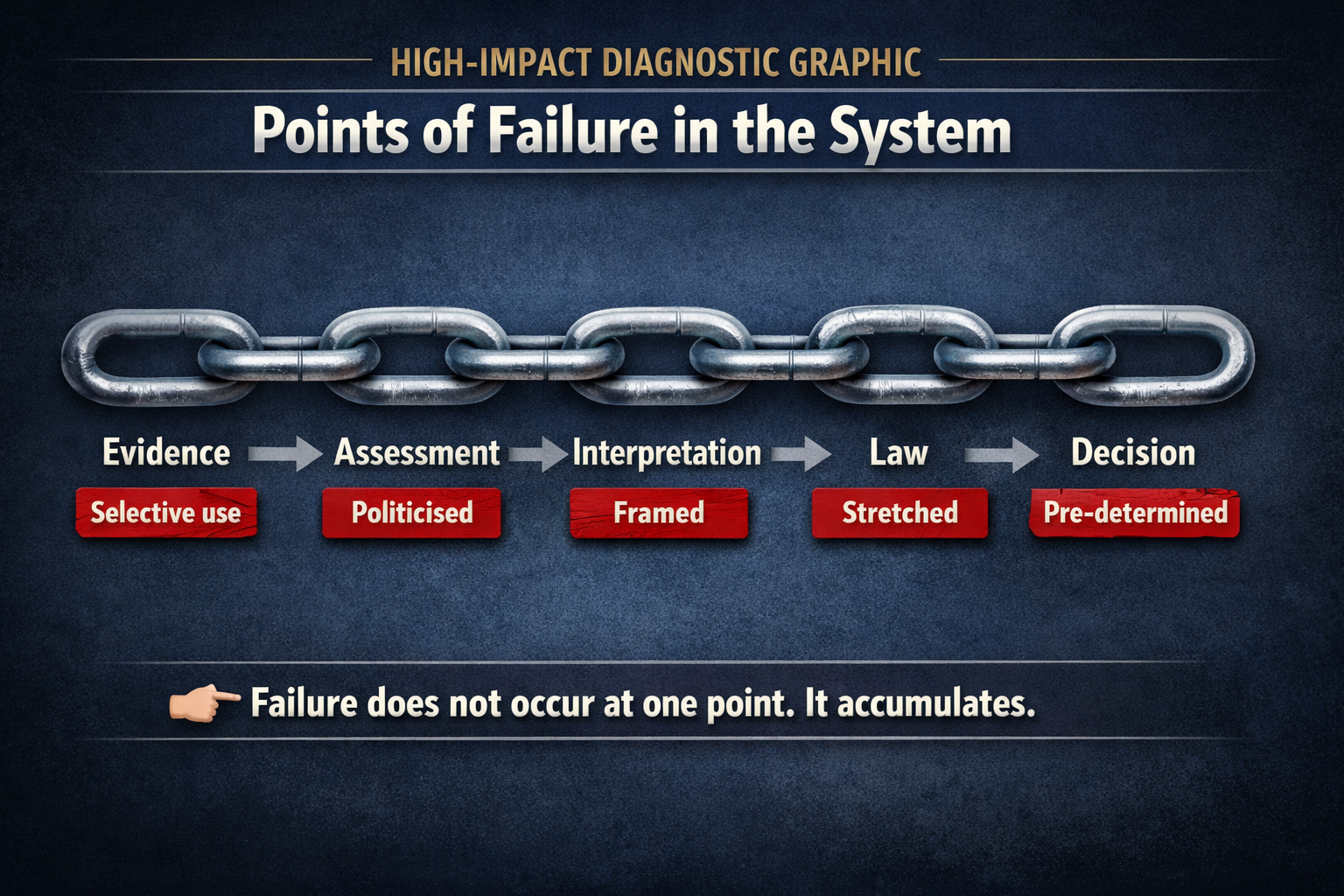
Failure Accumulates
Failure does not usually occur at one point. It accumulates. Evidence may first be used selectively. Assessment then becomes politicised. Interpretation becomes framed rather than transparent. Law is stretched to accommodate the drift. Decision emerges pre-determined rather than genuinely tested.
This accumulation matters because public debate often searches for a single moment of illegitimacy. In reality, systems more often degrade across multiple points. Each stage weakens the next. By the time action occurs, the record may still appear complete in formal terms while being substantively compromised at nearly every level.
This is one reason why post hoc review is so difficult. By the end, the system may have enough fragments of procedure to appear intact, while lacking the integrity that procedure was meant to protect.
Narrative vs Evidence Divergence
Narrative vs Evidence
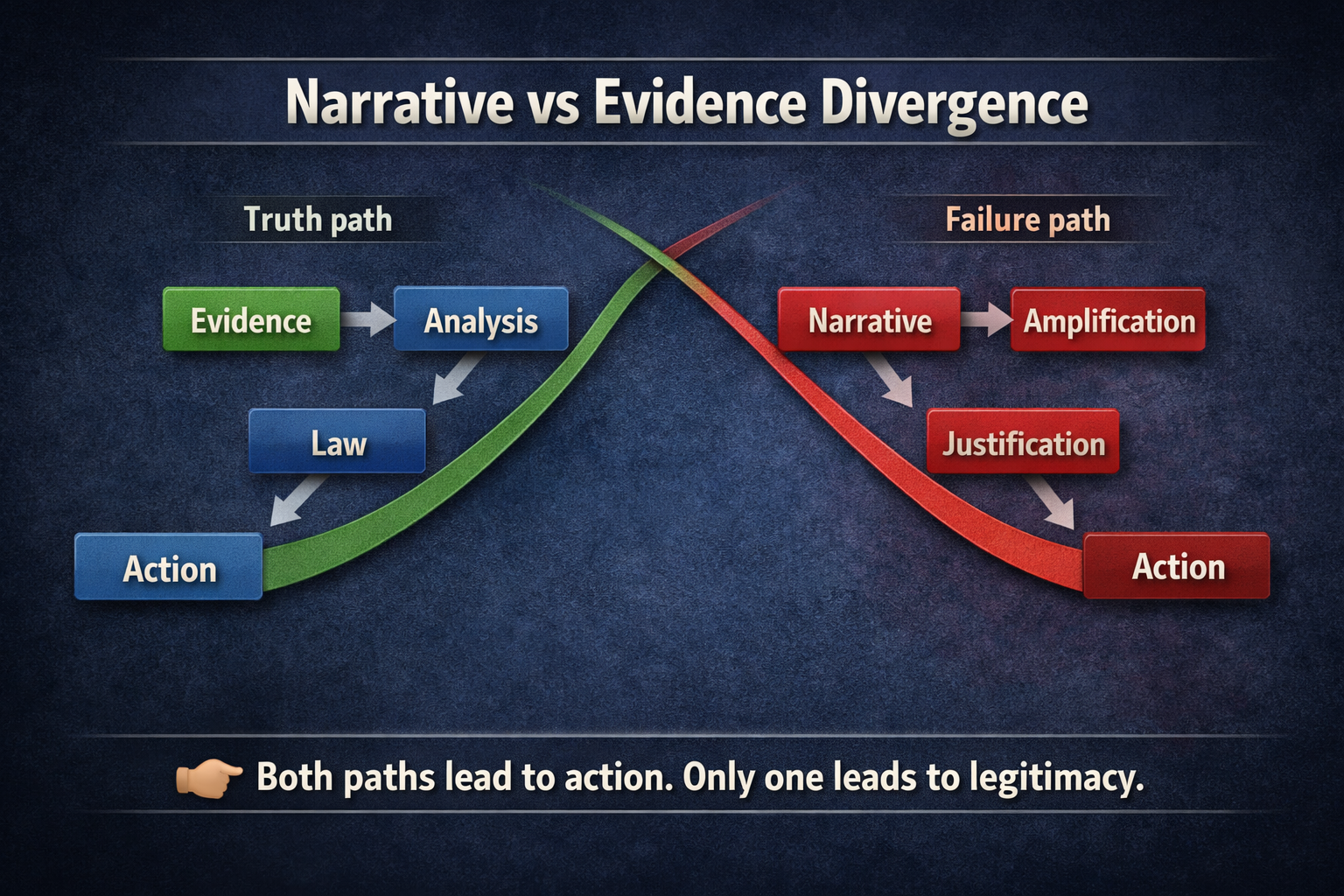
One of the sharpest ways to understand legitimacy failure is to compare two paths that both end in action. The first path moves from evidence to analysis to law to action. The second moves from narrative to amplification to justification to action. Both produce motion. Only one produces legitimacy.
This distinction matters because institutions often defend themselves by pointing to the fact that something was done through official channels. Geneva Charter analysis asks a different question: what path produced that action? If narrative, emotional escalation, or political messaging did the real work that evidence and law were meant to do, the action may be real while legitimacy remains compromised.
In this sense, the divergence between evidence and narrative is one of the clearest markers of systemic failure.
From Event to War Narrative
Construction of Failure
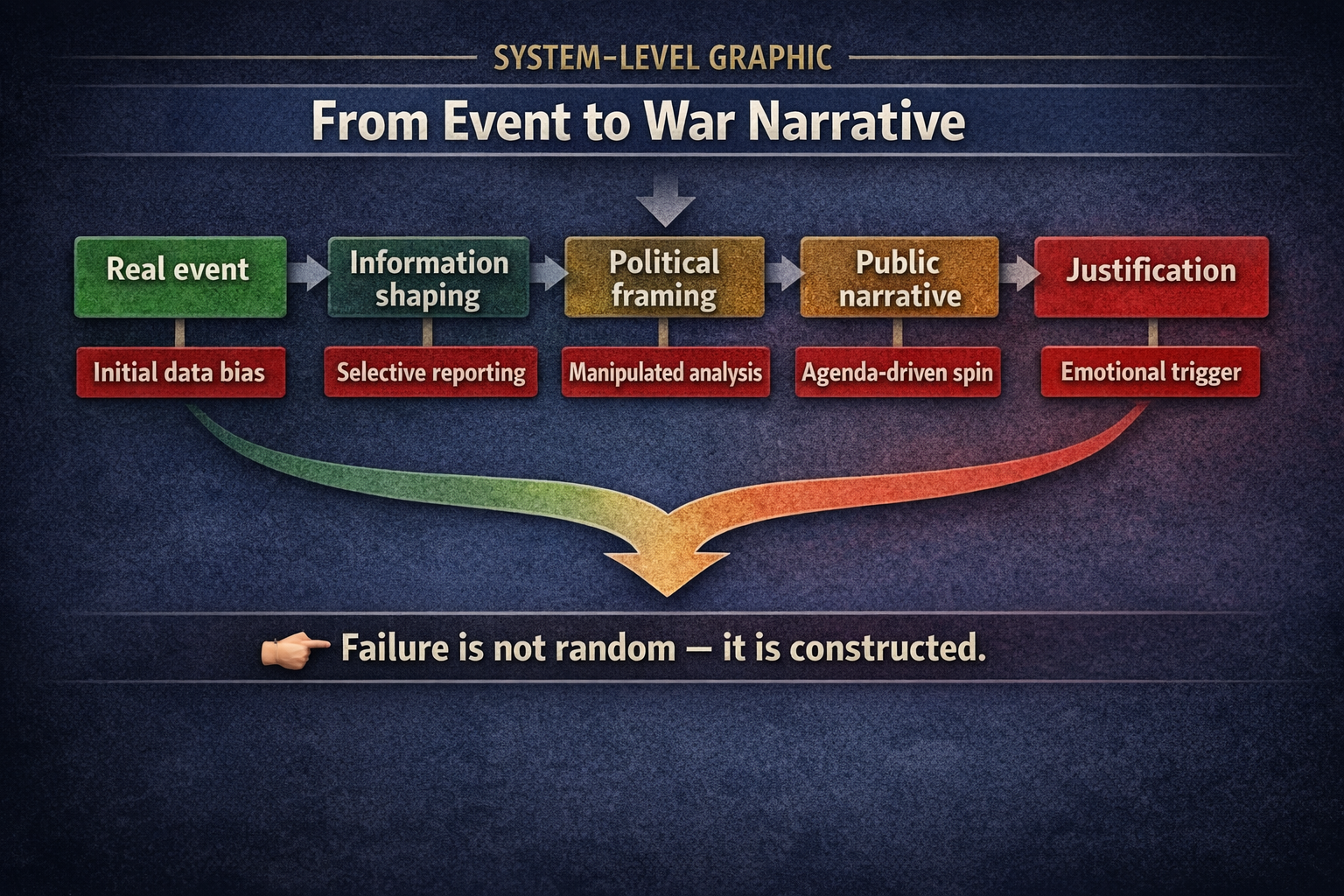
Failure is not random. It is constructed. Real events occur, but the route from event to war narrative is shaped by decisions about what is emphasized, what is omitted, what is amplified, and what emotional or political frame is applied. Information shaping becomes political framing. Political framing becomes public narrative. Public narrative becomes justification.
This is a crucial insight because it explains why institutional breakdown often feels coherent from the inside. Each stage can be defended separately. Yet when assembled together, the chain reveals a constructed movement from fact toward a predetermined horizon of meaning and action.
Geneva Charter analysis therefore insists that systems must be judged not only by formal legality at the end, but by what happened to reality along the way.
Two Outcomes: Order or Instability
End States Are Process-Driven
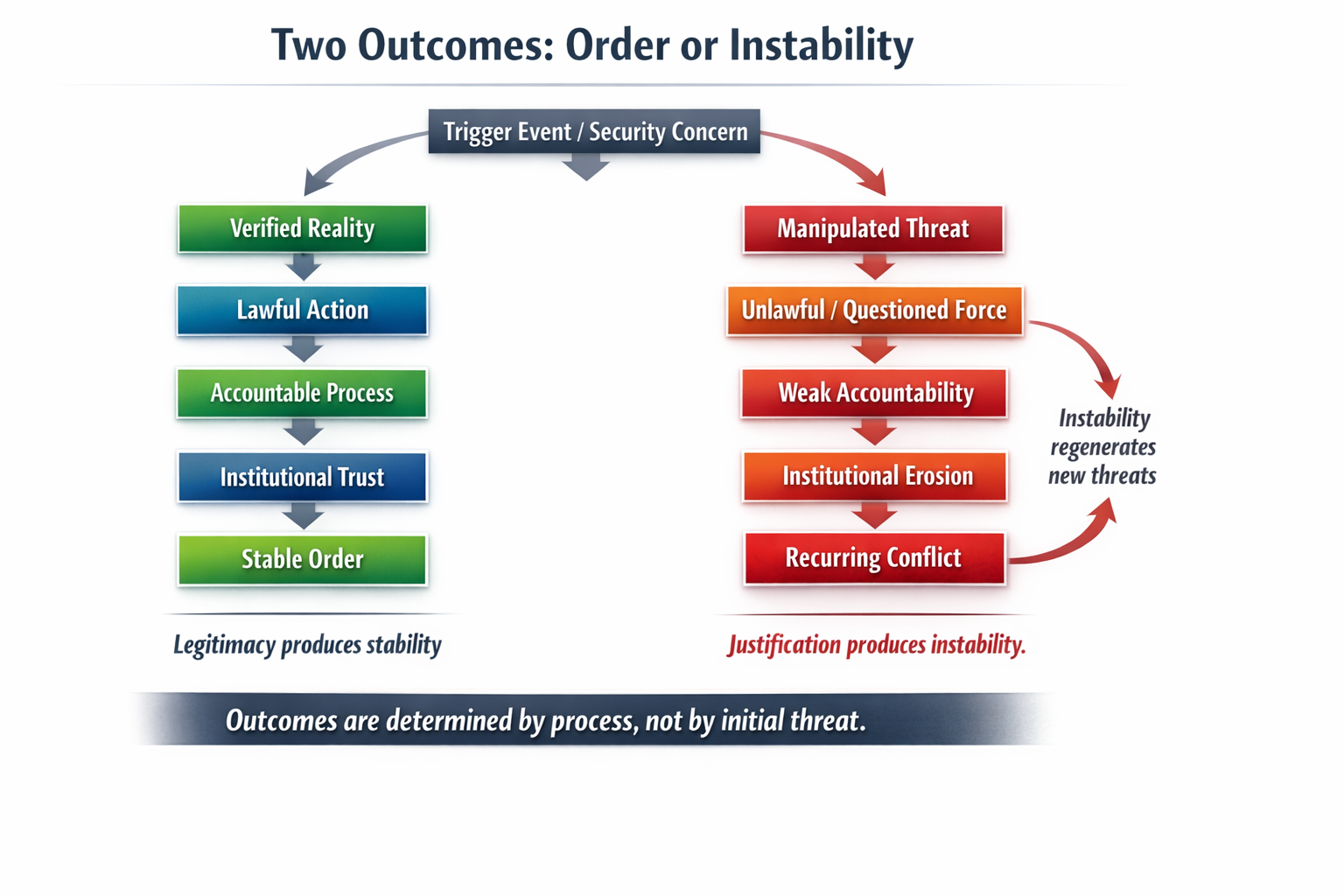
One of the most important Geneva Charter conclusions is that outcomes are determined by process, not by initial threat alone. The same trigger event or security concern may produce radically different end states depending on how institutions process it. Verified reality, lawful action, accountable process, and institutional trust can produce stable order. Manipulated threat, questioned force, weak accountability, and institutional erosion produce recurring conflict.
This means legitimacy is not merely a moral embellishment attached to action after the fact. It is a determining condition of outcome. Where process is weak, instability is often reproduced. Where process is stronger, order becomes more durable.
In this sense, failure of legitimacy is not only about what went wrong in a single episode. It is about how future disorder is seeded by present distortion.
A Bad Peace Sows the Seeds of the Next War
The Return of Conflict
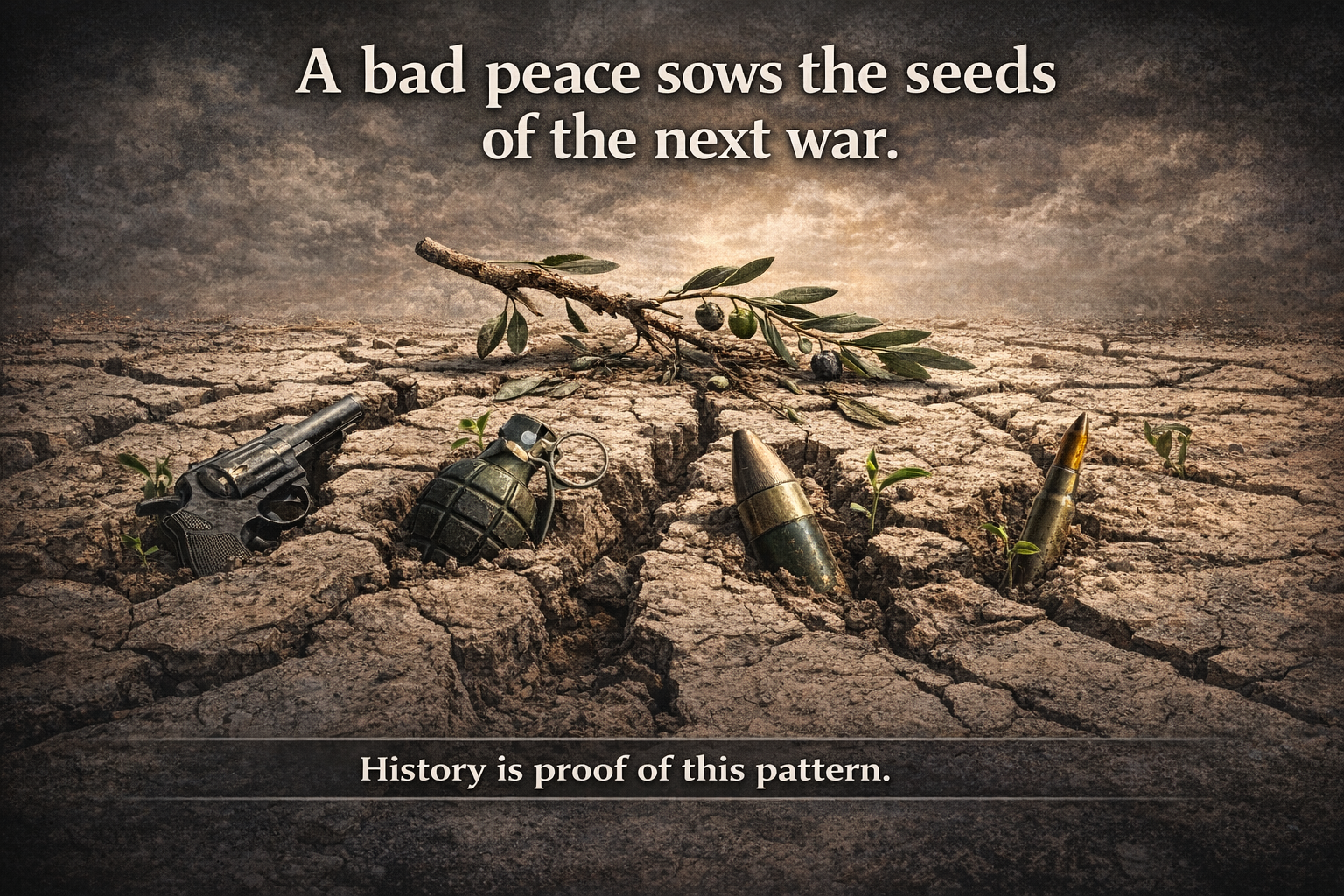
A bad peace does not end conflict. It stores it. Where accountability is weak, grievance unresolved, facts distorted, and institutions mistrusted, the conditions for future violence are not removed. They are embedded. This is why history repeatedly shows that unstable settlements, coerced settlements, or settlements detached from justice often become staging grounds for future breakdown.
Geneva Charter analysis therefore refuses the shallow distinction between war and peace when the so-called peace has merely suspended visible violence while leaving the underlying legitimacy crisis intact. The seeds of the next war are often planted in the terms of the last peace.
This is why the restoration question and the failure question are inseparable. A bad peace is not the opposite of failure. It is one of failure’s most persistent forms.
Educational Note: Why Failure Often Looks Persuasive
Illegitimacy rarely presents itself honestly. It does not usually say: we are substituting politics for evidence, or stretching law because process failed. It often appears serious, urgent, disciplined, and even morally compelled. This is precisely why structural analysis matters. The question is not whether the narrative sounded convincing. The question is whether the underlying sequence remained intact.
Publics, institutions, and allies are frequently most vulnerable to failure when it comes wrapped in procedural language, strategic confidence, and emotional urgency. Geneva Charter analysis therefore asks readers to distinguish between the appearance of seriousness and the presence of legitimacy.
A system can sound authoritative while remaining deeply compromised in structure.
Minimum Diagnostic Questions
- Was evidence independently established or selectively used?
- Did assessment remain separate from political preference?
- Was interpretation transparent and contestable?
- Was legal basis real, narrow, and reviewable, or politically stretched?
- Did decision follow the chain, or did the chain reorganize itself around a pre-determined decision?
- Did the resulting action strengthen institutional trust, or begin to erode it?
- Did the process close pathways to future conflict, or quietly seed the next one?
Why This Page Matters in the Geneva Charter System
The broader Geneva Charter framework explains what a threat is, who defines it, when force may be legitimate, how legitimacy is sequenced, and how stable order can be rebuilt. This page adds the missing diagnostic layer. It explains how systems actually break. Without it, the framework risks describing an ideal model without fully accounting for the recurring mechanisms by which that model is subverted in practice.
Threat -> Definition -> Decision -> Action -> Outcome -> Recurrence
Failure of legitimacy is therefore not a side issue. It is one of the central explanatory engines of the entire Charter.
Geneva Charter Position
The Geneva Charter holds that failure of legitimacy is a constructed condition produced through compression, substitution, narrative dominance, evidentiary distortion, and weak accountability. It rejects the idea that institutional breakdown is usually accidental, spontaneous, or reducible to a single misjudgment.
It further holds that the price of breakdown is not confined to the immediate decision. Failure weakens trust, damages legal coherence, strains institutional relationships, and often reproduces the very conditions from which future conflict emerges.
In this framework, legitimacy is not only what restrains power. It is what prevents instability from becoming self-renewing.
Closing reflection: Systems do not drift into failure by magic. They do so when evidence is narrowed, assessment politicised, law stretched, and action allowed to outrun accountability. The result is not simply bad judgment. It is a damaged order. And where damaged order is mistaken for restored order, the next cycle of conflict has often already begun.
