
What Is a Threat?
Distinguishing Risk, Hostility, and Imminence
This page addresses one of the most basic and most frequently manipulated questions in international affairs: what counts as a threat, what does not, and what happens when those distinctions are deliberately blurred.
Political systems, media environments, security institutions, and public narratives often use the language of danger as if all levels of danger carry the same meaning. They do not. Concern is not the same as risk. Risk is not the same as hostility. Hostility is not the same as threat. Threat is not the same as imminent threat. And imminent threat is not the same as armed attack. These distinctions are not semantic detail. They are the basis on which law, restraint, institutional credibility, and public trust either hold or break.
The Geneva Charter treats this question as foundational because manipulation begins here. If the concept of threat is stretched, inflated, compressed, or rhetorically weaponised, every later stage of analysis becomes unstable. The public can be moved from uncertainty to urgency without the evidentiary threshold ever being properly crossed. Institutions can be pressured into action without a lawful basis being clearly established. Legal language can then be used to stabilise a decision whose weakness began much earlier, at the level of definition.
This page therefore defines the spectrum of threat, shows how threshold inflation operates, examines how political systems exploit manipulated danger, and explains why control over information becomes a precondition for control over justification. It should be read as the conceptual foundation for the pages that follow in the Geneva Charter framework, especially “Who Defines a Threat?” and “When Is Force Legitimate?”.
Geneva Charter doctrine: Not all danger is threat, and not all threat justifies force.
Core Principle
A threat is not merely anything undesirable, hostile, or frightening. In Geneva Charter terms, threat assessment must remain disciplined by evidence, context, timing, capability, intent, and legal threshold. The distinction between a lower-order danger and a legally meaningful threat must be preserved if legitimacy is to survive.
This is essential because the misuse of force often begins long before force itself is used. It begins when categories are collapsed. It begins when political rhetoric upgrades risk into imminence, competition into existential danger, or hostility into lawful necessity. Once that inflation occurs, later claims of urgency or legality inherit a distortion already embedded at the level of description.
The Spectrum of Threat
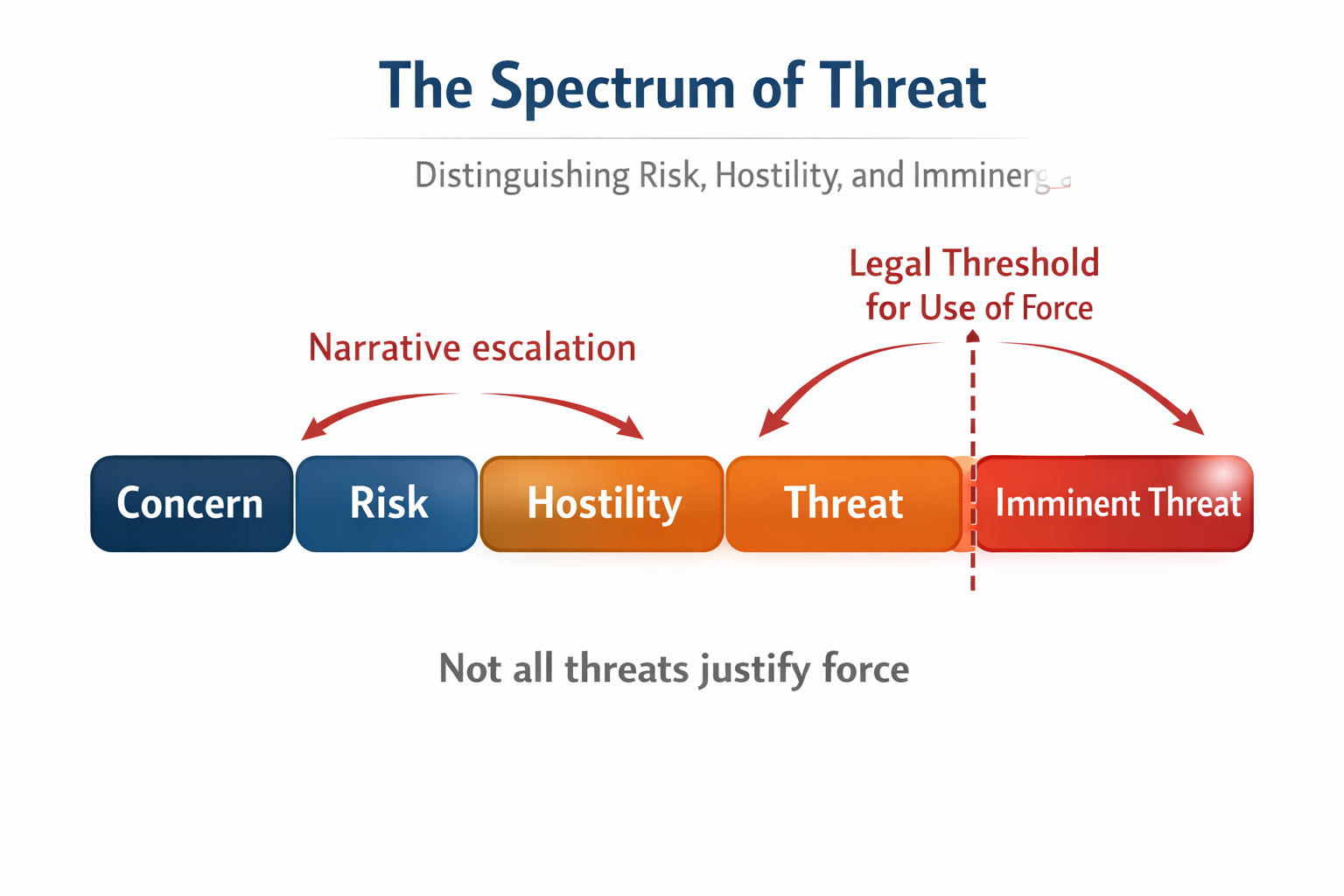
The Spectrum of Threat
The spectrum of threat begins well before any lawful basis for force exists. A concern may justify attention. A risk may justify contingency planning. Hostility may justify defensive posture, sanctions, diplomacy, resilience measures, and strategic caution. A threat indicates a more serious convergence of capability, intent, and potential harm. But even there, the threshold for force may still not have been crossed.
The decisive distinction lies between threat and imminent threat. That line matters because this is where legal threshold becomes relevant. Political systems often speak as if any threat carries immediate entitlement to force. The UN Charter framework does not. The existence of hostility, competition, pressure, or malign intent does not by itself create lawful necessity for armed action.
Geneva Charter analysis therefore insists on preserving this spectrum. Where lower-order conditions are rhetorically upgraded into higher-order categories, the public can be led into accepting measures that would otherwise appear legally or strategically indefensible.
Threat Inflation Model
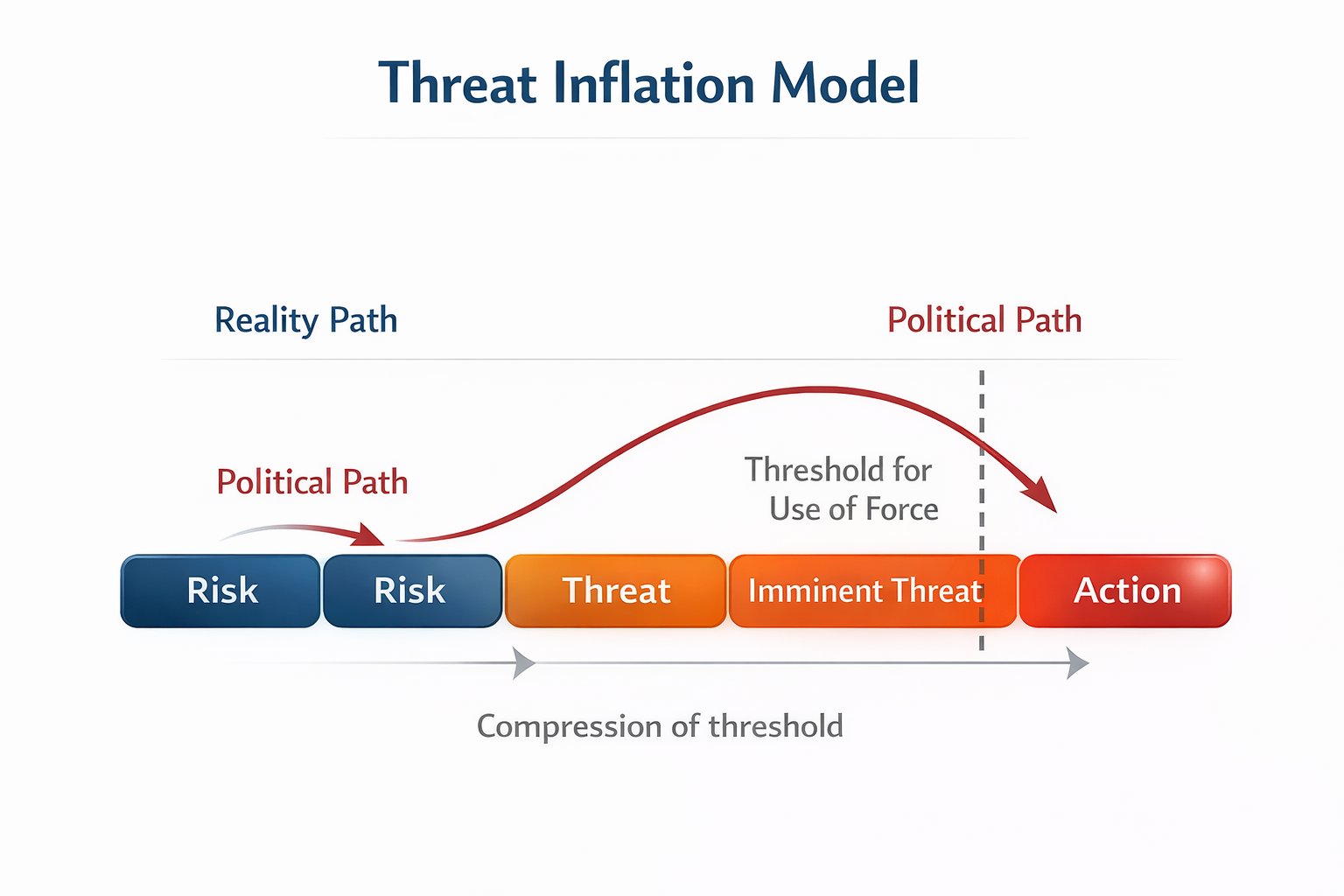
Threat Inflation
Threat inflation is the compression of threshold. It occurs when the ordinary progression from concern, risk, and hostility toward higher-order danger is shortened or politically forced, so that action appears justified before the legal or evidentiary burden has been met.
In the reality path, evidence accumulates, assessment remains disciplined, and thresholds are crossed in sequence. In the political path, pressure skips steps. Risk is narrated as imminent danger. Ambiguity is narrated as certainty. Long-term competition is framed as immediate crisis. Once that compression occurs, the move toward action begins to outrun the facts that should govern it.
This matters because most illegitimate escalations do not announce themselves as fabrications. They emerge through accelerated framing, selective emphasis, and strategic language designed to make the threshold appear already crossed.
Exploiting Threats
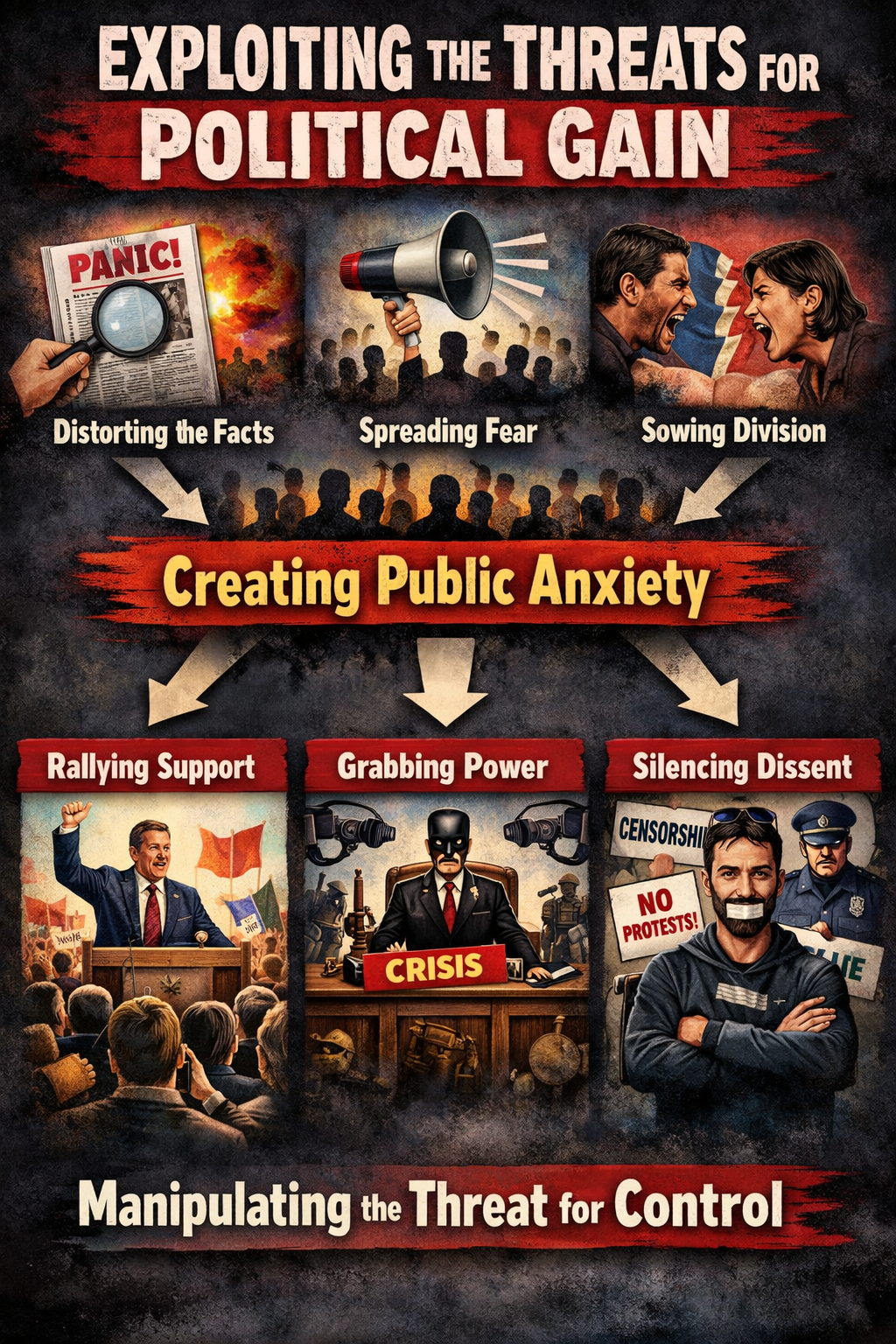
Political Exploitation of Threat
Manipulated threat narratives are rarely neutral. They are often politically useful. Inflated danger can unify public anxiety, justify extraordinary measures, marginalise dissent, and reframe legal caution as weakness. For that reason, threat language is one of the most powerful tools available to governments, factions, and political actors seeking accelerated consent.
The exploitation of threat does not always require outright invention. It may rely instead on distortion, selective release, intensification of worst-case language, or the strategic omission of context. In all such cases, the effect is similar: the public is moved from deliberation to fear, and fear is moved into policy leverage.
Geneva Charter analysis is therefore concerned not only with whether a threat exists, but with who benefits from its framing, how its urgency is constructed, and whether the movement from concern to crisis is supported by disciplined evidence rather than political utility.
What Happens When Threats Are Misdefined
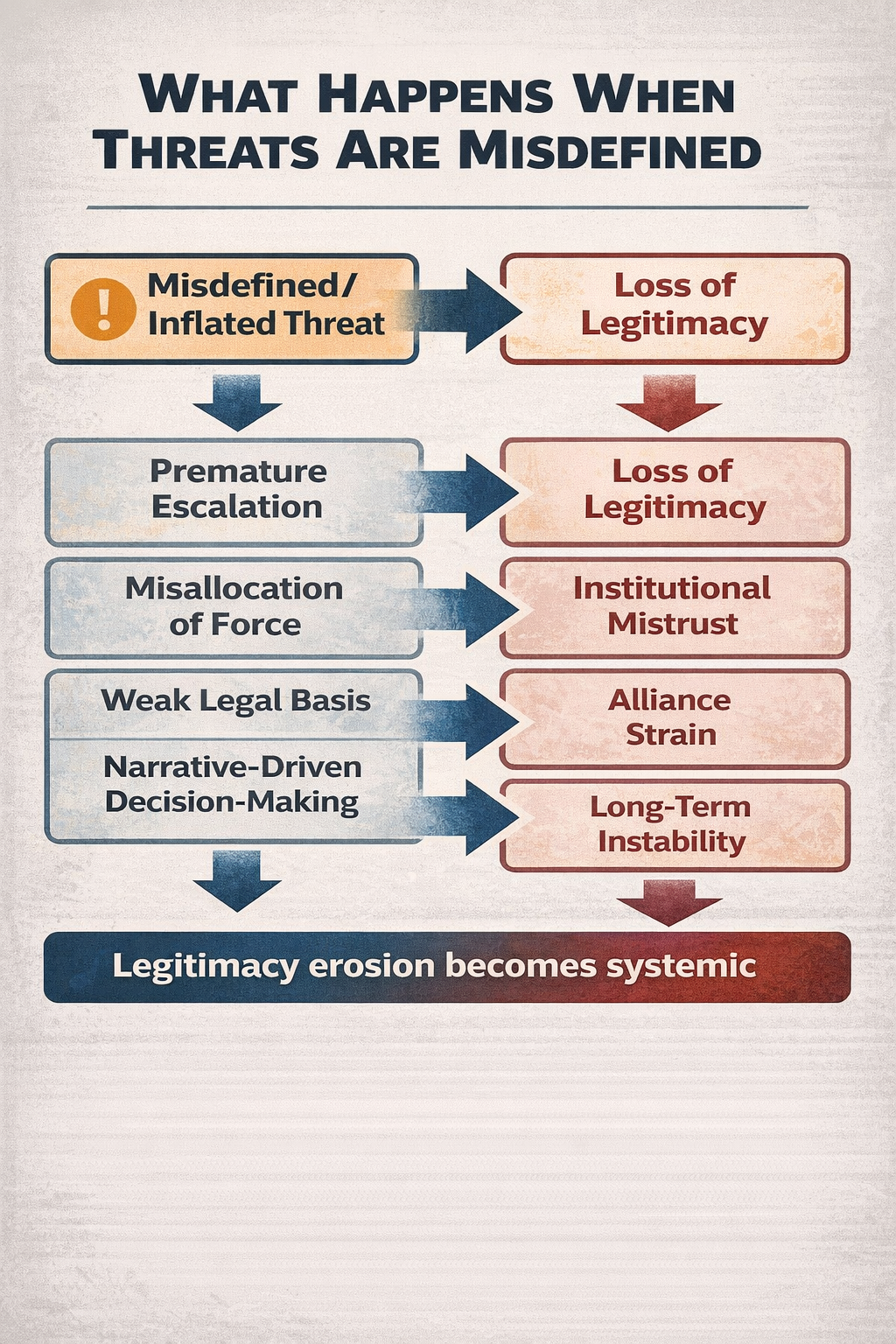
System Impact
Misdefined threat is not merely an analytical problem. It is a system problem. Once the threshold is distorted, the consequences spread well beyond the original claim. Premature escalation becomes more likely. Force is misallocated. Legal basis weakens. Decision-making becomes narrative-driven rather than evidence-driven.
From there, wider institutional damage follows. Legitimacy declines. Public trust weakens. Alliances come under strain when partners no longer share the same evidentiary baseline. Over time, instability becomes self-reinforcing because the structures that should constrain escalation have themselves been degraded.
This is why Geneva Charter analysis treats threat definition as a structural issue. When threats are misdefined, legitimacy erosion becomes systemic.
Who Controls Reality?
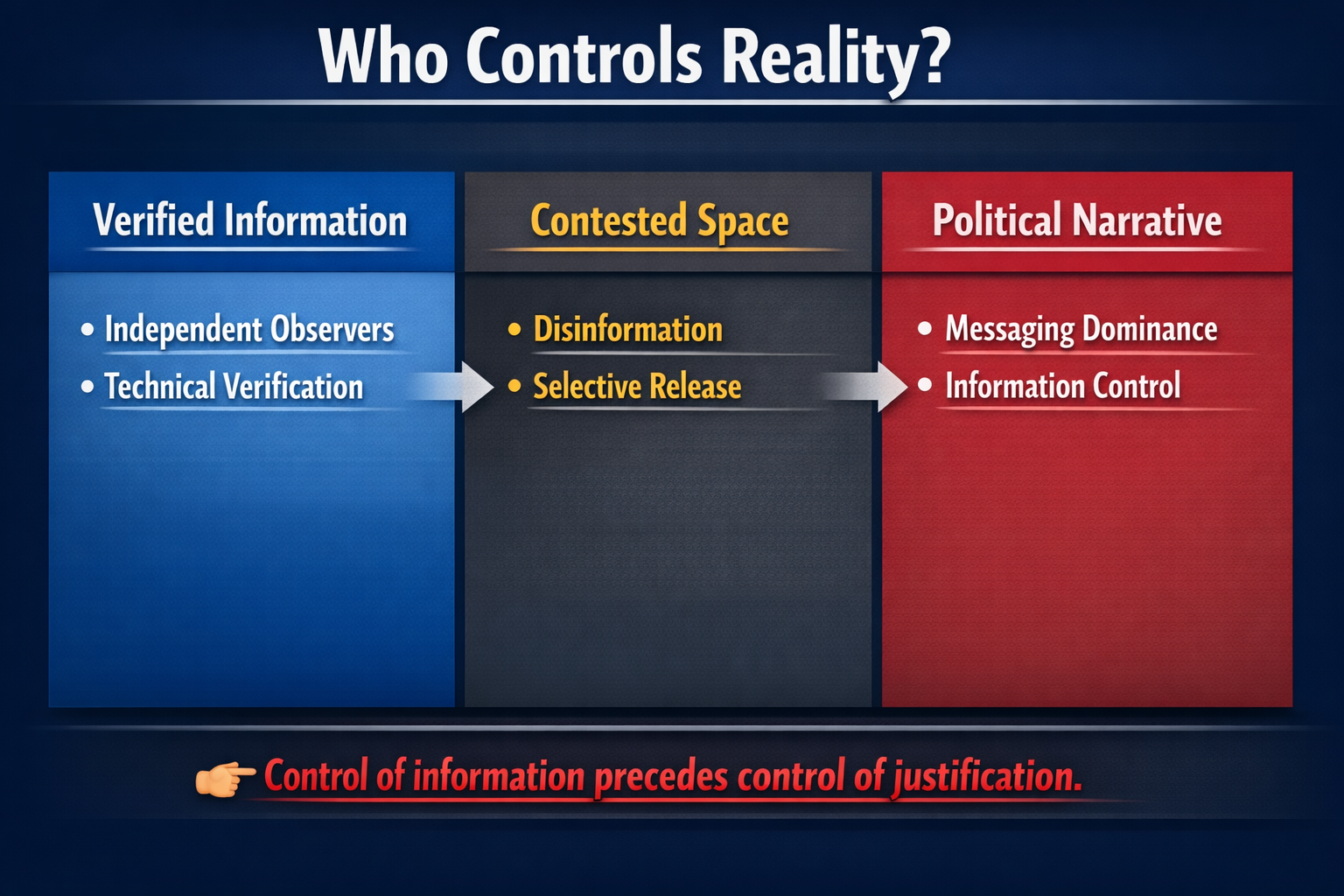
Information Integrity
Before institutions control justification, they often seek to control reality. Verified information, independent observers, and technical verification form the strongest defense against manipulation. Between that reality-based domain and the realm of political messaging lies a contested space in which disinformation, selective release, omission, and strategic ambiguity operate.
Once political narrative dominates this contested space, information control becomes easier and public interpretation becomes less independent. At that point, what people are asked to accept is no longer merely a threat assessment. It is an entire architecture of justification built on managed perception.
Geneva Charter doctrine therefore holds that control of information precedes control of justification. The protection of verification, independent observers, and technical monitoring is not ancillary to legitimacy. It is one of its preconditions.
Pathways to Legitimacy under Conflict
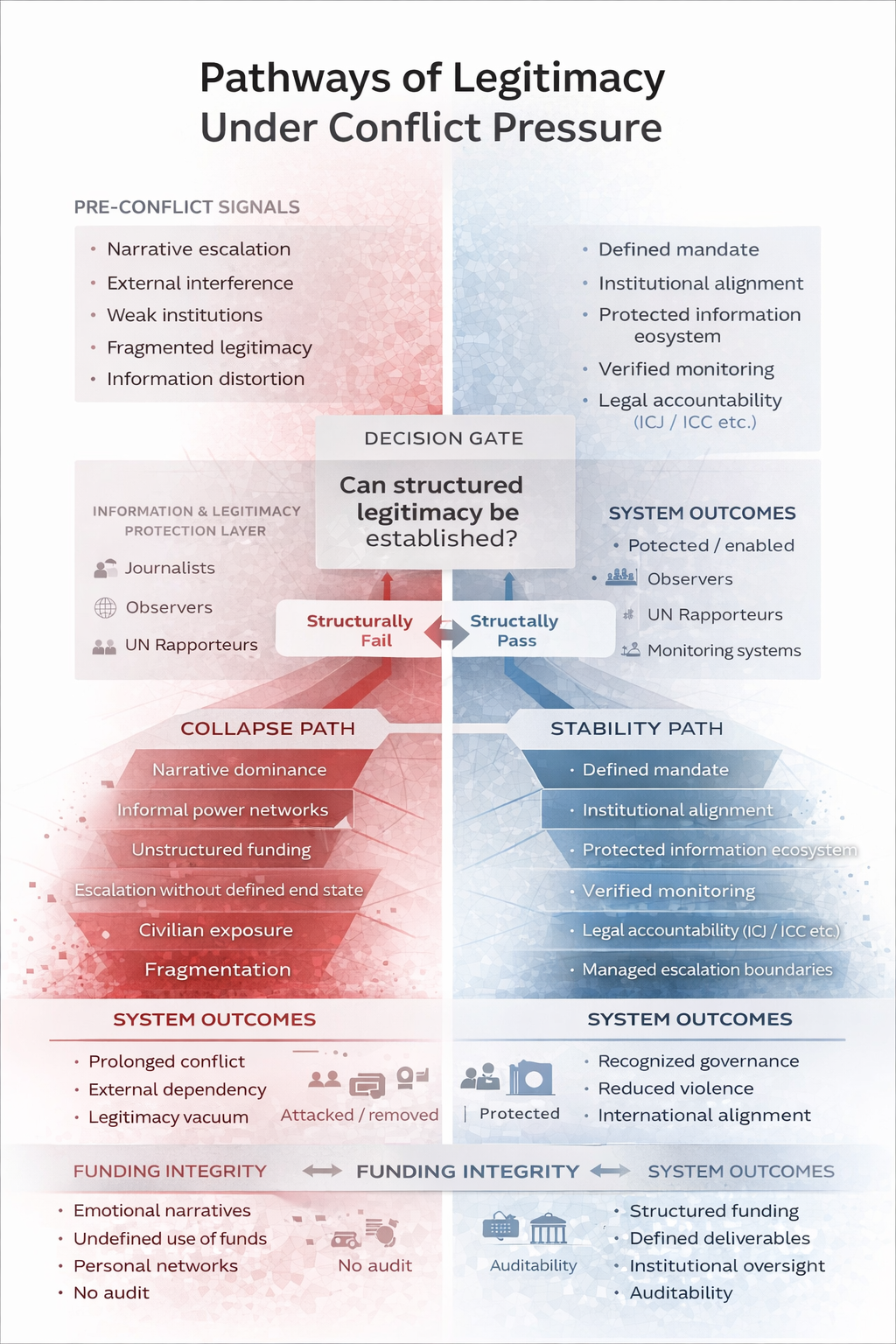
Pathways to Legitimacy under Conflict
Under conflict conditions, legitimacy is rarely maintained automatically. It must be actively protected. The pathway to legitimacy depends on preserving independent verification, disciplined assessment, transparent interpretation, lawful threshold, and accountable response, even when pressure to shortcut those stages becomes intense.
This is precisely why the concept of threat must be kept narrow, disciplined, and reviewable. If the first category in the chain is unstable, every later stage becomes more vulnerable to manipulation. The result is not only analytical weakness. It is structural drift toward narrative-driven action.
The Geneva Charter therefore treats the definition of threat as the first protection point in the wider architecture of legitimacy.
Key doctrine line: Control of the threshold determines control of escalation.
Educational Note: Risk, Threat, and Imminence Are Not Interchangeable
A risk may be serious and still not justify coercive action. A hostile actor may be dangerous and still not present an imminent threat. A strategic environment may be deteriorating and still not satisfy any lawful threshold for force. These distinctions matter because policy failure often begins with linguistic collapse.
Once that collapse occurs, public reasoning becomes easier to manipulate. Fear fills the gap between what is known and what is claimed. Urgency fills the gap between what is possible and what is lawful. The more those gaps are hidden, the harder it becomes for institutions or publics to resist escalation.
This page therefore insists on conceptual discipline before political discipline. If the categories themselves are unstable, the policies built on them will be unstable as well.
Why This Page Matters in the Geneva Charter System
This page exists because the Geneva Charter framework must begin before threat is assigned to any actor or institution. “Who Defines a Threat?” asks who has the authority to classify danger. “When Is Force Legitimate?” asks when a claimed threat may cross into lawful action. But before either question can be answered, the threshold categories themselves must be clear.
Threat -> Definition -> Decision -> Action -> Outcome
Without this conceptual foundation, every later page inherits ambiguity. With it, the entire framework gains clarity, restraint, and sharper resistance to manipulation.
Geneva Charter Position
The Geneva Charter holds that threat must be defined narrowly enough to preserve law, but clearly enough to preserve security. It rejects the inflation of ordinary danger into exceptional urgency where evidence, timing, and lawful basis are not sufficient to support that move.
It further holds that the misuse of threat language is not merely rhetorical excess. It is an institutional risk. Once thresholds are distorted, legitimacy weakens, public judgment becomes easier to manipulate, and the pathway from concern to force becomes dangerously compressed.
In this framework, the disciplined definition of threat is one of the first conditions of lawful order itself.
Closing reflection: The abuse of force often begins with the abuse of categories. Where risk is narrated as imminence, and hostility as lawful necessity, the threshold of action is no longer governed by evidence or law. It is governed by narrative power. That is why the first defense of legitimacy is conceptual clarity.
