
The Legitimacy Chain
From Fact to Force
Legitimacy is sequential. It cannot be reconstructed at the end if broken at the beginning.
The Geneva Charter defines legitimacy not as a slogan, a moral tone, or a political preference, but as a chain. Each stage depends on the integrity of the stage before it. If the factual basis is weak, the assessment becomes unstable. If the assessment is politicised, interpretation becomes advocacy. If interpretation is not transparent, lawful decision becomes difficult to defend. If decision is not lawful, action cannot remain legitimate merely because it is forcefully expressed.
Legitimacy Chain
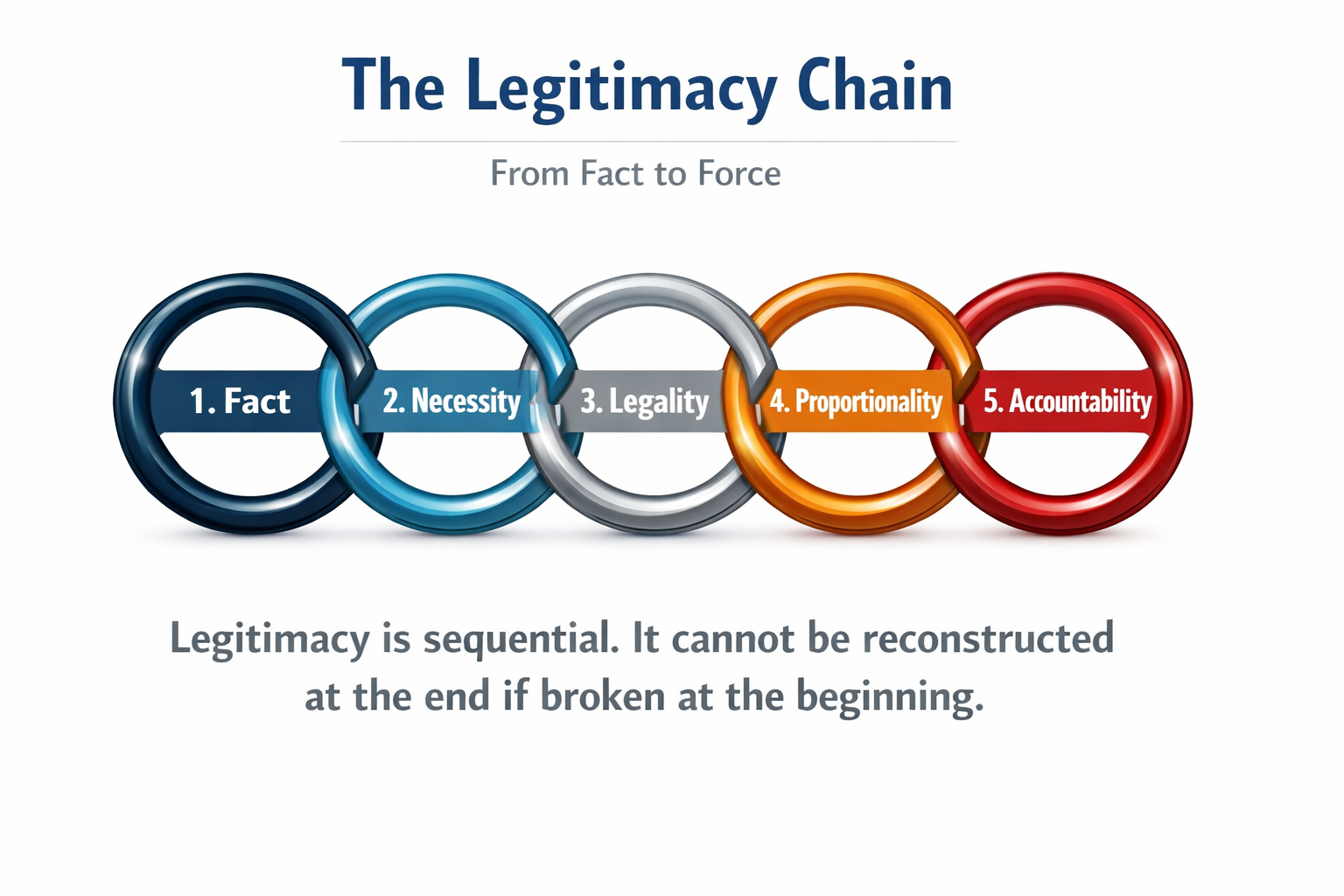
The Sequence
The legitimacy chain can be expressed in five stages:
- Verified information – facts must be independently grounded and capable of review
- Independent assessment – evidence must be evaluated without political substitution
- Transparent interpretation – the movement from fact to meaning must be visible and contestable
- Lawful decision – action must rest on a real legal basis rather than asserted urgency alone
- Accountable action – execution must remain reviewable, proportionate, and answerable to consequence
Why It Matters
Public arguments about war, intervention, sanctions, coercion, and security often focus on the end point. Was the action necessary? Was the outcome desirable? Was the cause persuasive? Geneva Charter analysis begins earlier. It asks whether the chain leading to action remained intact.
This matters because legitimacy rarely fails only at the moment of action. It usually fails upstream. Facts are selectively presented. Assessment is shaped by policy preference. Interpretation becomes politically loaded. Legal language is then used to stabilise a decision that was already moving ahead. By the time force is exercised, the real failure may have occurred much earlier.
The legitimacy chain therefore provides a disciplined method for identifying where systems bend, where they break, and why later procedural form cannot always rescue earlier evidentiary collapse.
The Core Rule
If legitimacy fails at the level of fact or assessment, it cannot be fully repaired by stronger rhetoric, later procedure, or more confident assertion. Legitimacy is sequential. It must be built in order.
Geneva Charter Position
The legitimacy chain is the signature analytical model of the Geneva Charter. It explains how a lawful and reviewable order depends on more than good intention, institutional language, or political confidence. It depends on sequence.
In this framework, legitimacy is neither assumed nor retroactively declared. It is earned stage by stage, from fact to assessment, from assessment to interpretation, from interpretation to decision, and from decision to action.
Closing line: Where the chain holds, legitimacy can be tested and defended. Where the chain breaks, force may still occur, but legitimacy does not survive intact.
