
When Is Force Legitimate?
From Threat Definition to Lawful Action
This page forms the middle link in the Geneva Charter framework. If “Who Defines a Threat?” examines how legitimacy is established before force, and “From Conflict to Stable Order” examines how legitimacy must be rebuilt after violence, this page addresses the decisive moment in between: the threshold at which concern, risk, or threat is translated into action.
The use of force is the most serious power a state can exercise in international affairs. It can kill, displace, destroy, destabilise, and reconfigure political order far beyond the immediate incident that triggered it. For that reason, force cannot be treated as simply one policy tool among others. It is exceptional. It sits at the outer boundary of lawful action.
The core Geneva Charter question is not whether threats exist. Threats do exist. The question is whether the path from threat to force has crossed the necessary legal, evidentiary, and institutional thresholds. A threat, even if real, does not automatically create a lawful basis for force. That distinction is where much of modern illegitimacy begins.
This page therefore focuses on the moment where many systems fail: the jump from asserted danger to claimed necessity. It clarifies what international law permits, what legitimacy requires, and where political systems commonly compress assessment, interpretation, and decision until justification replaces verification.
Geneva Charter doctrine: A threat, even if real, does not automatically create a lawful basis for force.
Core Principle
Force becomes legitimate only where a lawful basis exists, the evidentiary threshold is met, and the path from assessment to action remains institutionally disciplined. Political urgency cannot substitute for legal threshold. Strategic advantage cannot substitute for independent verification. Narrative intensity cannot substitute for necessity.
In Geneva Charter terms, legitimacy in the use of force requires more than sincerity of belief. It requires demonstrable separation between evidence, interpretation, law, and action. Without that separation, claims of necessity become difficult to distinguish from claims of convenience.
The Threshold of Force
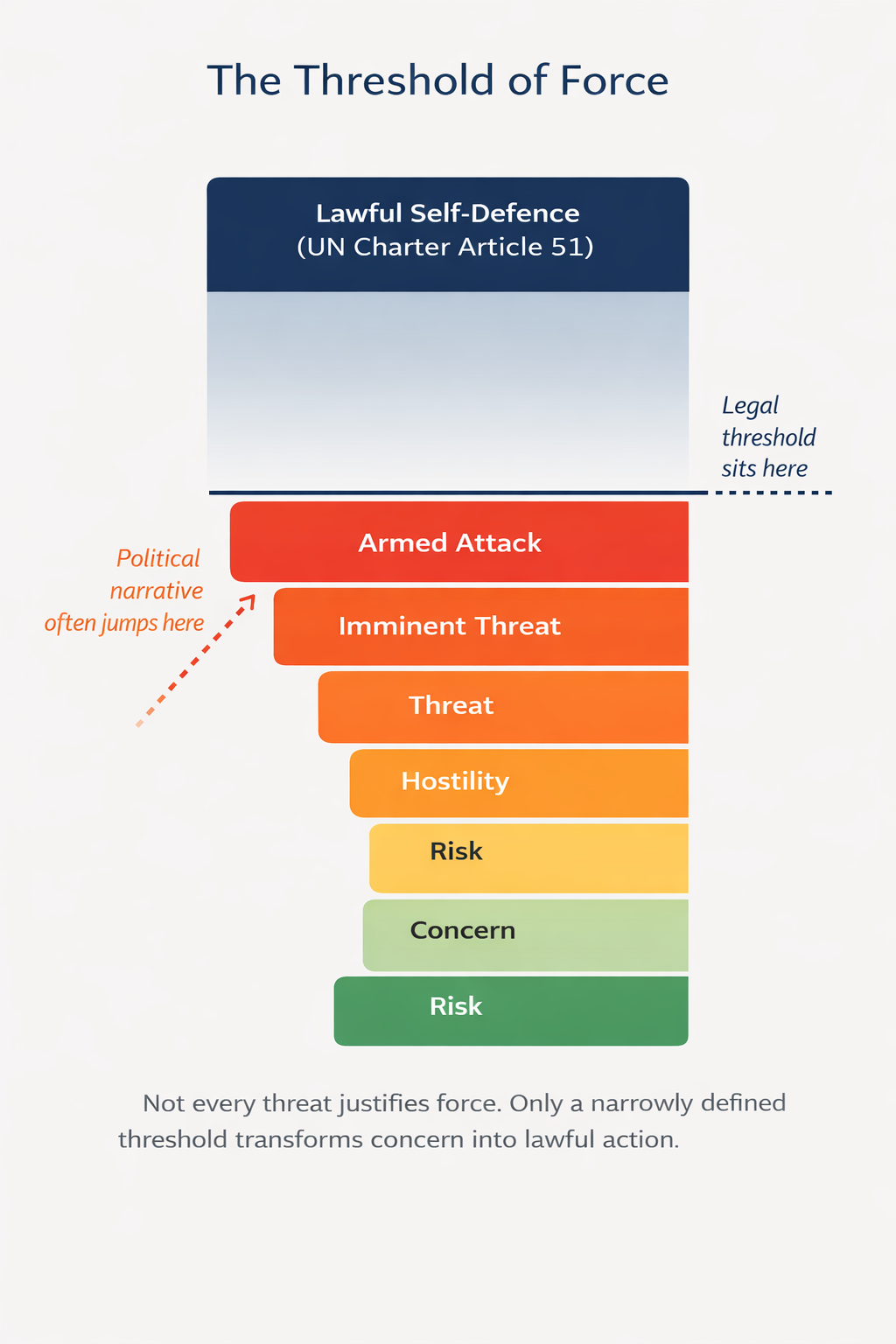
The Threshold of Force
Not every threat justifies force. States may face hostility, intelligence warnings, hostile rhetoric, strategic pressure, proxy activity, or escalating danger without yet crossing the legal threshold that permits armed response. This distinction is essential because much modern misuse of force begins with the rhetorical inflation of lower-order danger into higher-order legal necessity.
The language of concern, risk, hostility, threat, imminent threat, and armed attack must not be treated as interchangeable. A concern may justify vigilance. A risk may justify preparedness. A hostile environment may justify deterrence, sanctions, diplomacy, or defensive posture. But the lawful use of force remains tied to a much narrower threshold under the UN Charter framework.
Article 2(4) of the UN Charter prohibits the threat or use of force against the territorial integrity or political independence of any state. Article 51 preserves the inherent right of self-defence if an armed attack occurs. In practice, debates also arise around imminence, necessity, and proportionality. But these are not open-ended licenses. They are constraining concepts. The burden is not simply to claim danger, but to demonstrate why the legal threshold has been crossed.
Geneva Charter analysis therefore insists on a disciplined sequence: identify the actual level of danger, distinguish that level from politically amplified narrative, and test whether the situation truly crosses the threshold at which force becomes legally and institutionally defensible.
From Assessment to Action
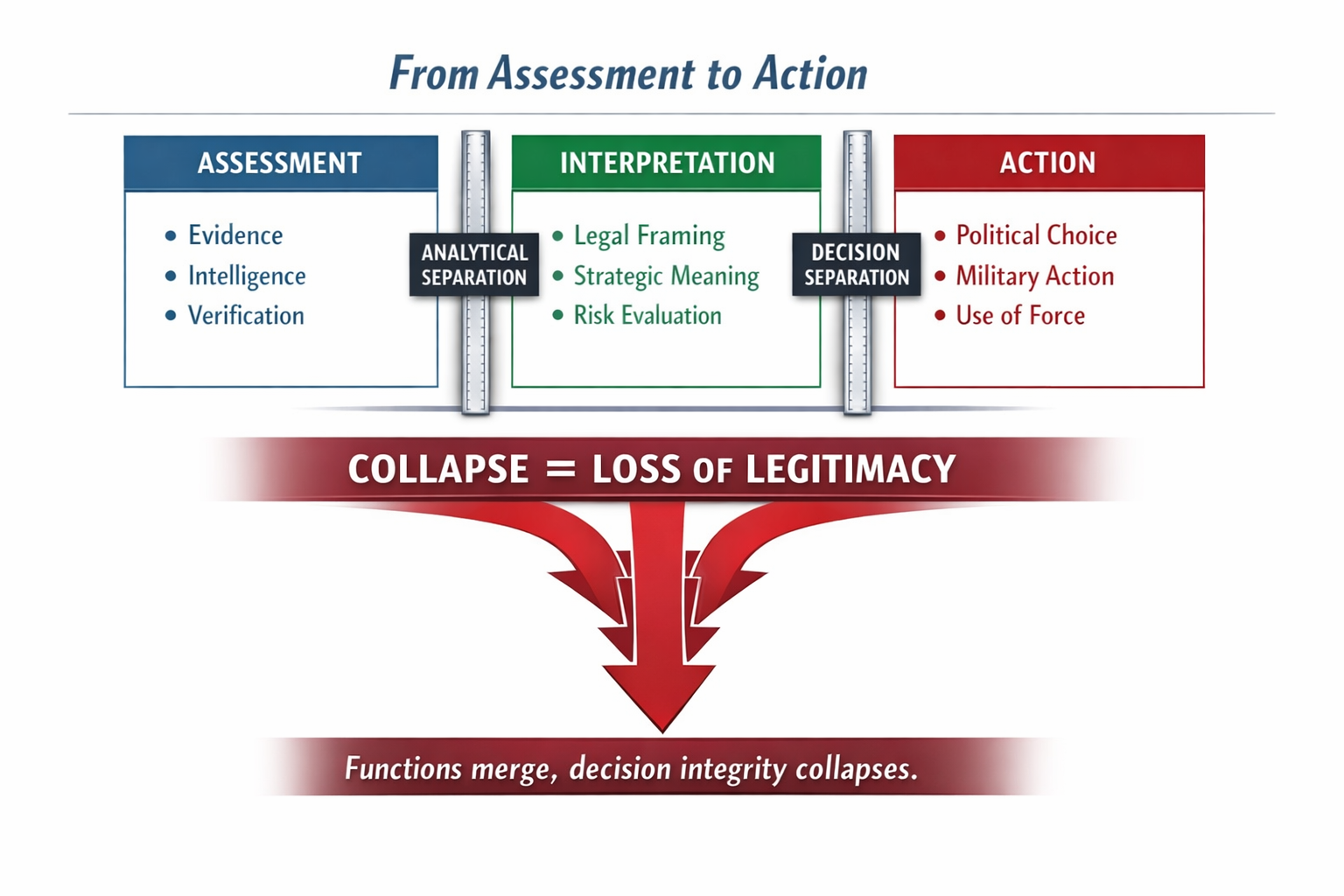
From Assessment to Action
The mechanism of legitimacy failure is not only the wrong outcome. It is the collapse of function along the way. Assessment should establish what is happening on the basis of evidence, intelligence, and verification. Interpretation should explain what that evidence means in legal, strategic, and risk terms. Decision should determine what action, if any, is taken. These are distinct functions and must remain distinct if legitimacy is to survive.
When these functions are kept separate, action remains tethered to a reviewable record. When they collapse into one another, the decision process becomes self-validating. Assessment is shaped by desired outcome. Interpretation becomes advocacy. Action then appears to confirm what was politically wanted from the outset.
In Geneva Charter terms, this collapse is where legitimacy begins to fail most visibly. It is not simply that a state acts. It is that the institutional process no longer preserves any meaningful firewall between evidence, meaning, and force.
Two Pathways from Threat to Force
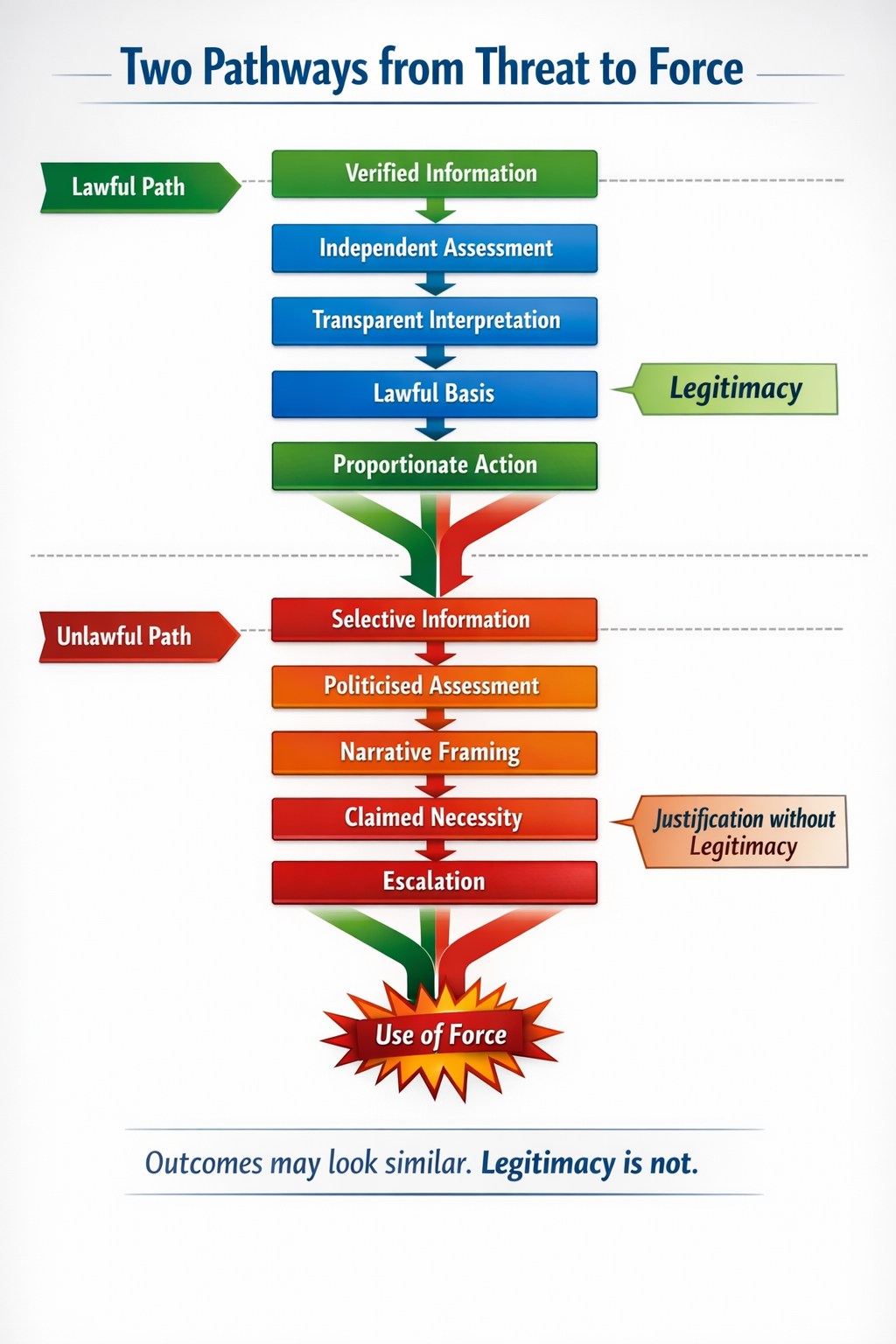
Lawful and Unlawful Pathways
Two pathways may appear to arrive at the same visible destination: use of force. Yet legitimacy is not determined by the appearance of action alone. It is determined by the pathway that produced it.
The lawful path moves from verified information to independent assessment, from independent assessment to transparent interpretation, from transparent interpretation to lawful basis, and from lawful basis to proportionate action. This sequence keeps force tied to evidence and law.
The unlawful or illegitimate path often begins with selective information, proceeds through politicised assessment, hardens through narrative framing, and culminates in claimed necessity and escalation. The resulting action may still be defended with legal vocabulary, but it is no longer grounded in the same chain of legitimacy.
This is why Geneva Charter analysis insists that outcomes may look similar while legitimacy is not. Force can be exercised in both cases. What differs is whether the path was reviewable, lawful, and disciplined, or whether justification replaced verification along the way.
Legal Gateways for Use of Force
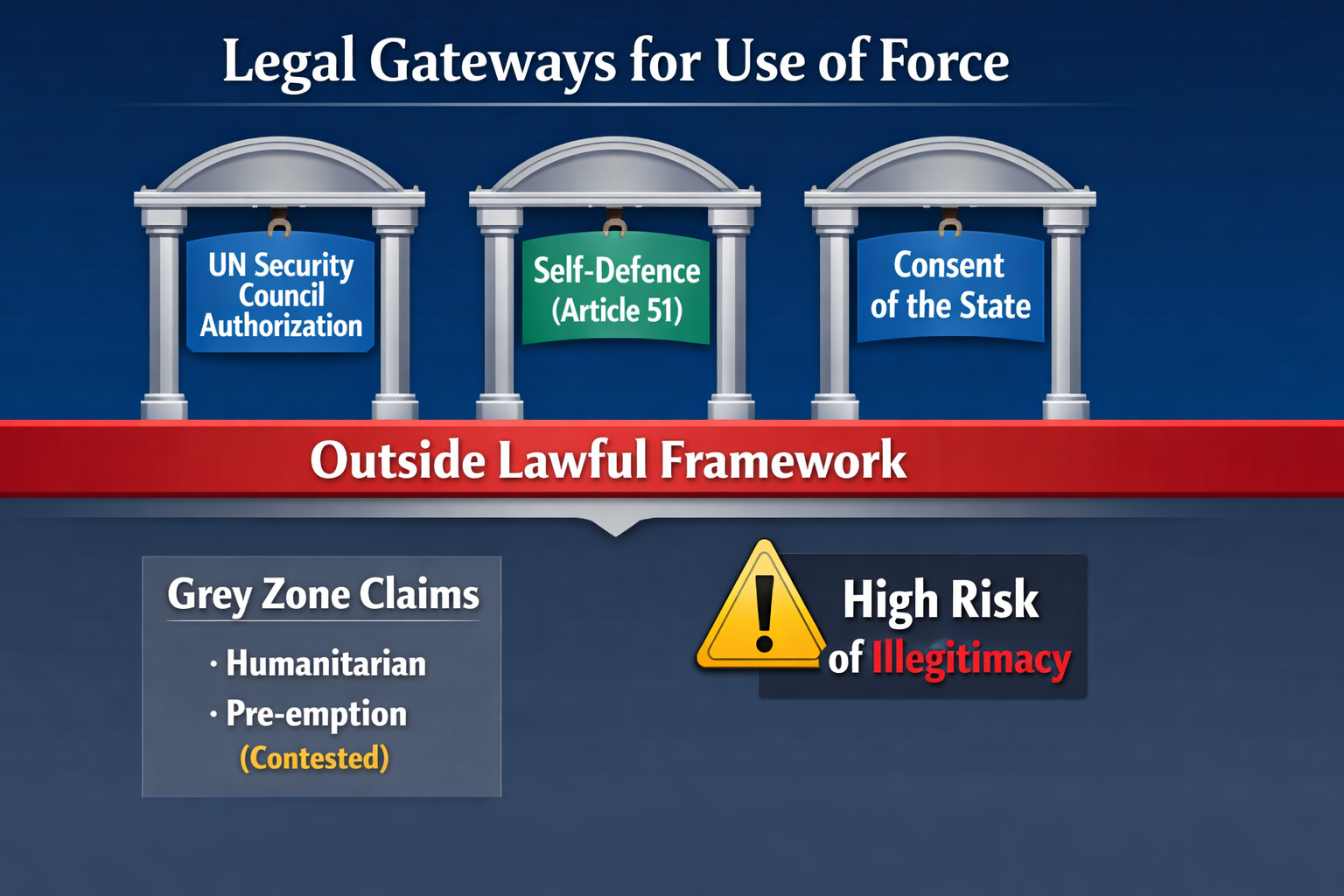
Legal Gateways for Use of Force
In broad terms, the lawful gateways for force are limited. They are not infinitely elastic and should not be presented as if they were. The clearest gateways are:
- UN Security Council authorization
- Self-defence under Article 51
- Consent of the state in whose territory force is used
Around these gateways lies a grey zone of contested claims, often including humanitarian justification, pre-emption, or expansive theories of prevention. These claims are frequently argued in practice, but they do not automatically constitute settled lawful pathways. Their ambiguity is precisely why institutional discipline matters.
Geneva Charter analysis does not deny the political reality of these claims. It insists that where they are invoked, they should be treated with heightened scrutiny, not lowered standards. Contested doctrine is not the same as established lawful basis.
The Threshold Test: Imminence, Necessity, Proportionality
Even where a lawful gateway exists, not every use of force will be legitimate. The threshold must still be tested. Three concepts are especially important: imminence, necessity, and proportionality.
Imminence concerns timing and immediacy. The fact that a hostile actor exists or that danger is possible does not by itself prove that force is immediately justified. Claims of imminence must not become a rhetorical container into which all strategic anxieties are placed.
Necessity asks whether force is actually required. If non-force alternatives remain viable, the claim of necessity weakens. Necessity is not established merely because force appears faster, more decisive, or politically attractive.
Proportionality asks whether the scale, scope, and effects of force remain tied to the lawful objective being claimed. Once force expands beyond that objective, legitimacy begins to erode even if the initial threshold may have been crossed.
The Geneva Charter Legitimacy Test
The five-step legitimacy chain applies directly to force:
- Verified information – Is the evidentiary basis real, independent, and reviewable?
- Independent assessment – Has analysis remained separate from political preference?
- Transparent interpretation – Is the move from fact to meaning visible and contestable?
- Lawful decision – Does a genuine legal basis exist under the governing framework?
- Accountable action – Does the use of force remain proportionate, reviewable, and constrained by consequence?
If legitimacy fails at step one or step two, later invocation of law rarely repairs the damage. If it fails at step four, force becomes difficult to defend regardless of the sincerity with which it is claimed. If it fails at step five, legitimacy erodes during execution even if earlier thresholds may initially have appeared stronger.
Common Failure Modes
Most illegitimate uses of force do not present themselves as lawless. They present themselves as urgent, necessary, morally compelling, or strategically inevitable. This is why the most important failures are often structural rather than openly admitted.
- Pre-emptive stretch – a real or possible future danger is expanded into present legal necessity without sufficient threshold evidence.
- Narrative escalation – rhetoric outruns assessment, and public framing makes force appear inevitable before legal and evidentiary tests are satisfied.
- Proxy justification – the complexity of indirect conflict is used to obscure responsibility, threshold, or lawful basis.
- Selective information – contradictory evidence is minimized, excluded, or politically displaced.
- Threshold inflation – risk, hostility, and strategic concern are rhetorically upgraded into imminent threat.
- Mandate drift – even where an initial basis exists, the scope of action expands beyond its lawful and proportionate frame.
Educational Note: Threat, Risk, and Lawful Force Must Not Be Collapsed
Public discourse often compresses several distinct propositions into one. A state may be hostile. A region may be unstable. A strategic environment may be dangerous. Intelligence may point to preparation or malign intent. None of these facts automatically prove that force is lawful at that moment.
This matters because the move from concern to action often takes place rhetorically before it takes place legally. Once the public is persuaded that the situation is urgent, legal threshold can be silently lowered in practice even when it remains formally high in doctrine.
Geneva Charter analysis therefore insists on a stricter discipline: identify the nature of the danger, identify the lawful gateway, test the threshold, and only then evaluate the legitimacy of force.
Institutional Requirements
If legitimacy in the use of force is to be preserved, institutions must do more than merely authorize action. They must preserve the evidentiary and legal boundaries that make action reviewable and constrained.
- Independent intelligence assessment protected from political substitution
- Clear legal analysis tied to identifiable lawful gateways
- Explicit documentation of threshold reasoning on imminence, necessity, and proportionality
- Separation between classified findings and public political messaging
- Institutional capacity to record dissenting analytical views
- Oversight bodies capable of examining both process and substance
- External verification wherever possible through inspectors, monitors, and independent observers
- Post-action review strong enough to determine whether force remained within its stated basis
Why This Page Matters in the Geneva Charter System
This page completes the front-to-back logic of the Charter. “Who Defines a Threat?” addresses the upstream legitimacy of assessment. “When Is Force Legitimate?” addresses the conversion of threat into action. “From Conflict to Stable Order” addresses the downstream legitimacy of restoration after violence. Together, they map the full sequence:
Threat -> Decision -> Action -> Outcome
Without this middle page, the system lacks the decisive bridge where most real-world failure occurs. With it, the Charter can speak not only about diagnosis and restoration, but also about the legality and legitimacy of the use of force itself.
Geneva Charter Position
The Geneva Charter holds that force is legitimate only where the pathway from threat to action remains disciplined by evidence, law, and institutional separation. A real threat does not abolish the need for lawful threshold. Urgency does not abolish the need for verification. Strategic pressure does not abolish the need for accountability.
The Charter therefore rejects any model in which force becomes lawful merely because it is politically desired, rhetorically justified, or framed as unavoidable. It treats the move from danger to action as one of the strictest tests in the international system, because once force is used the consequences cannot be confined to argument alone.
In this framework, the legitimacy of force depends not only on what is claimed, but on whether the chain from fact to action remained intact, reviewable, and resistant to political substitution at every stage.
Closing reflection: Not every danger justifies force. Not every threat creates lawful necessity. The decisive question is whether the path from assessment to action remained disciplined by evidence, constrained by law, and reviewable after the fact. Where that discipline collapses, force may still occur, but legitimacy does not.
