
Verification & Investigative Monitoring
Evidence integrity in conditions of dispute, manipulation, and synthetic media
In contested environments, visibility alone is not enough. Verification determines whether information can be relied upon, contextualised, and preserved as part of a credible public record. In an era shaped by synthetic media, manipulated content, and competing narratives, verification is no longer optional. It is the condition under which evidence can retain public, legal, and institutional value.
On this page
1. Core Principle
The Geneva Charter holds that verification is essential to the integrity of monitoring. Observation may produce visibility, but verification determines whether information can be relied upon. In contested environments, unverified material can distort reality as easily as it can reveal it.
Verification protects monitoring from confusion, manipulation, and premature conclusion. It is the disciplined process through which content is tested before it enters a credible record.
2. Why Verification Matters
Conflict and governance crises generate competing claims, selective narratives, and deliberate attempts to shape perception. False or altered content can circulate faster than validated material, while real content may be miscaptioned, recontextualised, or selectively edited to mislead.
Visibility without verification can intensify confusion rather than reduce it. Public understanding, diplomacy, investigative reporting, and legal process all depend on evidence that has been tested for origin, context, sequence, and consistency.
3. What Verification Includes
Verification is a structured process rather than a single act. It may include source identification, date and time confirmation, geolocation, metadata review where available, image and video integrity assessment, sequence reconstruction, and cross-source corroboration.
It also requires contextual validation. Content that is technically authentic may still be misleading if presented with false chronology, false location, or false attribution. Verification therefore tests both material integrity and contextual accuracy.
Verification transforms content into evidence by testing origin, context, sequence, and consistency.
4. From Claim to Verified Record
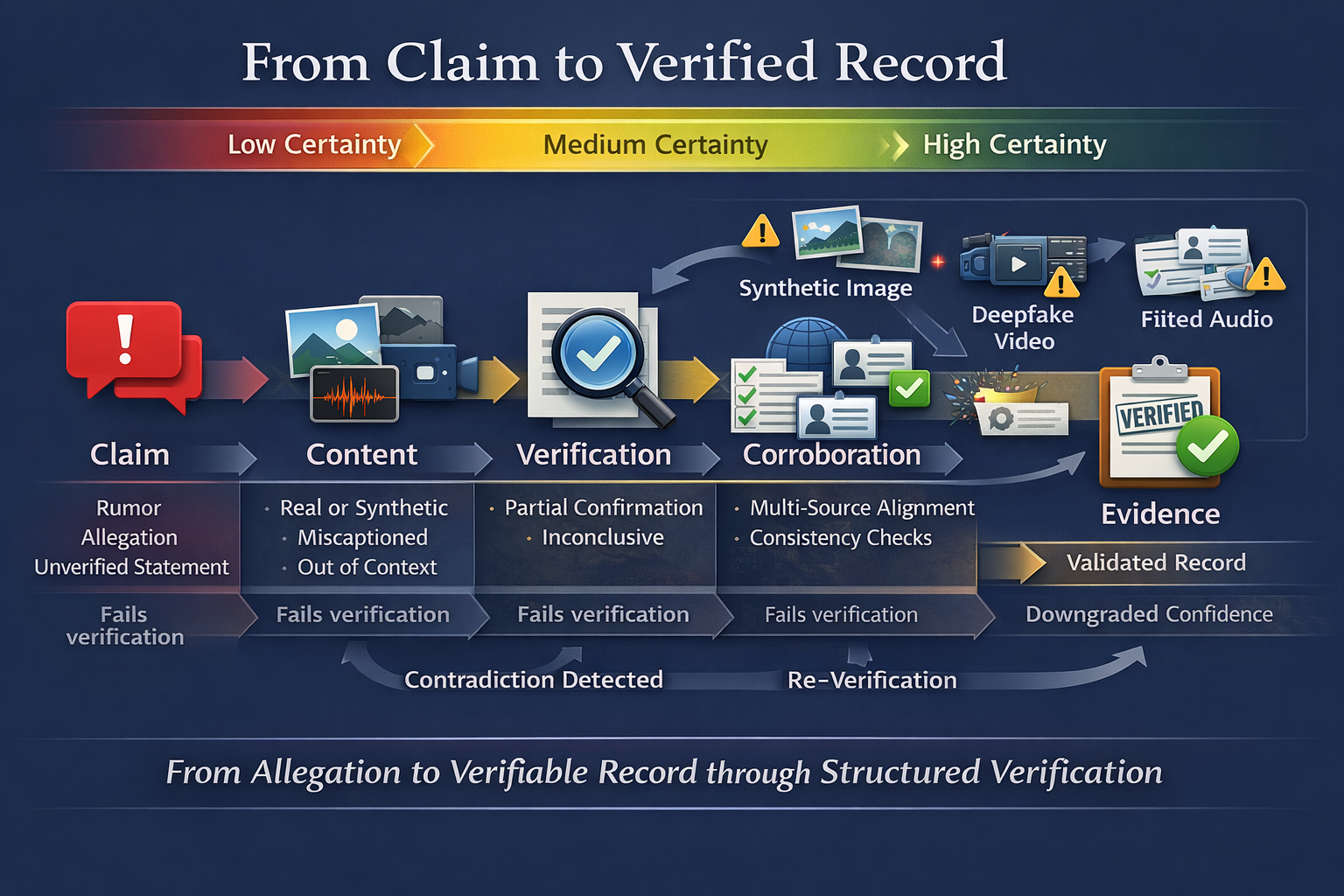
The progression below illustrates how information moves from allegation toward validated record. It also shows where verification can fail, where confidence may need to be downgraded, and how synthetic or manipulated content can disrupt the evidentiary chain.
5. Investigative Monitoring
Investigative monitoring connects individual pieces of content to a wider evidentiary record. It compares claims against documented facts, identifies repeated patterns, links separate incidents, and helps determine whether observed material is isolated, misleading, or part of a verifiable chain of events.
This may involve open-source analysis, satellite imagery, witness corroboration, event reconstruction, cross-platform comparison, and continuity checks across time. The aim is not simply to collect material, but to preserve disciplined visibility under contested conditions.
6. Synthetic Media and Evidence Risk
The integrity challenge is no longer limited to fabrication. It now includes synthetic images, manipulated video, cloned audio, false subtitles, false translations, altered metadata, selective editing, and the repurposing of authentic footage in false context.
Not all evidence risk comes from fully fake content. Much of the danger comes from real material presented with misleading chronology, location, attribution, or narrative framing. In such cases, technical authenticity alone is not enough.
In an era of synthetic media, verification is no longer optional. It is the condition under which evidence can retain public, legal, and institutional value.
7. Verification Standards
The Geneva Charter recognises several minimum principles of verification discipline:
- No evidentiary claim without source review
- No image, video, or audio treated as self-proving
- No single-source conclusion where corroboration is reasonably possible
- Clear distinction between allegation, probable finding, and verified fact
- Preservation of uncertainty where verification remains incomplete
- Correction where later evidence changes assessment
These standards do not guarantee certainty in every case, but they reduce the risk of error, distortion, and evidentiary collapse.
8. Limits of Verification
Some material cannot be conclusively verified. Access may be restricted, metadata may be absent or altered, witnesses may be unavailable, and speed pressures may undermine confidence. In some cases, verification can only establish probability, not certainty.
Verification reduces uncertainty. It does not always eliminate it. A credible monitoring framework must therefore preserve caution, methodological transparency, and the discipline to state when full confirmation is not yet possible.
9. Geneva Charter Position
The Geneva Charter recognises verification and investigative monitoring as indispensable functions in any system seeking legitimacy, accountability, and lawful order.
In an era shaped by synthetic media and contested narratives, evidence must be tested, contextualised, and preserved with methodological discipline. Without verification, monitoring loses reliability. Without reliability, accountability weakens. Without accountability, legitimacy deteriorates.
